Skip to content
If you haven’t filed taxes in years, you need to act now before the IRS takes enforcement action. The agency can file substitute returns that overstate your tax liability, impose penalties up to 25% of what you owe, and levy your bank accounts or wages without further warning. Filing voluntarily before the IRS contacts you gives you more options to resolve your situation and potentially reduce penalties.

Why Taxpayers Fall Behind on Filing?
Life events like job loss, divorce, serious illness, or overwhelming debt can make tax filing feel impossible. Some taxpayers believe they don’t need to file because they expect a refund or didn’t earn much income that year. Others fear the tax bill they might owe and hope the problem will somehow resolve itself.
Unfortunately, avoiding the IRS only makes the situation worse. The agency lost 27% of its workforce yet continues to pursue unfiled returns aggressively through automated systems and enforcement actions. Every year you skip filing adds penalties, interest, and complexity to your tax situation.
What Happens When You Don’t File?
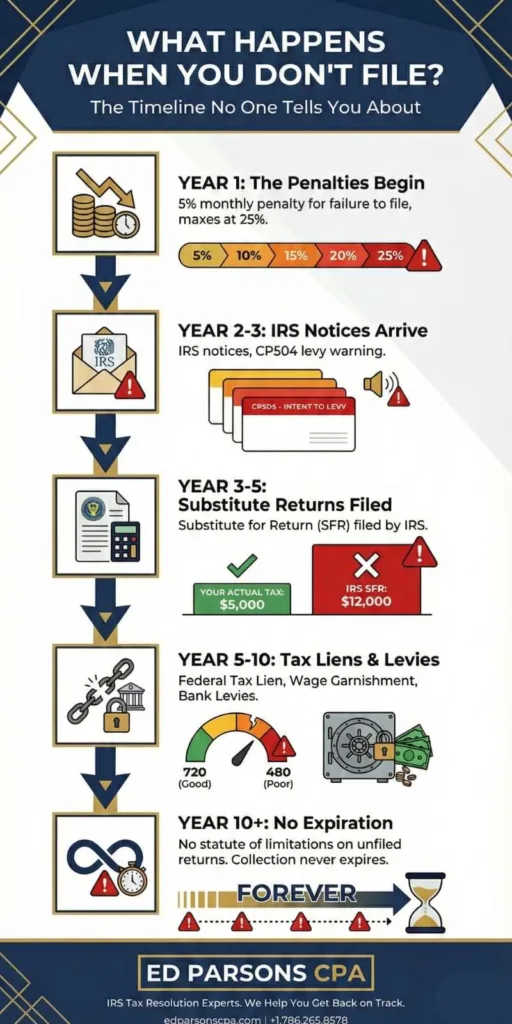
The consequences of not filing taxes escalate significantly over time. The IRS doesn’t forget about unfiled returns, and there’s no statute of limitations on assessing taxes for years you never filed.
| Time Period | IRS Actions | Penalties & Interest |
|---|---|---|
| 1-2 years | Automated notices, delayed refunds | 5% monthly penalty up to 25% |
| 3-5 years | Substitute For Return (SFR) filed | Penalties max out, interest compounds daily |
| 5-10 years | Federal tax liens, levy threats | Collection enforcement intensifies |
| 10+ years | Wage garnishment, bank levies | No expiration on unfiled returns |
The failure to file penalty charges 5% of your unpaid tax for each month your return is late, maxing out at 25% after five months. If your return is more than 60 days late, you face a minimum penalty of $525 or 100% of your unpaid tax, whichever is less. This penalty is ten times higher than the failure to pay penalty, making filing crucial even when you can’t pay immediately.
When you don’t file, the IRS can file a Substitute for Return (SFR) on your behalf. This calculates your income from W-2s and 1099s using the worst possible tax scenario. An SFR gives you no deductions, no credits, no business expenses, and typically uses the least favorable filing status, resulting in a tax bill far higher than what you’d actually owe.
How Many Years Back Must You File?
If you never file a required tax return, there is no statute of limitations for the IRS to assess or collect tax. The normal three-year audit window and ten-year collection period only begin after you actually file a return. This means the IRS can technically go back decades to demand unfiled returns.
However, in practice, the IRS typically requests the most recent six years of unfiled returns to bring taxpayers into compliance. This is an internal policy, not a legal limitation, and can be waived for cases involving suspected fraud or substantial tax debt.
If you haven’t filed in 10 years, you’ll typically need to file returns for the most recent six tax years. However, if you’re owed refunds for older years, you only have three years from the original due date to claim them. After that window closes, any refund becomes property of the U.S. Treasury and can never be claimed.
Your Step-by-Step Plan to Get Current
Taking action before the IRS finds you gives you more control and better options for penalty relief. Here’s exactly how to get back into compliance:
Step 1: Gather Your Tax Documents. Request wage and income transcripts from the IRS by filing Form 4506-T or accessing your account at IRS.gov. These transcripts show all income reported to the IRS. Collect receipts for deductions, business expenses, and credits you’re eligible to claim.
Step 2: Prepare Back Tax Returns. Use the tax forms and instructions that were current for each specific year. If you’re overwhelmed by multiple years or complex tax situations, working with an experienced tax resolution CPA ensures your returns are prepared correctly and accurately.
Step 3: File Returns in the Correct Order. File starting with the oldest year first and working forward to the most recent year. Mail paper returns to the IRS address specified for your state. Send each year’s return separately with certified mail and request a return receipt.
Step 4: Address Payment Options. If you can’t pay the full amount immediately, the IRS offers installment agreements, Offers in Compromise to settle for less, or Currently Not Collectible status if paying would cause financial hardship. These options are only available after you’ve filed all required returns.
When Collection Actions Escalate?
The IRS uses increasingly aggressive collection tactics the longer you remain out of compliance. Early notices inform you of the balance due and request payment. Later notices become more serious, including the CP504 notice that gives you 30 days before the IRS levies your bank account.
A Final Notice of Intent to Levy means the IRS can seize assets, garnish wages, or freeze bank accounts without further warning. A Federal Tax Lien is a public notice that appears on credit reports and attaches to everything you own. The only way to release a tax lien is to pay the full amount owed or negotiate an agreement with the IRS, but neither option is available until you file all missing returns.
Lost Refunds You Can Never Claim
If you haven’t filed and the IRS would have owed you money, you only have three years from the original due date to claim that refund by filing your return. After the three-year window closes, your refund becomes unclaimable and goes to the U.S. Treasury forever.
This commonly affects lower-income taxpayers who would have qualified for refundable credits like the Earned Income Tax Credit. For tax year 2025 returns due April 15, 2026, you have until April 15, 2029 to file and claim any refund. After that date, the opportunity is permanently lost.
How Professional Help Changes the Outcome?
Resolving multiple years of unfiled returns while managing IRS collection actions requires expertise most taxpayers don’t have. A CPA who specializes in tax resolution knows exactly what documentation the IRS requires, how to structure payment proposals the agency will accept, and which penalty relief options apply to your situation.
They can identify legitimate deductions and credits you might have missed, potentially reducing your actual tax liability significantly below what the IRS calculated in an SFR. The sooner you address unfiled returns with professional help, the more resolution options remain available and the easier it becomes to negotiate favorable terms.
Take Action Before the IRS Forces Action
Unfiled tax returns never go away on their own. Time doesn’t make the problem better; it makes consequences worse. Every month you delay adds more penalties and interest while reducing your options for favorable resolution.
If you haven’t filed taxes in years, start today by gathering documentation and preparing to file voluntarily. The IRS views voluntary compliance far more favorably than forced compliance, giving you access to penalty relief programs like First Time Abate and reasonable payment terms.
Understanding IRS notices you’ve already received helps you assess how urgent your situation has become. If you’ve received collection notices or your situation involves multiple years of unfiled returns, professional tax resolution services can navigate the complexity while protecting your financial interests.
The path forward starts with one decision: to address the problem now rather than waiting for the IRS to decide your timeline. Filing those missing returns is the only way to stop penalties, preserve your assets, and move forward with your financial life.