Skip to content

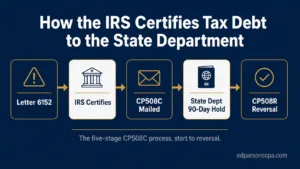
The $62,000 figure many taxpayers still search for was the 2024 threshold for “seriously delinquent” federal tax debt under IRC Section 7345. The threshold is indexed annually for inflation. For 2026 it sits at more than $66,000, and it includes assessed tax, penalties, and interest combined across every open tax year. Crossing the threshold is what gives the IRS authority to certify the debt to the State Department. Where a balance sits against that line, and what happens once it crosses, is covered in how the IRS certifies the debt to the State Department.
If you searched the $62,000 IRS tax debt threshold, you found the right concept but the older number. The IRS indexes the figure for inflation each year, and the amount that triggers passport certification has moved upward every year since the program launched.
This article explains where the $62,000 figure came from, the current threshold, what the balance includes, and how penalties and interest push real taxpayers over the line.
What “Seriously Delinquent” Actually Means?
Seriously delinquent tax debt is defined by IRC Section 7345, enacted under the FAST Act in 2015. The IRS has used the statute to certify taxpayers to the U.S. State Department since early 2018.
Certification authorizes the State Department to deny passport applications, refuse renewals, revoke existing passports, or limit a passport to direct return travel. Once you receive a CP508C notice, the certification is already in motion.
For the full mechanics of the notice itself, see CP508C notice can lead to passport revocation or denial.
Why You Are Still Seeing $62,000?
$62,000 was the certification threshold for tax year 2024. It appears in older articles, advisory letters, and IRS guidance still indexed by search engines.
The actual figure changes every year. Relying on a stale number is one of the most common reasons taxpayers misjudge their exposure.
The Current 2026 Threshold and Annual History
Quick facts on how the threshold has moved:
- 2026 threshold: more than $66,000
- Indexed annually for inflation under IRC Section 1(f)(3)
- Includes assessed tax, penalties, and interest combined
- Applies across all open federal tax years, not per return
- The IRS publishes the figure on its passport revocation program page each year
How Penalties and Interest Push You Over?
Original principal alone is rarely what crosses the line. Failure-to-pay penalty accrues at 0.5% per month (up to 25%), interest is charged at the federal short-term rate plus 3%, and both compound across years.
Quick exposure math:
- Taxpayer with $48,000 in original tax across 2021-2023
- Failure-to-pay penalty stack: roughly $9,000 to $12,000
- Accrued interest across the period: roughly $6,000 to $9,000
- Combined balance can hit $63,000 to $69,000 within a few years
That is how a perceived $48k problem ends up over the 2026 threshold without a new dollar of tax assessed.
If you came here searching a number you saw somewhere, that is the whole problem in one line. The figure is indexed and moves every year, while penalties and interest push a balance upward at the same time, so people cross the line long before they feel they are in trouble. The second of my six passport emails is about exactly that. An automatic note goes out first to confirm the address, and the emails only start once you answer it. Put me on the list. You can stop them whenever you like; the unsubscribe link is in every email.
Threshold by Year and What Counts
The table below shows the indexed threshold history and what the IRS measures.
| Tax Year | Threshold | Annual Change | Inflation Adjustment Source |
| 2022 | $55,000 | Baseline | Rev. Proc. 2021-45 |
| 2023 | $59,000 | +$4,000 | Rev. Proc. 2022-38 |
| 2024 | $62,000 | +$3,000 | Rev. Proc. 2023-34 |
| 2025 | $64,000 | +$2,000 | Rev. Proc. 2024-40 |
| 2026 | $66,000 | +$2,000 | Annual IRS inflation guidance |
| Measurement | Assessed tax plus accrued penalties and interest, combined across all open years | Not per return; one running federal balance | IRC Section 7345; indexed under Section 1(f)(3) |
The threshold compares your total federal tax debt against a single dollar amount. The composition does not matter; what matters is the running balance on your account.
What Counts Toward the Threshold (and What Does Not)?
Tax debts that count:
- Individual federal income tax
- Trust Fund Recovery Penalties (TFRP)
- Business taxes for which an individual is personally liable
- Other assessed civil penalties
- Interest accrued on any of the above
Debts that do not count (or are excluded by IRS policy):
- Debts being paid timely through an approved installment agreement
- Debts under an accepted Offer in Compromise
- Currently Not Collectible status due to hardship
- Debts suspended for pending innocent spouse relief
- Debts subject to a timely requested CDP hearing on the relevant levy
- Combat zone taxpayers and certain disaster area taxpayers
Common Mistakes About the Threshold
- Assuming the $62,000 number from older articles still applies
- Comparing only original tax owed without including penalties and interest
- Believing each tax year is measured separately against the threshold
- Thinking that an installment agreement “in progress” but not yet approved counts as an exclusion
- Paying the balance below the threshold and assuming certification reverses on its own
- Forgetting that TFRP and personally liable business taxes count toward the same threshold
Questions Taxpayers Actually Ask
“I owe $58,000 across two tax years. Am I safe in 2026?”
Probably not. With penalties and interest, the running balance is likely already past $66,000. The original tax is not the right figure to track.
“Is the $62,000 figure still used anywhere?”
Only as a historical reference for tax year 2024. The IRS publishes the current figure on its passport revocation page each year.
“If my installment agreement is still pending, am I excluded?”
Not until the IRS formally approves it. The exclusion applies to agreements that are active and being paid timely, not applications in process.
“Does state tax debt count toward the threshold?”
No. The statute applies only to federal tax debts. State liens and balances do not push you toward CP508C.
What to Do If You Are Near the Threshold?
If your federal balance is anywhere within $5,000 to $10,000 of the current threshold, the right move is to confirm the exact figure before any IRS lien filing or levy converts it into a passport problem.
Pulling the current IRS account transcripts identifies every assessed liability and accrued penalty, and confirms whether your running balance has crossed the line. The certification process explains which balances count toward it. If it has not, the focus shifts to which resolution path keeps it from crossing. The IRS maintains the official passport revocation program page with the current year threshold, and the Taxpayer Advocate Service publishes annual reports on Section 7345 implementation