Skip to content
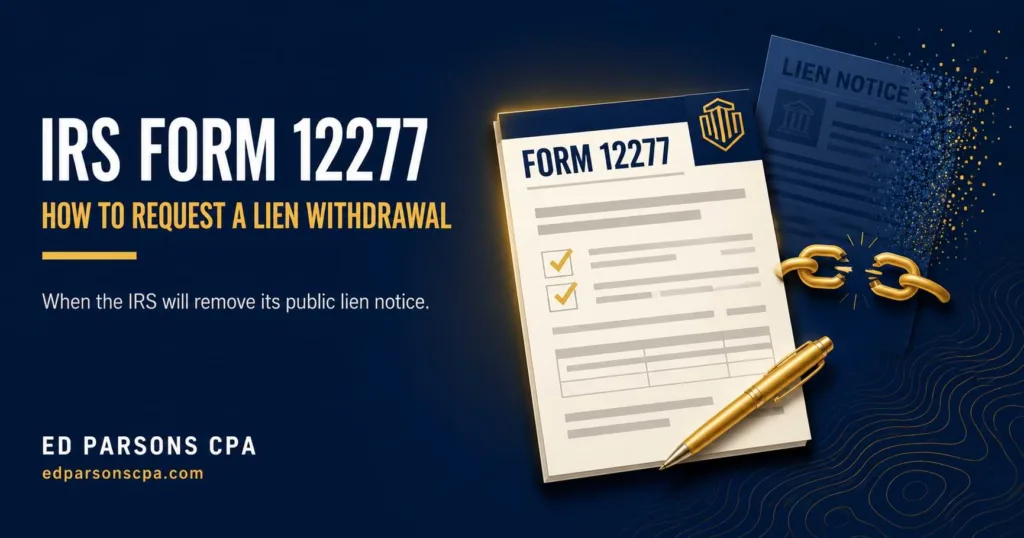
IRS Form 12277, officially titled “Application for Withdrawal of Filed Form 668(Y),” is the form you use to request that the IRS withdraw a Notice of Federal Tax Lien from public records. A withdrawal is different from a release. A withdrawal removes the lien filing entirely, as if it were never recorded, while a release only confirms the debt was satisfied but leaves the public record in place. The IRS will consider a withdrawal on four grounds: the lien was filed prematurely or not in accordance with IRS procedures, you entered into a Direct Debit Installment Agreement, withdrawal would facilitate tax collection, or the lien was filed during a pending Collection Due Process hearing.
If you are still trying to understand what a federal tax lien is or how the filing process works, start with our guide on federal tax lien and why the IRS filed one against you. This article focuses on the specific procedure for requesting a withdrawal using Form 12277.
Lien Release vs. Withdrawal: Why You Need Federal Tax Lien Withdrawal
Most taxpayers assume that once they pay their tax debt or reach a resolution, the lien problem is solved. In many cases, it is not. When the IRS releases a lien, it files a Certificate of Release confirming that the tax obligation has been satisfied. But the original Notice of Federal Tax Lien remains on file at the county recorder’s office as a historical record. Anyone searching public records, including mortgage lenders, title companies, and background check services, will still find it.
A withdrawal goes further. When the IRS withdraws a lien, it removes the Notice of Federal Tax Lien from the public filing entirely. For all practical purposes, it is as if the lien was never filed. This matters for anyone who needs a clean public record for mortgage approval, refinancing, professional licensing, or government contract eligibility. If you are concerned about the lending impact of a lien on your record, our guide on federal tax lien affects your credit score and borrowing power explains what lenders actually see.
The distinction between release and withdrawal is not just procedural. It has a real financial impact on your ability to borrow, transact, and operate a business for years after the underlying debt is resolved.
The 4 Grounds for Lien Withdrawal Under IRC 6323(j)
The IRS does not withdraw liens automatically. You must apply using Form 12277 and demonstrate that your situation meets at least one of the four statutory grounds outlined in Internal Revenue Code Section 6323(j).
Ground 1: The lien was filed prematurely or not in accordance with IRS administrative procedures. This applies when the IRS failed to follow its own internal process before filing the NFTL. Examples include filing the lien before sending the required notice and demand for payment, filing during a pending installment agreement, or filing while a Collection Due Process hearing request was being processed. If the IRS skipped a required step, the lien may have been filed in violation of its own procedures.
Ground 2: You entered into a Direct Debit Installment Agreement (DDIA). This is the most commonly used path to withdrawal under the IRS Fresh Start Initiative. If you owe $25,000 or less in assessed tax (or pay down to that threshold), enter into an installment agreement with payments made by direct debit from your bank account, and are current on all filing and payment requirements, the IRS will generally agree to withdraw the lien. The agreement must be active and in good standing at the time of the withdrawal request.
Ground 3: Withdrawal would facilitate collection of the tax liability. This ground is less commonly used but applies when the taxpayer can demonstrate that removing the lien would actually make it easier for the IRS to collect what is owed. An example might be a business owner whose vendor relationships or bonding capacity are damaged by the lien, preventing them from earning the revenue needed to pay the tax debt.
Ground 4: The lien was filed during a pending Collection Due Process (CDP) hearing. If you timely requested a CDP hearing after receiving Letter 3172 and the IRS filed the lien before the hearing was resolved, the filing may have been premature. This overlaps with Ground 1 in some cases but specifically addresses timing relative to the CDP process.
The Direct Debit Installment Agreement Path (Fresh Start)
For most individual taxpayers, the Direct Debit Installment Agreement is the most accessible route to a lien withdrawal. The IRS introduced this option as part of its Fresh Start Initiative to give taxpayers who demonstrate consistent compliance a path to removing the lien from public records.
The requirements are specific. Your total assessed tax liability (not including penalties and interest in certain calculations) must be $25,000 or less. If your balance exceeds that threshold, you may be able to pay down the balance to qualify. Your installment payments must be made through direct debit, not through voluntary manual payments. You must be current on all required tax return filings. And the agreement must be in good standing with no defaults at the time you submit Form 12277.
Meeting these requirements does not guarantee an automatic approval. The IRS reviews each Form 12277 application individually, and the supporting explanation you provide on the form plays a significant role in the outcome. This is where Line 11 and Line 12 of the form become critical. Line 11 requires you to select the specific withdrawal basis that applies to your case. Line 12 requires a written explanation that supports your request. The wrong basis or a vague, unsupported explanation is the most common reason applications are denied or returned for additional information.
What to Expect After Submitting Form 12277?
After you submit Form 12277, the IRS does not process withdrawals immediately. Processing times vary, but most applications take 30 to 60 days for an initial response. In some cases, the IRS will request additional documentation or clarification before making a determination.
If the application is approved, the IRS files a withdrawal notice with the same recording office where the original NFTL was filed. This effectively removes the lien from public records. You should request a copy of the withdrawal notice for your own records, as you may need to provide it to lenders, title companies, or licensing agencies.
If the application is denied, the IRS will provide a reason. Common denial reasons include selecting the wrong withdrawal basis on Line 11, providing an insufficient explanation on Line 12, not meeting the DDIA eligibility requirements, or having outstanding compliance issues such as unfiled returns. A denial does not permanently close the door. You can correct the deficiency and resubmit, but each cycle adds weeks or months to the timeline. If you have a property sale or refinancing on a deadline, those delays can be costly. Understanding lien affects real estate and financial transactions is an important context for managing those timelines.
Why Most DIY Applications Get Denied or Delayed?
Form 12277 is a single-page document, and the IRS makes it available as a downloadable PDF on its website. But the simplicity of the form is misleading. The form itself is straightforward. The strategy behind it is not.
The most common mistakes fall into three categories. First, taxpayers select the wrong withdrawal basis on Line 11 because they do not fully understand the four statutory grounds. A taxpayer who entered a DDIA but selects Ground 1 (premature filing) instead of Ground 2 (DDIA) creates a mismatch that the IRS will flag. Second, the written explanation on Line 12 is either too vague or does not align with the selected basis. A statement like “I am requesting a withdrawal because the lien is harming my credit” does not address any of the four grounds. Third, taxpayers submit the form before confirming that all compliance requirements are met, resulting in a denial that could have been avoided with a simple review of their account transcript.
The real issue is not the form. It is knowing which ground applies, what supporting facts the IRS evaluates for that ground, and how to write the Line 12 explanation so that it directly addresses the criteria the IRS reviewer is checking. That determination depends on your filing posture, the notice history that led to the lien, the type of installment agreement you have (if any), your current compliance status, and the specific transaction or outcome you are trying to protect.
Inside Tax Resolution Lab, the Form 12277 process is broken down by withdrawal basis. Each ground has its own procedural walkthrough, the specific supporting facts and documents required, and sample Line 12 language tailored to that basis. You can identify which ground fits your situation, confirm your eligibility before filing, and assemble the application correctly the first time rather than cycling through denials that delay the outcome by months.