Skip to content
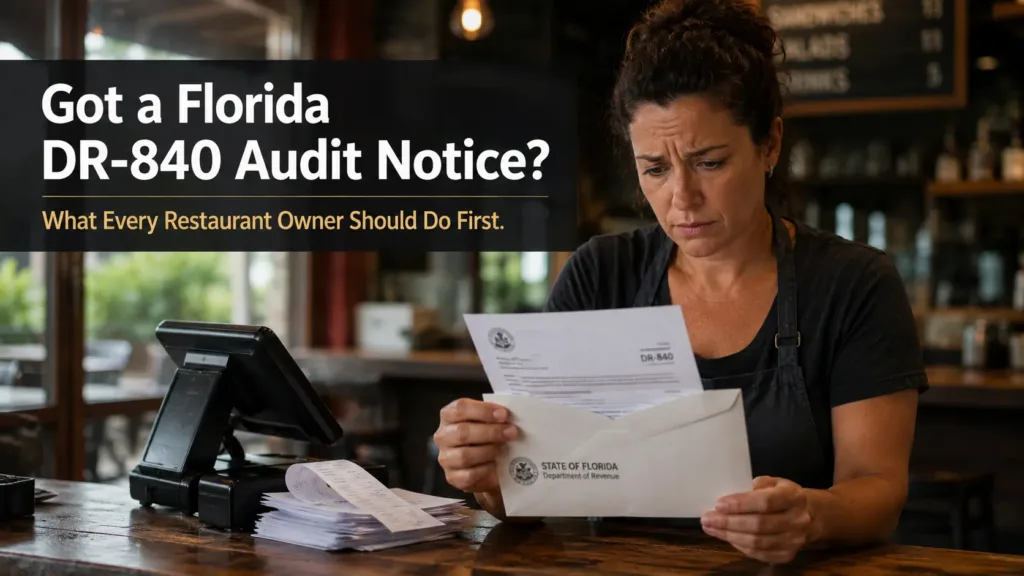
A Florida DR-840 (Notice of Intent to Audit Books and Records) tells you the Florida Department of Revenue has selected your restaurant for a sales and use tax audit. You generally have 60 days before the auditor begins. During that window the auditor requests your DR-15 returns, federal returns, POS data, bank statements, and vendor invoices. What you hand over in those 60 days, and how you frame it, shapes the entire assessment. Owners who turn over raw records without controlling scope often hand the auditor the very data used to inflate the bill.
The envelope from the Florida Department of Revenue is not a request. It is the opening move in a process that already assumes your restaurant under-reported sales tax. The DR-840 is the first formal step, and the clock starts the moment it lands.
Most restaurant owners react the same way. They gather POS reports, pull bank statements, and prepare to cooperate fully. That instinct feels right and is exactly how audits go wrong. Cooperation is not the problem. Handing over more than the auditor is entitled to, with no strategy behind it, is the problem.
Here is what the DR-840 actually triggers, what the auditor is looking for, and why the first 60 days carry more weight than anything that happens afterward.
What a DR-840 Notice Actually Is?
The DR-840 is the Florida Department of Revenue’s Notice of Intent to Audit Books and Records. It is the official notice that your business has been selected for examination, and it identifies the tax type (almost always sales and use tax for a restaurant) and the period under review.
Three details on the notice matter immediately:
- The audit period. Florida sales tax audits typically reach back three years, and the look-back can extend further if returns were filed late or never filed at all.
- The auditor assigned. The notice names the person and gives contact information. Every conversation with that auditor becomes part of the record.
- The 60-day window. The notice is required to give you at least 60 days before fieldwork begins. That window exists for your benefit, not the auditor’s, even though most owners burn it preparing the wrong things.
A Florida restaurant audit is rarely random. The Department targets businesses where its data already suggests a gap, so the notice usually means the auditor expects to find something.
What the Auditor Will Ask You to Hand Over?
The DR-840, and the document requests that follow it, will ask for far more than your sales tax returns. Expect requests for:
- Your filed DR-15 sales and use tax returns for the entire audit period.
- Federal income tax returns, so the auditor can compare reported gross receipts against reported sales.
- Point-of-sale data, including Z-tapes, daily sales summaries, and full transaction detail.
- Bank statements and merchant processor statements, used to reconcile deposits against reported sales.
- Vendor and supplier invoices, especially food and beverage purchases, which feed the markup analysis.
- Exemption documentation, lease agreements, and fixed asset records that can expose use tax.
The danger is not that these documents exist. It is that each one, handed over without context, becomes an input the auditor can use against you. Federal returns reveal gross receipts. Vendor invoices reveal food cost. Bank deposits reveal cash flow. Put together without explanation, they let the auditor build a number that has little to do with what you actually owe.
Why the First 60 Days Decide the Outcome?
Florida auditors frequently rely on indirect methods to estimate tax when they believe records are incomplete. The most common for restaurants is the markup method: the auditor takes your food and beverage cost, applies a standard industry markup, and treats the resulting figure as your expected taxable sales. If your reported sales are lower, the difference is presumed to be unreported and taxed.
That projection is an estimate, and estimates are rebuttable. But you can only rebut what you understand, and you can only protect what you have documented. The 60-day window is when that documentation gets organized, the audit scope gets defined, and the communication channel with the auditor gets controlled. Once fieldwork begins and the auditor has formed a position, every correction becomes an uphill negotiation.
Owners who use the window well rarely face the assessment they feared. Owners who skip it, hand over everything, and hope for fairness almost always pay more than they should.

The Mistake That Costs Restaurant Owners the Most
The single most expensive mistake is volunteering data. An auditor entitled to review a defined set of records for a defined period will happily accept years of unnecessary detail if you offer it. More data means more lines to question, more transactions to sample, and more opportunities to project a larger liability.
There is also the sampling problem. Rather than examine every transaction, Florida auditors often select a short sample period, calculate an error rate, and project that rate across the full audit period. A single unrepresentative sample, a holiday week, a slow month, a period with a POS glitch, can become a three-year assessment many times larger than the actual shortfall.
Understanding which records to provide, how to frame your sales mix, and how to test the auditor’s sample is not something a blog post can resolve for your specific numbers. That is exactly the work that happens inside a Business CPA Tax Resolution Case Analysis, where your DR-840, your returns, and your records are reviewed before you respond to a single auditor request.
Why Your Audit Is Probably Not Random
Florida selects sales tax audits from signals, not a lottery. Common triggers for restaurants include reported sales that fall below the markup the Department expects for your food cost, late or missing DR-15 filings, large swings in reported sales year over year, mismatches between federal gross receipts and state taxable sales, and industry-wide enforcement initiatives aimed at cash-heavy businesses.
If you received a DR-840, the Department most likely already sees a pattern it intends to question. That does not mean the assessment is correct. It means you should treat the notice as the start of a defense, not a formality.
What Happens After the 60-Day Window Closes
Once fieldwork begins, the auditor reviews the records you provided, applies an estimation method where they believe records are thin, and develops a preliminary position. You will eventually receive proposed findings showing the additional tax, penalties, and interest the Department believes you owe.
At that stage you still have rights. You can request an audit conference, dispute the numbers, file a formal protest, and pursue an appeal if you disagree with the final assessment. The catch is that each of these steps is harder once the auditor has built a position around the records you already handed over. The leverage you had during the 60-day window does not come back, which is precisely why what you do before responding carries more weight than how hard you push afterward.
What to Do Before You Respond
Before you send the auditor anything, three things need to happen: the notice and audit scope need to be read carefully, your records need to be reviewed for exposure, and a controlled response plan needs to be in place. The order matters. Responding first and strategizing later is how a manageable audit becomes a six-figure assessment.
If a DR-840 is sitting on your desk, the most useful next step is a focused review of your exposure before the auditor sees your records. A Business CPA Tax Resolution Case Analysis examines the notice, estimates your realistic exposure, and maps out how to respond, so you are negotiating from a position of control instead of reacting to the auditor’s math.
For the mechanics of how Florida projects unreported sales from a small sample, see how Florida sales tax audit sampling works for restaurants. If you have not yet received a notice but suspect under-reporting, the Florida Voluntary Disclosure Program may be a better path than waiting for the audit to find you.
Frequently Asked Questions

Next step
Before you send the auditor anything, get your DR-840 and records reviewed. A Business CPA Tax Resolution Case Analysis examines your notice, estimates your realistic exposure, and gives you a response plan so you control the audit instead of the auditor controlling you.