Skip to content

A U.S. person who owns Costa Rica real estate through an S.A. or S.R.L. may need to file Form 5471 when the entity is treated as a foreign corporation for U.S. tax purposes and ownership, officer, or control thresholds are met. Penalties start at $10,000 per form, per year, under IRC 6038(b). If you already know the S.A. is yours, I’ve written up what owning one means for your U.S. reporting year after year, and it is rarely just Form 5471.
“My Costa Rican attorney put the beach house in an S.A. for liability reasons. Does the IRS care about the company or just the house?”
“The company only holds a lot in Guanacaste and earns nothing. Do I really have a U.S. filing?”
A question this article answers: does a co-owner’s share change my U.S. reporting?
Why Costa Rica Real Estate Can Become a Form 5471 Issue
Costa Rica lets foreigners hold titled, fee simple property directly across roughly 95% of the country. Most U.S. buyers still close through a Sociedad Anonima (S.A.) or a Sociedad de Responsabilidad Limitada (S.R.L.), usually for liability protection, estate convenience, or closing logistics. The entity is a structural choice, not a legal requirement.
From the U.S. side, that choice may convert foreign real estate into foreign corporation stock. When it does, missing a required Form 5471 carries exposure that starts at $10,000 for each form, for each year, before continuation penalties are counted.
Most owners think about the condo in Tamarindo, the lot in Guanacaste, or the rental near Escazu. The U.S. tax system asks a different first question: what do you legally own on paper, the property itself or shares of the entity that holds it?
Why the U.S. Classification of an S.A. or S.R.L. Matters
The local label does not decide the U.S. answer. Treasury entity classification regulations make this a federal tax question, and the analysis does not depend only on how Costa Rican law recognizes the company.
Under those rules, a business entity with two or more owners is generally classified as a corporation or a partnership. A single owner entity may be treated as a corporation or disregarded entirely, depending on default rules and whether a classification election was ever filed.
Many owners have no idea whether an election exists. Until classification is confirmed, nobody can say whether Form 5471, a partnership filing, or a disregarded entity schedule applies. The structure requires classification analysis before anything goes on a return.
When a U.S. Owner May Become a Form 5471 Filer
Certain U.S. citizens and residents who are officers, directors, or shareholders in certain foreign corporations must file Form 5471. The IRS states the form and its schedules satisfy the reporting requirements of IRC sections 6038 and 6046.
Several triggers show up repeatedly in Costa Rica structures: crossing a 10% vote or value ownership line, serving as an officer or director while ownership changes hands, acquiring or disposing of shares during the year, and controlled foreign corporation status.
A controlled foreign corporation, or CFC, generally means a foreign corporation more than 50% owned by vote or value by U.S. shareholders, applying the direct, indirect, and constructive ownership rules of section 958. Attribution can pull a relative’s shares into your count, which is why family owned property companies deserve special care. Which filing category applies, and which schedules attach, depends on ownership, entity classification, income, and prior filings.
CFC and NCTI Rules Can Matter Even for a Property That Earns Nothing
A company that only holds a house can still be a CFC. Control is measured by ownership, not by activity, so a dormant holding company may carry the same reporting profile as an operating business.
CFC status opens income inclusion analysis under Net CFC Tested Income (NCTI), the regime formerly known as GILTI, and under Subpart F for passive items such as rent or interest. Whether any inclusion actually results depends on the numbers, but the analysis itself may be required. Individual owners weighing rate elections can start with our overview of Section 962 planning to see why that path carries its own complexity.
One more point catches many owners off guard: the assessment window on the entire income tax return can stay open until a required Form 5471 is filed. Silence does not start the clock.
Direct Title vs. Entity Ownership: How the U.S. View Changes
The table below shows how the analysis shifts the moment title moves inside an entity.
| Factor | Direct Fee Simple Title | Ownership Through an S.A. or S.R.L. |
| What you legally own | The property itself | Shares or quotas of a foreign entity that owns the property |
| First U.S. question | How is foreign property income or sale gain reported | How is the entity classified for U.S. tax purposes |
| Annual information reporting | Generally no entity form attaches to the land itself | Form 5471 may be required based on ownership, office held, or control |
| Rental income treatment | Typically reported directly by the owner | May require entity level analysis before it reaches the owner’s return |
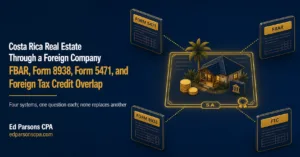
| Bank account exposure | Personal foreign accounts may be reportable | Company accounts plus signature authority can add FBAR and Form 8938 questions |
| Measurement | No ownership percentage to measure; the title is the asset | 10% vote or value can trigger filer status; more than 50% U.S. ownership can create CFC status; $10,000 per year penalty exposure per unfiled form |
The Numbers U.S. Owners Should Know
- $10,000: initial penalty per required Form 5471, per year, under IRC 6038(b).
- $50,000: maximum additional continuation penalties after IRS notice, which the Internal Revenue Manual describes as a stated maximum of $60,000 per form, per year.
- 10%: the vote or value ownership level that commonly triggers U.S. shareholder analysis.
- More than 50%: the U.S. ownership level, by vote or value, that can make a foreign company a CFC under section 958 rules.
- Roughly 95%: the share of Costa Rica where foreigners can hold titled, fee simple property directly, which makes the entity a choice rather than a requirement.
- Open ended: the assessment window on the full return can remain open while required international information returns sit unfiled.
Nobody in this position chose to become the shareholder of a foreign corporation. The attorney suggested an entity, the closing happened, and the U.S. question turned up years later on somebody else’s paperwork. I wrote five emails for that reader. Two things in them matter most: the penalty is assessed automatically, with no examination behind it, and until the form is filed the clock on your entire return never starts running. Start the series. The first thing to arrive is a confirmation request, and ignoring it means nothing else comes. You can unsubscribe from any email.
What Records a CPA Usually Needs to Review
A proper review starts with documents, not forms. The goal is to establish classification, ownership history, and money flow before any U.S. filing position is chosen.
- Formation documents, bylaws, and any classification election on file.
- The shareholder or quota ledger, ownership percentages, and transfer history.
- Property title and national registry records.
- Costa Rican accounting records with the income and expense history.
- Bank statements for company accounts and any account with signature authority.
- Loans, capital contributions, distributions, and owner paid expenses.
- Prior U.S. returns and any international forms already filed.
Owners planning to merge, dissolve, or transfer the company should pause first, because restructuring a Costa Rica holding company can itself be a reportable event. Heirs face a parallel records problem, covered in our guide to inherited Costa Rica real estate in a corporation.

Common Mistakes U.S. Owners Make
- Reporting rental income directly on Schedule E without confirming who legally owns the property. Our guide to Costa Rica rental property inside a foreign corporation explains why the entity question comes first.
- Assuming that no income means no filing. Form 5471 is ownership based information reporting, and the phrase “the company did nothing” is not a defense.
- Treating the closing attorney’s entity choice as the U.S. tax answer. Classification requires its own analysis.
- Leaving company bank accounts out of FBAR and Form 8938 reviews, including accounts held only under signature authority.
- Ignoring family attribution when parents, siblings, or children hold part of the entity.
- Discovering the problem at sale, inheritance, or refinancing, when records are hardest to reconstruct.

Next Step
Before you report the property as a simple foreign rental, or skip the year entirely, review whether the Costa Rican entity creates Form 5471 reporting. The right answer depends on the entity, its ownership, its income, its bank accounts, and the prior filings.
If you own Costa Rica real estate through a company, the practical next step is a structured review: classify the entity, confirm ownership history, and map the U.S. reporting forms. Form 5471 is built for exactly that review, from classification analysis through the schedules that attach.