Skip to content

Key Differences in IRS Streamlined Filing Options Explained

Differences Between IRS Streamlined Filing Options and Regular Filings: A Clear Guide for International Tax Compliance
By Edward Parsons, CPA, Edward Parsons, CPA
When U.S. tax compliance intersects with cross-border financial matters, selecting the appropriate pathway between IRS Streamlined Filing Compliance Procedures and standard regular filings becomes a critical strategic decision. This detailed guide explores the requirements, benefits, procedural nuances, penalty implications, and real-world applications of each option. Streamlined procedures are specifically designed to assist taxpayers with non-willful delinquencies, offering meaningful penalty relief and a more streamlined remediation process for unintentional omissions in foreign income, asset, or information reporting. Regular filings, by contrast, adhere to standard IRS rules, demanding comprehensive documentation and exposing filers to the full spectrum of penalties for late submissions, inaccuracies, or failures.
By examining eligibility criteria, lookback periods, documentation demands, enforcement differences, and practical examples, this article equips U.S. taxpayers—particularly those with international accounts or residency abroad—to align their approach with their specific facts. The analysis covers FBAR and FATCA interactions, willfulness determinations, professional guidance considerations, and long-term compliance strategies. Timely, informed action can significantly reduce financial exposure, limit IRS enforcement risks, and restore compliant status efficiently.
Key Takeaways
- Streamlined Filing Procedures provide targeted relief for non-willful cases through reduced or waived penalties, focused lookback periods (3 years tax returns + 6 years FBARs), and certification-based submissions.
- Regular Filings follow conventional IRS processes with standard deadlines, full documentation requirements, and exposure to complete penalty structures without special mitigation.
- Non-Willful Conduct is the foundational eligibility element for streamlined options, requiring a factual demonstration of negligence, inadvertence, mistake, or good-faith misunderstanding rather than intentional evasion.
- International Relevance: These pathways directly address common triggers like FBAR ($10,000 aggregate threshold) and FATCA (Form 8938), with streamlined offering particular advantages for expatriates unaware of U.S. worldwide reporting duties.
- Penalty Outcomes: Streamlined often results in 0% (SFOP) or 5% (SDOP) miscellaneous offshore penalties plus waivers; regular filings risk compounding failure-to-file, accuracy-related, and information return penalties.
- Professional Involvement: Highly recommended for eligibility assessments, narrative framing, documentation organization, and negotiation to optimize outcomes and avoid disqualification risks.
- Distinction from Other Programs: Streamlined targets non-willful taxpayers; the Voluntary Disclosure Practice (VDP) addresses higher-risk or willful scenarios with different costs and protections.
- Core Success Factors: Prompt action, thorough records, accurate willfulness certification, and integration with ongoing compliance routines minimize long-term risks.
Definitions and Foundational Concepts
IRS Streamlined Filing Compliance Procedures (SFCP) encompass two primary tracks tailored for individuals (and estates) with non-willful failures:
- Streamlined Foreign Offshore Procedures (SFOP): Geared toward qualifying foreign residents, typically featuring 0% miscellaneous offshore penalty.
- Streamlined Domestic Offshore Procedures (SDOP): For U.S. residents, generally including a 5% offshore penalty on a defined base of unreported foreign financial assets.
These procedures emphasize certification of non-willfulness and require coordinated submission of amended/deliquent returns and FBARs.
Regular (Standard) Filings involve submission of original or amended tax returns and related information forms under normal IRS rules. There is no intent-based relief or simplified lookback—filers face standard statutes of limitations and full penalty exposure for any deficiencies.
Lookback Periods in Detail:
- Tax Returns: Generally the 3 most recent years for which the filing deadline (including extensions) has passed.
- FBARs: The 6 most recent calendar years. These periods operate independently. Taxpayers with longer delinquencies must still address only the specified windows under streamlined but remain vigilant about broader liabilities under regular processes. Proper mapping prevents gaps or unnecessary filings.
Key Distinctions: Streamlined vs. Regular Filings
Understanding the structural and outcome differences is essential for decision-making.
Image Suggestion (Alt Text): Side-by-side comparison infographic highlighting penalty relief, process complexity, and eligibility for Streamlined vs Regular IRS filings.
Advantages and Practical Benefits of Streamlined Filing
Streamlined procedures deliver tangible advantages for qualifying taxpayers. The most impactful is penalty mitigation: SFOP often eliminates the miscellaneous offshore penalty entirely for eligible foreign residents meeting the 330-full-day physical presence test in one of the covered years, alongside waivers for various failure-to-file and information return penalties. SDOP applies a more moderate 5% penalty calculated on the highest aggregate value of specified unreported foreign financial assets across the period (excluding already-compliant assets).
Additional benefits include a narrower documentation focus, faster path to resolution, and reduced likelihood of aggressive collection actions. For international taxpayers, this framework corrects legacy FBAR and FATCA gaps efficiently, allowing emphasis on current-year compliance and future planning. Overall, it lowers financial and administrative burdens while re-establishing good standing with the IRS.
Implications for International Tax Compliance and Enforcement
Cross-border taxpayers frequently encounter overlapping obligations under FBAR (foreign financial accounts), FATCA (broader specified assets via Form 8938), and entity forms (e.g., Form 5471). Streamlined filing provides a practical mechanism to address unintentional non-compliance without the full punitive weight of regular processes. Regular filings, while appropriate in some contexts, expose filers to rapid penalty accumulation, audit triggers from FATCA data exchanges, and enforcement tools such as CP504 (intent-to-levy) and LT11 (pre-levy) notices, potentially leading to liens or levies.
Edge Cases and Considerations: Willfulness assessments are fact-intensive, incorporating evidence of knowledge, efforts to comply, and absence of concealment. Reckless disregard can disqualify streamlined relief. Longer delinquencies or multiple accounts heighten complexity, underscoring the value of early professional evaluation.
Critique Perspective: U.S. offshore enforcement initiatives, including FATCA and disclosure programs, seek parity between domestic and foreign holdings but have drawn criticism for broad application that may not fully differentiate taxpayer sophistication or awareness levels. Streamlined options help mitigate this for non-willful cases.
Procedural Steps: A Side-by-Side Comparison
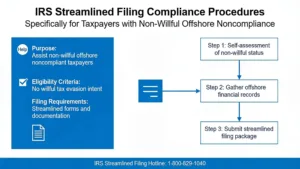
Streamlined Filing Steps:
- Assess eligibility (non-willful conduct, no active audit/investigation).
- Gather records and prepare 3 years of amended or original returns with relevant schedules.
- File 6 years of delinquent FBARs electronically through FinCEN.
- Complete and submit required certification forms attesting to non-willfulness.
- Remit any tax, interest, and applicable offshore penalty.
Regular Filing Steps:
- Compile exhaustive historical documentation for all relevant years.
- Prepare and submit complete or amended standard tax returns (e.g., Form 1040 series) with all attachments.
- Independently address foreign information reporting requirements.
- Respond to any IRS notices or inquiries under standard timelines.
These distinctions highlight the efficiency gains of streamlined when eligible.
Image Suggestion (Alt Text): Detailed flowchart illustrating procedural differences and decision points between Streamlined and Regular filing pathways.
Enforcement Differences, Risks, and Deadlines
Under streamlined programs, the IRS prioritizes verification of completeness and non-willfulness, with reduced escalation for compliant submissions. Regular filings carry standard enforcement risks, including full penalty assessments and collection actions if issues remain unresolved. There are no fixed “expiration” deadlines for streamlined eligibility, but prompt submission is critical to prevent penalty growth, statute complications, and potential disqualification. Missing regular deadlines triggers immediate liabilities.
Professional Consultation: When and Why It Matters
Engaging a qualified tax professional (such as CPA Edward Parsons) is advisable in scenarios involving:
- Complex Holdings: Multiple foreign accounts, entities, or layered structures.
- Eligibility Uncertainty: Ambiguous facts around willfulness or residency tests.
- Historical Issues: Prior non-filings, IRS contact, or overlapping delinquencies.
- High Stakes: Significant balances or risk of recharacterization as willful.
Professionals excel at evidence organization, defensible narrative construction, IRS communication, and pathway optimization—often resulting in superior outcomes, time savings, and reduced stress.
Streamlined vs. Voluntary Disclosure Practice (VDP)
Streamlined procedures are reserved for non-willful conduct with favorable penalty treatment. The VDP addresses willful or higher-risk cases, requiring fuller disclosures and typically involving civil fraud and willful FBAR penalties (though proposals as of late 2025 may introduce adjustments). Selection depends on a candid risk assessment of the facts and documentation strength. Misrouting a submission can forfeit protections or waste limited opportunities.
Effective Navigation and Long-Term Strategies
To successfully resolve delinquent international filings:
- Conduct a Thorough Inventory: Catalog accounts, forms, years, and values.
- Evaluate Facts Objectively: Determine willfulness with supporting evidence.
- Assemble Documentation: Build chronological records demonstrating good faith.
- Seek Input: Obtain tailored advice before submission.
- Implement Ongoing Compliance: Establish annual reviews, threshold monitoring, and professional check-ins to prevent recurrence.
Essential Reporting Forms: blog
- FinCEN Form 114 (FBAR).
- IRS Form 8938 (FATCA).
- Form 1040 series with international schedules.
- Streamlined certification forms (14653 for foreign; 14654 for domestic).
Frequently Asked Questions
What common mistakes undermine streamlined eligibility?
Assuming non-willfulness without robust factual support, submitting incomplete packages, or delaying action that allows penalties to accrue or triggers IRS contact.
How does professional assistance enhance outcomes
A interpret nuanced rules, prepare IRS-ready submissions, frame explanations effectively, and coordinate multi-form filings—reducing errors and improving relief prospects.
Are there strict deadlines for streamlined procedures?
No universal cutoff exists, but earlier submission limits exposure and preserves options. Monitor facts-specific timelines closely.
What unique benefits do U.S. citizens abroad gain?
SFOP frequently enables near-complete penalty relief for genuine unawareness cases, simplifying correction of FBAR/FATCA omissions tied to foreign residency.
How does the IRS evaluate non-willful behavior?
Through objective analysis of facts, contemporaneous records, taxpayer explanations, and absence of indicia of intent (e.g., no concealment).
What core documents support a streamlined application?
Amended returns for 3 years, FBARs for 6 years, certification forms, and corroborating evidence (bank statements, correspondence, timelines).
Can streamlined filing fully eliminate prior penalties?It can waive or substantially reduce many penalties for eligible non-willful cases, though underlying tax liabilities plus interest generally remain due.
Conclusion
Navigating between streamlined filing and regular filings requires careful alignment of your facts with IRS criteria. For non-willful international delinquencies, streamlined procedures represent an efficient, penalty-mitigating solution that facilitates prompt remediation and long-term compliance. Regular filings provide a baseline pathway but demand greater diligence to manage full risks. Assess your situation promptly, prioritize organized documentation, and consult a knowledgeable professional such as Edward Parsons, CPA to chart the optimal course. Early, strategic intervention not only curbs penalties and enforcement actions but also strengthens your overall tax posture in an era of heightened global transparency and information exchange. Proactive compliance is the most reliable strategy for financial stability and peace of mind.