Skip to content

The FBAR (FinCEN Form 114) is a Bank Secrecy Act report filed with FinCEN, not an IRS tax form. You must file it when the combined maximum value of all your foreign financial accounts exceeds $10,000 at any time during the year.
The rule reaches accounts you own and accounts you can control, including foreign pensions, insurance policies with cash value, brokerage accounts, and accounts held through entities and trusts. Filing the FBAR does not replace Form 8938, Form 8621, Form 5471, Form 8858, or Form 3520.
The $10,000 threshold is lower than most people think
The FBAR test is an aggregate test. You take the highest value that each foreign financial account reached during the year, add those peaks together across every account, and compare the total to $10,000.
Two accounts that each peaked at $6,000 put you over the line, even though neither crossed $10,000 on its own. A dormant account with a one-day spike counts at that spike.
The rule also reaches further than ownership. Under 31 C.F.R. 1010.350, the report covers accounts where you hold a financial interest and accounts where you only hold signature or other authority, meaning you can move the money by dealing directly with the institution.
The report itself is filed electronically with FinCEN through the BSA E-Filing System, separate from your tax return. It is due April 15, with an automatic extension to October 15 that requires no request.
The FBAR is not an IRS tax form, and that changes everything
The FBAR is a Title 31 disclosure created by the Bank Secrecy Act. The IRS examines FBAR compliance and enforces the civil penalties, but the report is filed with FinCEN, a separate Treasury bureau.
That distinction is not trivia. Because the FBAR is an account disclosure, it reports accounts. It does not report your income, your entity ownership, your trust status, your PFIC tax, or the asset detail that FATCA collects.
A perfectly filed FBAR can sit on top of an income tax problem, and a perfectly filed tax return can sit on top of an FBAR problem. The penalties run on separate tracks too.
A non-willful FBAR violation currently carries a civil penalty of up to $16,536 per report, per year, an inflation adjusted figure. The Supreme Court held in Bittner v. United States that non-willful penalties accrue per annual report, not per account. Willful violations are a different world: the greater of $165,353 or 50 percent of the account balance, per violation.
The IRS FBAR page covers who files, the deadlines, and the five-year recordkeeping rule. What it cannot do is tell you which of your specific accounts fall inside the categories below. That is where complicated situations go wrong. The harder account types each have their own guide: foreign pensions, Australian superannuation, Colombian CDTs, fiduciarias and AFP pensions, crypto exchanges, gambling and offshore payment platforms, foreign mutual funds in a brokerage account, a foreign corporation’s accounts, foreign disregarded entities, a U.S. business’s foreign accounts, signature authority without ownership, and accounts held through a foreign non-grantor trust.
The accounts that surprise people
Foreign pensions and retirement accounts. The exceptions that shelter U.S. IRAs and qualified plans do not automatically extend to foreign plans. IRS examination guidance treats foreign retirement accounts such as Canadian RRSPs as normally reportable, and superannuation, AFP, and other country-specific plans each require account-by-account review.
Foreign insurance and annuity policies with cash value. A policy you can borrow against or surrender for value is an other financial account under the regulation. The reportable figure is the cash surrender value, never the death benefit.
Foreign brokerage and investment accounts. The securities account abroad is generally reportable. The funds inside it are a separate question: many foreign mutual funds and ETFs are PFICs, which raises Form 8621 issues the FBAR never touches. We break down what goes on the FBAR when you own foreign funds in its own guide.
Accounts held through entities. Own more than 50 percent of an entity, and its foreign accounts can become your indirect financial interest. Officers and controllers with signing rights face their own analysis, even without any ownership.
Trust accounts. Grantors, trustees, beneficiaries, and protectors each stand in a different position relative to the trust’s accounts. Filing a trust information return does not answer the account question.
Crypto and payment platforms. Under FinCEN Notice 2020-2, an account holding only virtual currency is not currently defined as reportable. A fiat balance or other reportable assets inside the same account can change that answer, and offshore payment or gambling balances turn on whether the account fits a reportable category at all.
Signature authority without ownership. Treasurers, controllers, trustees, and family members with account powers can owe an FBAR on money that was never theirs.
Every account in that list belongs to someone who was told, or assumed, that it did not count. I put five short emails together for that reader: how the threshold adds every foreign account together at its single highest point, which accounts reach you without being in your name, what separates a non-willful penalty from a willful one, and how a missed year gets put right without making the record worse. Send me the five FBAR emails. A confirmation email comes first, and nothing else arrives until you click it. Each email carries a one-click unsubscribe.
One account, several reports: how the FBAR overlaps with IRS forms
The most expensive misunderstanding in this area is the belief that one filing covers another. It never does. Each report answers its own legal question, on its own form, with its own penalty.
| FBAR (FinCEN Form 114) | IRS international forms (8938, 8621, 5471, 8858, 3520) | |
| Filed with | FinCEN, through the BSA E-Filing System | The IRS, with your income tax return |
| Authority | Title 31, the Bank Secrecy Act | The Internal Revenue Code |
| What it reports | Foreign financial accounts you own or control | Income, foreign assets, entities, trusts, and PFIC tax, form by form |
| Measurement | $10,000 combined maximum account value at any time in the year | Form-specific thresholds, such as $50,000 and up for Form 8938 |
| Penalty family | Up to $16,536 per report if non-willful; the greater of $165,353 or 50% of the balance if willful | $10,000-family penalties per form, plus tax, interest, and accuracy penalties |
Form 8938 is the FATCA asset statement attached to your tax return, with thresholds that start at $50,000 and rise with filing status and residence. Relief for duplicative reporting exists among the IRS forms, but no IRS form ever excuses the FBAR. The full breakdown lives in our FBAR vs Form 8938 vs Form 8621 comparison.
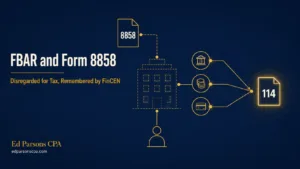
Form 8621 taxes and reports the PFIC itself, fund by fund. Form 5471 and Form 8858 report foreign corporations, disregarded entities, and branches, but they do not report those entities’ bank accounts to FinCEN. Form 3520 and Form 3520-A report trust transactions and ownership, and leave the account analysis fully open.
Schedule B, Part III asks the foreign account question directly on your tax return. Examiners and courts weigh how that box was answered when they decide whether a violation was non-willful or willful.
The diagnostic checklist we run before any FBAR is filed
Seven data points determine what gets reported, and on which forms:
- Account holder: who is named on the account, and who stands behind that name through an entity or a trust.
- Institution location: where the institution that maintains the account operates, not where the underlying assets were issued.
- Account type: bank, securities, pension, insurance or annuity with cash value, or another financial account category.
- Control rights: who can direct the disposition of funds by communicating with the institution, including signers with no ownership.
- Maximum annual value: the highest balance during the year, converted to U.S. dollars at the Treasury year-end rate.
- Income: whether the interest, dividends, gains, or distributions the account produced actually reached the tax return.
- Related forms: whether the same facts also trigger Form 8938, Form 8621, Form 5471, Form 8858, or Form 3520.
Miss one data point and the filing built on it is wrong.

Where complicated FBARs go wrong
The first failure pattern is the incomplete FBAR. The bank accounts get reported, and the pension, the insurance policy, and the entity accounts do not. An incomplete or inaccurate FBAR is treated as a violation, the same as no FBAR at all.
The second pattern is the accurate FBAR sitting on an inaccurate return. The accounts were disclosed, but the income was never picked up, and the PFIC, entity, or trust forms were never filed. The account report becomes evidence of what you knew, without fixing what you owed.
The third pattern is the wrong repair. Past-due FBARs are not a simple upload. The correct path depends on whether income was reported, what the willfulness facts look like, and which programs you are still eligible for, and the streamlined procedures alone span three years of returns and six years of FBARs. Choosing wrong can close better options permanently, which is why how foreign account mistakes are repaired gets its own guide in this series.

Getting the current year right is the cheapest problem to solve. Our FinCEN Form 114 FBAR CPA Filing service handles the account analysis, valuation, and filing, including pension, insurance, entity, trust, and signature authority accounts. When prior years are missing, the IRS Streamlined Filing CPA Package is built for non-willful taxpayers who need returns and FBARs corrected together.