Skip to content
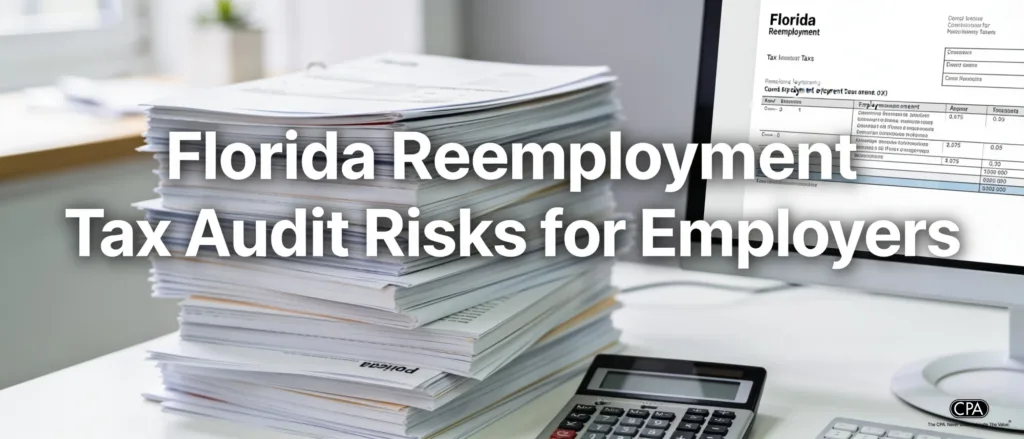
Florida Reemployment Tax Audit Risks for Employers

Florida Reemployment Tax Audit Risks for Employers
By Edward Parsons,
Florida reemployment tax audits expose employers to serious liability across three core risk areas: worker misclassification, unreported wages, and inaccurate payroll records. The Florida Department of Revenue treats these audits as formal examinations, not routine reviews. Misclassified independent contractors are the most common trigger, converting untaxed payments into assessed reemployment tax liability with penalties.
Key Takeaways
Florida reemployment tax audits begin with a formal Notice of Intent to Audit from the Department of Revenue.
Misclassifying workers as independent contractors ranks among the top triggers for reemployment tax audit penalties.
Employers in Doral and across Florida face back taxes, interest, and penalties spanning up to 3 audit years.
Edward Parsons, CPA recommends businesses secure professional representation before the auditor arrives on-site.
Florida reemployment tax audits begin with a formal Notice of Intent to Audit from the Department of Revenue.
Misclassifying workers as independent contractors ranks among the top triggers for reemployment tax audit penalties.
Employers in Doral and across Florida face back taxes, interest, and penalties spanning up to 3 audit years.
Edward Parsons, CPA recommends businesses secure professional representation before the auditor arrives on-site.
What Is Florida Reemployment Tax and Who Pays It?
Understanding Florida Reemployment Tax Audits begins with understanding the tax itself. Florida reemployment tax previously known as unemployment tax is a state-level payroll tax that funds temporary financial support for workers who lose their jobs. Every business operating in Florida carries an obligation to contribute to this fund.
Who Is Required to Pay Florida Reemployment Tax?
Every Florida business with employees is required to contribute to the reemployment tax fund. Contribution amounts vary based on two primary factors:
Payroll size – larger payrolls generally produce higher tax obligations
Claims history – a higher rate of former employees filing unemployment claims raises an employer’s tax rate over time
Payroll size – larger payrolls generally produce higher tax obligations
Claims history – a higher rate of former employees filing unemployment claims raises an employer’s tax rate over time
No Florida employer is exempt from this obligation simply by being small or newly formed.
What Agency Administers Florida Reemployment Tax?
The Florida Department of Revenue administers the reemployment tax program. The Department provides several resources to help businesses stay compliant:
Worker classification guidance
Reemployment tax forms and publications
Taxpayer education tutorials covering filing and payment requirements
Worker classification guidance
Reemployment tax forms and publications
Taxpayer education tutorials covering filing and payment requirements
These resources exist because classification errors treating employees as independent contractors. Are among the most common triggers for a formal audit.
Reemployment tax is not a minor administrative detail. Misclassification or underpayment exposes a Florida business to back taxes, interest, and penalties that compound over time. Getting the classification right from the start is far less costly than resolving it after an auditor arrives.

How Does a Florida Reemployment Tax Audit Begin?
Understanding Florida Reemployment Tax Audits starts with a single formal document: a Notice of Intent to Audit issued by the Florida Department of Revenue. Florida reemployment tax audits are not routine paperwork reviews they are structured examinations of a business’s payroll practices, worker classification decisions, and overall compliance with one of Florida’s most actively enforced tax regimes.
What Triggers the Notice of Intent to Audit?
The Florida Department of Revenue conducts reemployment tax audits as a systematic check to verify that businesses are meeting their tax obligations. The audit process is designed to identify gaps in how workers are classified, how payroll is reported. Whether the correct tax contributions have been made. Businesses that rely heavily on contractors or off-payroll workers tend to draw closer scrutiny.
What Does the Audit Actually Examine?
Once the notice arrives, the scope becomes clear. The Department’s examination typically covers three core areas:
Payroll practices – how wages are calculated, recorded, and reported
Worker classification decisions – whether individuals treated as independent contractors should have been classified as employees
Tax compliance – whether the business has met its obligations under Florida’s reemployment tax rules
Payroll practices – how wages are calculated, recorded, and reported
Worker classification decisions – whether individuals treated as independent contractors should have been classified as employees
Tax compliance – whether the business has met its obligations under Florida’s reemployment tax rules
Each of these areas carries real financial exposure. Back taxes, penalties, interest, and the potential loss of a favorable earned tax rate are all at stake. Florida businesses that receive a Notice of Intent to Audit should treat the document seriously from the moment it arrives. Ed Parsons CPA, a Doral, FL-based practice, works with Florida business owners to assess audit exposure. Organize a defensible response before the process advances.

What Are the Most Common Audit Triggers for Florida Employers?
Understanding Florida Reemployment Tax Audits begins with recognizing what draws the Florida Department of Revenue’s attention in the first place. Worker misclassification specifically, treating employees as independent contractors is the single most common trigger for a reemployment tax audit in Florida.
When a business pays workers off-payroll. Issues 1099s instead of W-2s, the Department of Revenue examines whether employment taxes should have been withheld and remitted all along. That gap between how a business labels its workers. How those workers actually function is exactly what auditors are trained to find.
Which Types of Florida Businesses Face the Highest Audit Risk?
Small and mid-sized businesses, startups, technology companies. Professional services firms that rely heavily on contractors face elevated audit risk in Florida. These business models often depend on flexible, project-based labor arrangements. And that dependence creates the classification patterns that trigger scrutiny. A staffing-heavy tech startup in Orlando carries a different risk profile than a traditional brick-and-mortar retailer, even if both operate under the same state tax rules.
What Does a Florida Reemployment Tax Audit Actually Examine?
A Florida reemployment tax audit is a formal examination focused on three core areas:
How the business classifies its workers – employee versus independent contractor
How the business pays its workers – payroll, 1099, or other arrangements
How the business reports its workers – quarterly filings, wage records, and documentation
How the business classifies its workers – employee versus independent contractor
How the business pays its workers – payroll, 1099, or other arrangements
How the business reports its workers – quarterly filings, wage records, and documentation
The audit is not a general financial review. Auditors concentrate specifically on the employment relationship. Whether the business met its reemployment tax obligations for every worker it engaged. Businesses that cannot produce clear, consistent documentation supporting contractor status face the greatest exposure when the auditor arrives.

What Penalties and Consequences Can Florida Employers Face?
Understanding Florida Reemployment Tax Audits reveals a consequence stack that goes well beyond a simple back-tax bill. Florida employers found noncompliant face back taxes, penalties, interest, loss of their earned tax rate, and in serious cases felony exposure.
The range of consequences breaks down into several distinct categories:
Back taxes and interest on reclassified wages, often covering multiple prior years
Penalties assessed on unpaid reemployment tax balances
Loss of earned tax rate, which forces the employer onto a higher rate going forward
Felony exposure in cases involving willful misclassification or fraud
Federal tax consequences, because Florida’s reemployment tax program is funded by the IRS and audit results are reported directly to the IRS
Back taxes and interest on reclassified wages, often covering multiple prior years
Penalties assessed on unpaid reemployment tax balances
Loss of earned tax rate, which forces the employer onto a higher rate going forward
Felony exposure in cases involving willful misclassification or fraud
Federal tax consequences, because Florida’s reemployment tax program is funded by the IRS and audit results are reported directly to the IRS
That last point is the one most Florida employers miss entirely.
Why Does a State Audit Create Federal Tax Exposure?
Florida’s reemployment tax audits are funded by the IRS, which means the findings do not stay at the state level. When the Florida labor and employment agency the enforcement authority for payroll tax and employment matters. Concludes an audit, those results flow to the IRS. A business that reclassified workers at the state level now faces scrutiny of its federal payroll tax filings as well. One audit becomes two problems.
Can a Business Lose Its Tax Rate After an Audit?
Florida employers earn a favorable reemployment tax rate through a history of low claims. An adverse audit finding disrupts that history. The state can strip the earned rate. Assign a higher one, increasing the employer’s ongoing payroll tax burden even after the audit closes. The financial impact compounds year over year.
Ed Parsons CPA, a Doral, FL-based practice serving Florida businesses, works directly with employers navigating reemployment tax audits and the federal exposure that follows.
How Should Florida Employers Respond to an Audit Notice?
Florida employers who receive a Notice of Intent to Audit from the Florida Department of Revenue should treat the notice as a serious formal examination. Not a routine paperwork check. Understanding Florida Reemployment Tax Audits begins with recognizing that the stakes include back taxes, penalties, interest. Potential loss of an earned tax rate.
The first practical step is to organize records before the auditor arrives. That means pulling together payroll documentation, worker classification decisions, and any prior correspondence with the Department of Revenue.
What Steps Should an Employer Take Immediately After Receiving the Notice?
A structured response matters. Employers should work through the following priorities:
Review the notice carefully to identify the audit period and the specific issues flagged
Gather payroll records, contractor agreements, and worker classification documentation for the period under review
Access the Florida Department of Revenue’s employer portal to verify that filed returns and account information are current and accurate
Seek professional guidance before responding to the auditor directly
Review the notice carefully to identify the audit period and the specific issues flagged
Gather payroll records, contractor agreements, and worker classification documentation for the period under review
Access the Florida Department of Revenue’s employer portal to verify that filed returns and account information are current and accurate
Seek professional guidance before responding to the auditor directly
Acting without preparation increases exposure. A Florida reemployment tax audit examines payroll practices and worker classification decisions in detail. An unguided response can create new problems.
Is Professional Help Necessary for a Reemployment Tax Audit?
Professional guidance is likely warranted. A Florida reemployment tax audit is not a routine paperwork review. The consequences of a poor response extend well beyond the audit itself. Edward Parsons, CPA a Doral, FL-based practice. Provides payroll and reemployment tax audit defense for Florida employers, offering direct senior-level involvement rather than routing clients through junior staff. Florida employers facing an audit notice benefit from that kind of focused, experienced representation.
FAQ
What are the most common risks in a Florida reemployment tax audit?
Florida reemployment tax audits expose employers to liability across three core risk areas: worker misclassification, unreported wages, and inaccurate payroll records.
How far back does a Florida reemployment tax audit go?
The Florida Department of Revenue assesses back taxes, interest, and penalties spanning up to 3 audit years.