Skip to content
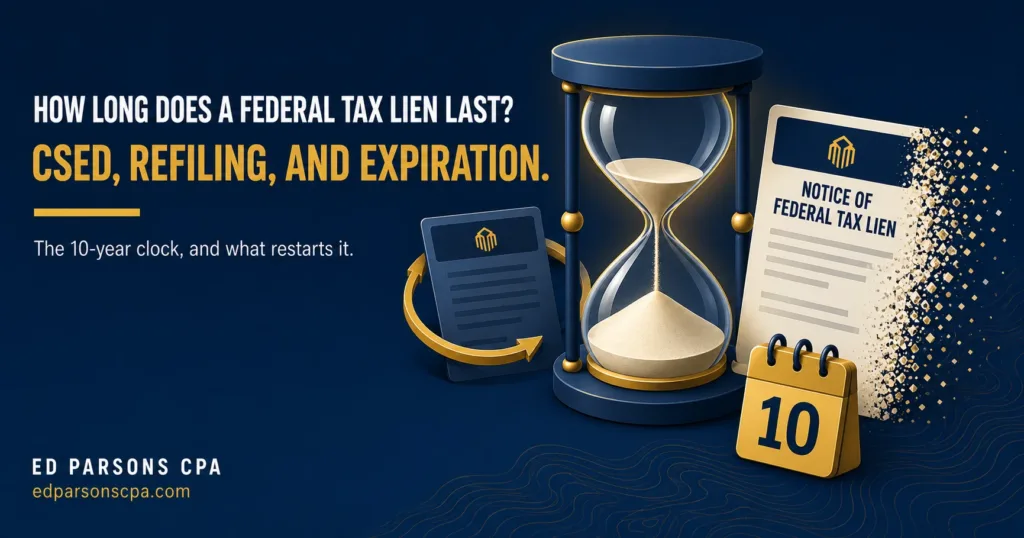
A federal tax lien generally lasts 10 years from the date the IRS assesses your tax liability, not from the tax year itself and not from the date you filed your return. This 10-year window is governed by the Collection Statute Expiration Date (CSED) under IRC Section 6502.
However, the actual duration can be shorter or longer than 10 years. Tolling events such as bankruptcy filings, Offers in Compromise, and Collection Due Process hearings pause the clock. The IRS can also refile the NFTL to preserve its priority position against competing creditors.
If you want to know exactly when your lien expires, you need a transcript-level CSED analysis tied to your specific account history.
The Collection Statute Expiration Date (CSED) Explained
The CSED is the legal deadline after which the IRS loses its authority to collect a tax debt. Under IRC 6502, the IRS generally has 10 years from the assessment date to collect.
This is where most taxpayers get confused. The assessment date is not the same as the tax year or the filing deadline.
How assessment dates work:
- Self-assessed returns: The IRS typically assesses within weeks of processing. A 2019 return filed in April 2020 might be assessed in May 2020, giving the IRS until roughly May 2030 to collect.
- IRS adjustments and audits: The assessment date is when the adjustment posts, which could be years after filing.
- Substitute for Return (SFR): If the IRS files on your behalf, the assessment date is whenever the SFR processes, potentially pushing the CSED out significantly.
Each tax year carries its own separate CSED. You can verify assessment dates by requesting IRS account transcripts or having a tax professional pull them through e-Services.
Events That Pause or Extend the 10-Year Clock
The 10-year statute is not a fixed countdown. Several events “toll” (pause) the CSED, and the paused time gets added back.
Common tolling events:
| Tolling Event | What Happens to the CSED |
|---|---|
| Offer in Compromise (OIC) | Tolled while pending, plus 30 days after rejection or withdrawal |
| Installment Agreement (with waiver) | Tolled only if taxpayer signed a statute extension as part of the agreement |
| Bankruptcy (automatic stay) | Tolled during stay, plus 6 additional months after discharge or dismissal |
| Collection Due Process (CDP) hearing | Tolled while the hearing and any Tax Court petition are pending |
| Innocent Spouse Relief request | Tolled while the claim is pending, plus 60 days |
| Taxpayer living outside the U.S. | Tolled for continuous periods of 6 months or more spent abroad |
| Lawsuit by the IRS to reduce assessment to judgment | Tolled while litigation is pending |
Each of these events individually may add months or years to the collection window. When multiple events stack, the cumulative extension can be dramatic.
A practical example: A taxpayer assessed in 2016 who filed an OIC in 2018 (pending 14 months before rejection) and then filed bankruptcy in 2020 (lasting 18 months) could see their original 2026 CSED pushed to 2029 or later.
Many taxpayers unknowingly trigger tolling events. An OIC that gets rejected does not just waste time. It actively extends the collection window.

IRS Lien Refiling: How the IRS Extends Its Priority
There is an important distinction between the federal tax lien (the statutory lien) and the Notice of Federal Tax Lien (NFTL). The statutory lien arises automatically when the IRS assesses a liability and the taxpayer fails to pay. The NFTL is the public notice filed with state or county offices alerting creditors.
Under IRC 6323(g), the NFTL includes a self-releasing date, typically 10 years plus 30 days from assessment. If the collection period has been extended through tolling, the IRS must refile the NFTL to maintain its priority.
Key refiling rules:
- The first refiling window opens roughly 9 years and 30 days after assessment and closes on the NFTL self-release date
- If the IRS fails to refile within this window, the NFTL self-releases and the lien loses priority against purchasers, security interest holders, and judgment lien creditors
- Subsequent refiling periods run in 10-year increments from the close of the prior period
- Refiling does not create new debt or restart the CSED; it preserves the IRS priority position
What refiling means for taxpayers: If the IRS misses the refiling window, the lien may self-release even though the underlying tax debt remains collectible. This can create strategic opportunities, particularly in cases involving property sales or refinancing.
If you have received a Notice of Federal Tax Lien and believe the refiling window may apply, a professional review of your lien filings alongside your CSED timeline is essential.
What Happens When a Federal Tax Lien Expires?
Once the CSED passes, the IRS must release the federal tax lien within 30 days.
After expiration:
- The IRS can no longer levy bank accounts, garnish wages, or seize property for that liability
- Any existing NFTL must be released and reflected in public records
- The debt ceases to exist for collection purposes
- Credit reporting agencies should remove the lien notation, though you may need to request updates directly
There is one notable exception. If the IRS issued a levy on a “fixed and determinable” right to future income (such as pension payments) before the CSED expired, the IRS may continue receiving those payments after the statute closes.
If the CSED has passed and the IRS has not released your lien, you can request release by filing Form 12277 or contacting the Centralized Lien Operation. You may also explore lien subordination or discharge options if you need faster resolution for a property transaction.
Why Waiting Out the CSED Is Usually the Most Expensive Option?
Many taxpayers assume the best strategy is to simply wait 10 years. In practice, this approach often costs far more than proactive resolution.
The real cost of waiting:
- Penalties and interest continue accruing, often doubling or tripling the original balance
- The NFTL damages credit scores and borrowing capacity for a decade
- Property sales, refinances, and business financing become difficult with an active lien
- The IRS can levy bank accounts and garnish wages at any point during the collection period
- Unknowing tolling events can silently extend your timeline by years
When proactive resolution makes more sense: Strategies like a Partial Pay Installment Agreement (PPIA), an Offer in Compromise, or lien subordination can resolve or reduce the liability faster while limiting damage to your credit and financial life.
Every taxpayer’s CSED timeline is different. Tolling events you may not be aware of could have extended your statute by years. A transcript analysis reveals your actual expiration date.