Skip to content
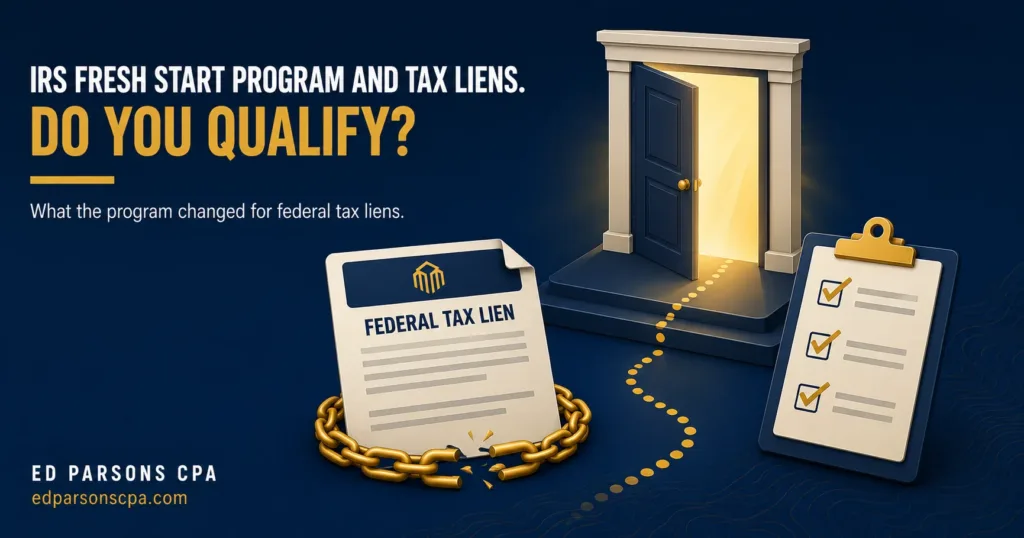
The IRS Fresh Start Program changed federal tax lien rules in two significant ways. First, the IRS raised its lien filing threshold from $5,000 to $10,000, meaning taxpayers who owe less than $10,000 generally will not have a lien filed against them. Second, Fresh Start created a pathway for lien withdrawal (not just release) for taxpayers who enter a Direct Debit Installment Agreement and owe $25,000 or less. These changes do not eliminate tax liens entirely. They narrow the circumstances under which liens are filed and expand options for removing them from public records.
Fresh Start Lien Changes: The $10,000 Filing Threshold
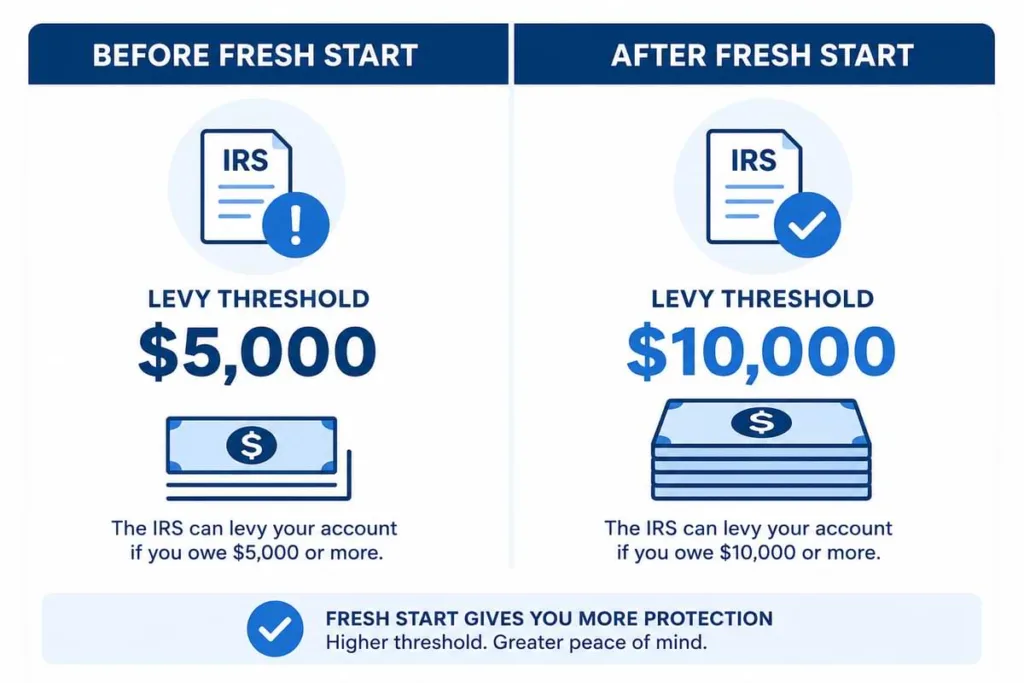
Before Fresh Start, the IRS routinely filed a Notice of Federal Tax Lien when a taxpayer’s assessed balance reached $5,000 and the taxpayer did not respond to the CP14 or CP504 collection notices. That threshold created problems for taxpayers with relatively modest tax debts who suddenly found their credit damaged and their property encumbered.
Under Fresh Start, the IRS raised the threshold to $10,000. If your total assessed balance (including penalties and interest) stays below that amount, the IRS generally will not file a lien, provided you remain in compliance with filing requirements.
There are important details behind that number. The $10,000 threshold is not a guarantee. The IRS retains discretion to file a lien at any balance if it determines that collection is at risk. Self-employed taxpayers, individuals with prior non-filing history, or those with assets that could be transferred quickly may still see a lien filed below $10,000.
If you received a Notice of Federal Tax Lien (a Letter 3172 or a CP504 leading to a lien filing), you can learn about your Collection Due Process hearing rights in our guide to Letter 3172 and CDP hearing rights.
Lien Withdrawal Through Direct Debit Installment Agreement
One of the most impactful Fresh Start changes involves lien withdrawal. Before the program, if the IRS filed a lien, it generally stayed in public records until the debt was fully paid and the lien was released. A release removes the legal claim but leaves the public filing visible on credit reports and in county records.
Fresh Start introduced a different outcome: lien withdrawal. A withdrawal removes the lien from public records entirely, as if it were never filed. The IRS uses Form 12277 (Application for Withdrawal of Filed Form 668(Y)) to process this request.
To qualify for lien withdrawal under the Direct Debit Installment Agreement (DDIA) path, you must meet all of the following conditions:
- Your total assessed tax liability is $25,000 or less
- You have entered into a Direct Debit Installment Agreement (automatic bank withdrawal, not manual payments)
- You have made three consecutive on-time payments through direct debit
- You are current on all tax filing obligations
- You are not in default on any other installment agreement
The distinction between withdrawal and release matters significantly for your financial life. Our detailed guide on Form 12277 and lien withdrawal walks through the full application process.
Streamlined Installment Agreements Under Fresh Start
The IRS Fresh Start Initiative also expanded the Streamlined Installment Agreement program, which allows taxpayers to set up a payment plan without providing detailed financial disclosure to the IRS.
| Measurement | Before Fresh Start | After Fresh Start |
| Lien filing threshold | $5,000 | $10,000 |
| Lien withdrawal available? | Generally no | Yes, via DDIA ($25K or less) |
| Streamlined IA limit | $25,000 | $50,000 |
| Streamlined IA term | 60 months | 72 months |
| Financial disclosure required? | Yes, above $25K | No, up to $50K (streamlined) |
| OIC collection potential | 5 years of income | 1-2 years of income |
The expanded limit from $25,000 to $50,000 means significantly more taxpayers can set up a payment plan without submitting Form 433-A (Collection Information Statement) or Form 433-F. This matters because the financial disclosure forms require documenting every asset, bank account, income source, and monthly expense. That process often delays resolution by weeks or months.
Fresh Start also extended the maximum repayment term from 60 to 72 months. The longer timeframe reduces monthly payment amounts and keeps more taxpayers in compliance with their agreements.
What Fresh Start Does NOT Do (Cutting Through the Hype)?
If you have searched for information about the IRS Fresh Start Program, you have likely encountered advertising that promises dramatic outcomes. Here is what Fresh Start actually does not do.
- It does not automatically remove existing tax liens. You must apply for withdrawal and meet specific eligibility criteria.
- It does not guarantee an Offer in Compromise. The IRS still evaluates your reasonable collection potential based on assets, income, and expenses.
- It does not reduce the amount you owe. Penalties and interest continue to accrue while you are in an installment agreement.
- It does not apply to state tax liens. Fresh Start is a federal program administered by the IRS only.
- It does not protect you from future liens if you fall out of compliance with filing or payment requirements.
Many tax resolution companies use Fresh Start as a marketing umbrella for services that may or may not involve the actual program changes. A qualified CPA can assess whether your specific situation benefits from Fresh Start provisions or requires a different resolution strategy entirely.
Common Mistakes Taxpayers Make With Fresh Start
- Assuming the $10,000 threshold is absolute. The IRS can still file a lien below $10,000 if it believes collection is at risk.
- Confusing lien release with lien withdrawal. A release satisfies the lien but does not remove the public record. A withdrawal erases the public filing entirely.
- Setting up a manual-payment installment agreement instead of direct debit. Only Direct Debit Installment Agreements qualify for lien withdrawal under Fresh Start.
- Failing to stay current on new tax obligations while in a payment agreement. Filing late or owing new tax in a subsequent year can default your agreement and reinstate lien filing.
- Paying a company thousands of dollars to apply for Fresh Start when the basic application (Form 12277 or Form 9465) can be filed with proper professional guidance.

Questions Taxpayers Commonly Ask
“I owe $8,000 to the IRS. Will they file a lien against me?”
Generally, no. Under Fresh Start, the IRS raised the lien filing threshold to $10,000. However, the IRS retains discretion to file at any balance if it determines your collection is at risk. Filing all required returns and responding to notices helps protect you.
“The IRS already filed a lien. Can Fresh Start remove it?”
Yes, if you meet the criteria. By entering a Direct Debit Installment Agreement and making three consecutive payments on time (with a balance of $25,000 or less), you can apply for lien withdrawal using Form 12277. This removes the lien from public records.
“I owe $40,000. Does Fresh Start help me?”
Yes. While the $25,000 DDIA withdrawal path does not apply to your balance, the Streamlined Installment Agreement limit was expanded to $50,000 under Fresh Start. You can set up a 72-month payment plan without providing detailed financial disclosure.
How a CPA Determines Your Best Fresh Start Path?
Fresh Start opened several doors for taxpayers, but walking through the right one depends on your balance, filing status, and compliance history. The program is not a single solution. It is a set of policy changes that created multiple pathways, each with distinct eligibility requirements.
A CPA experienced in IRS tax resolution evaluates your situation across several factors:
- Total assessed balance (including penalties and interest) to determine which Fresh Start provisions apply
- Filing compliance history across all tax years to confirm eligibility for streamlined options
- Current income and asset profile to determine if an Offer in Compromise is viable under the revised calculation formula
- Whether a lien has been filed and if withdrawal (rather than just release) is achievable and strategically worthwhile
- The Collection Statute Expiration Date (CSED) to determine how remaining time affects your resolution options
Understanding how lien subordination and discharge options interact with Fresh Start provisions can also open additional pathways, especially for taxpayers who need to refinance or sell property while a lien is active.

Fresh Start is a set of doors, not a single one, and which of them is open to you turns on your balance, your filing history and how the debt is currently being paid. I would rather look than speculate. Tell me where the account stands and I will come back with which Fresh Start route you actually qualify for, whether a withdrawal is realistic in your case, and what the work costs. If none of them fit, I will say that instead of selling you the version that does not.
Talk to a CPA Who Knows IRS Lien Resolution
Ed Parsons CPA, licensed since 2009, resolves IRS tax liens, negotiates installment agreements, and secures lien withdrawals for taxpayers across the United States. If you are dealing with a federal tax lien or exploring your Fresh Start options, get clarity on your next steps, visit our IRS Tax Lien Help page to schedule a consultation.