Skip to content

If you’re a U.S. citizen living in São Paulo, Rio de Janeiro, or anywhere in Brazil, you still owe the IRS a tax return every year regardless of where you earn your income. Most Americans abroad don’t realize how quickly unfiled returns, unreported foreign accounts, and missed FBAR deadlines can escalate into passport revocation, tax liens, or IRS collections. This guide explains your options and how to fix it.
“Do I Still Owe U.S. Taxes If I Live in Brazil?”
Yes and this surprises a lot of people.
The United States taxes its citizens based on citizenship, not residency. It’s one of only two countries in the world that does this. Living full-time in Brasília or working for a Brazilian company does not remove your filing obligation.
Here’s what that means in practice:
- You must file a U.S. tax return every year, even with zero U.S.-source income
- Foreign bank accounts over $10,000 at any point require an FBAR (FinCEN Form 114)
- Brazilian bank accounts are already being reported to the IRS under FATCA
- Missing returns can trigger automatic penalties, collections, and IRS passport revocation

How Many Americans in Brazil Are Affected?
- Over 1.5 million U.S. citizens live in Brazil (one of the largest expat populations in South America)
- Only a fraction of file-compliant U.S. returns are filed annually
- FBAR penalties start at $10,000 per account per year for non-willful violations
- The IRS collected over $1 billion in offshore penalties in a recent enforcement cycle
What Conversational Questions Bring People to This Page?
People searching for help often ask questions like:
“I’ve lived in Brazil for 6 years and never filed U.S. taxes what happens now?”
“My Brazilian bank sent my account info to the IRS. Am I in trouble?”
“Can the IRS take my passport if I live abroad?”
“I got an IRS notice at my parents’ address in Florida. What does it mean?”
If any of these sound familiar, you’re in the right place.
Your Core IRS Compliance Obligations as an American in Brazil?
1. Annual U.S. Tax Return (Form 1040)
Due June 15 (automatic extension for expats). You may owe nothing after applying the Foreign Earned Income Exclusion, but the return must still be filed. Learn more about US expat tax filing requirements for 2025.
2. FBAR (FinCEN 114)
Required if your Brazilian accounts checking, savings, investment, pension combined exceeded $10,000 at any time during the year. Filed separately from your tax return at FinCEN’s BSA E-Filing System.
3. FATCA Form 8938
Required if Brazilian financial assets exceed $200,000 (single filer abroad) at year-end, or $300,000 at any point. This is filed with your 1040.
4. Foreign Earned Income Exclusion (FEIE)
You may be able to exclude up to $126,500 (2024) of Brazilian-sourced earned income from U.S. taxation. But if the IRS audits your FEIE claim, you need documentation. See the IRS Audit of the Foreign Earned Income Exclusion 2025 Guide for what to expect.
IRS Resolution Options: What’s Available to Americans in Brazil
| Resolution Option | Best For | Penalty Relief? | Timeframe | Measurement |
| Streamlined Foreign Offshore | Non-willful, 3+ unfiled years | Yes 5% penalty | 3–6 months | Most common expat solution |
| Installment Agreement | Can’t pay balance in full | Partial | Ongoing | Up to 72 months |
| Offer in Compromise | Significant financial hardship | Yes | 12–24 months | IRS accepts ~40% of cases |
| Currently Not Collectible | Unemployed / no income | Temporary | Reviewed annually | Halts collections |
| Passport Reinstatement | Seriously delinquent ($62,000+) | No | 30–90 days after resolution | Requires full compliance |
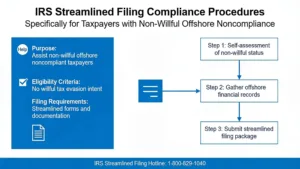
The Streamlined Foreign Offshore Procedure: The Most Common Fix
If you’ve been living in Brazil and missed filing for years, this is usually your best starting point.
The IRS Streamlined Filing program allows qualifying Americans abroad to:
- File 3 years of back tax returns
- Submit 6 years of FBARs
- Pay a 5% miscellaneous offshore penalty (instead of full FBAR and FATCA penalties)
- Certify the non-filing was non-willful (not intentional tax evasion)
This program is not permanent. The IRS can close or tighten it at any time. If you qualify, acting sooner protects you.
One important note: If the IRS has already opened an examination or contacted you about your foreign accounts, you may no longer qualify for Streamlined. Work with a CPA before submitting anything.
What Happens If You Ignore It
The IRS doesn’t forget about Americans abroad. Here’s how enforcement typically escalates:
- Automated notices sent to your last known U.S. address (often a family member’s home)
- Substitute for Return (SFR) filed by the IRS usually with no deductions, maximizing what you owe
- Tax lien filed against your name visible in public records, affecting credit and property
- Passport flagged by the State Department as “seriously delinquent” renewal denied or revoked
- Bank levy or wage garnishment if you have U.S.-based income or return to the U.S.
If you’ve already received a notice or letter, our IRS tax lien help page explains your immediate options.
Common Mistakes Americans in Brazil Make
These are the most frequent errors our CPA sees:
- ❌ Assuming Brazilian taxes paid = U.S. obligation gone (they’re separate systems, though a foreign tax credit can help)
- ❌ Not filing because “I didn’t earn anything in the U.S.” (residency doesn’t matter)
- ❌ Thinking a small account balance means no FBAR required (the $10,000 threshold is a combined, ever-reached balance)
- ❌ Using a general CPA in Brazil who doesn’t know U.S. international tax rules
- ❌ Waiting for the IRS to contact them before getting compliant (voluntary disclosure is always better than audit)
- ❌ Filing the Streamlined procedure without a CPA and making certification errors that can void the program’s protections
Brazil-Specific Considerations You Should Know
FATCA and Brazilian Banks
Brazil signed a FATCA intergovernmental agreement with the U.S. Major Brazilian banks Itaú, Bradesco, Santander Brasil, Nubank already report U.S. account holders to the Brazilian tax authority (Receita Federal), which shares that data with the IRS. Your accounts are likely already visible.
The U.S.–Brazil Tax Treaty
The U.S. and Brazil do not have a comprehensive income tax treaty. This means you cannot rely on treaty benefits to reduce double taxation the way Americans in the UK or Germany can. The Foreign Tax Credit and FEIE are your primary tools. See the IRS Brazil Tax Treaty Documents page for what does exist.
Brazilian Pension Accounts (PGBL/VGBL)
These are commonly missed in FBAR and FATCA filings. If you hold a PGBL or VGBL, Brazil’s equivalent of a 401(k), it almost certainly needs to be reported. The IRS rules on foreign pension accounts are complex and require case-by-case analysis.
Currency Conversion
All Brazilian income must be reported in U.S. dollars on your 1040. The IRS accepts the official IRS yearly average exchange rate for conversion. Using the wrong rate is a common audit trigger.
Why Work With a CPA Instead of Handling This Yourself?
The IRS Streamlined procedure looks simple on paper. In practice, the certification statement declaring your non-filing was non-willful is a legal attestation. Getting it wrong can result in the IRS treating your submission as a willful disclosure, which opens you up to much larger penalties and potential criminal referral.
Our international tax services are built specifically for Americans living outside the U.S. We work remotely with clients across Brazil São Paulo, Rio de Janeiro, Curitiba, Recife and handle every step, from pulling your IRS transcripts to filing your returns and FBARs.
Working with a licensed CPA (not a general tax preparer) also gives you federally protected privilege in audit situations. For more on why this matters, visit Why Work With a CPA.