Skip to content
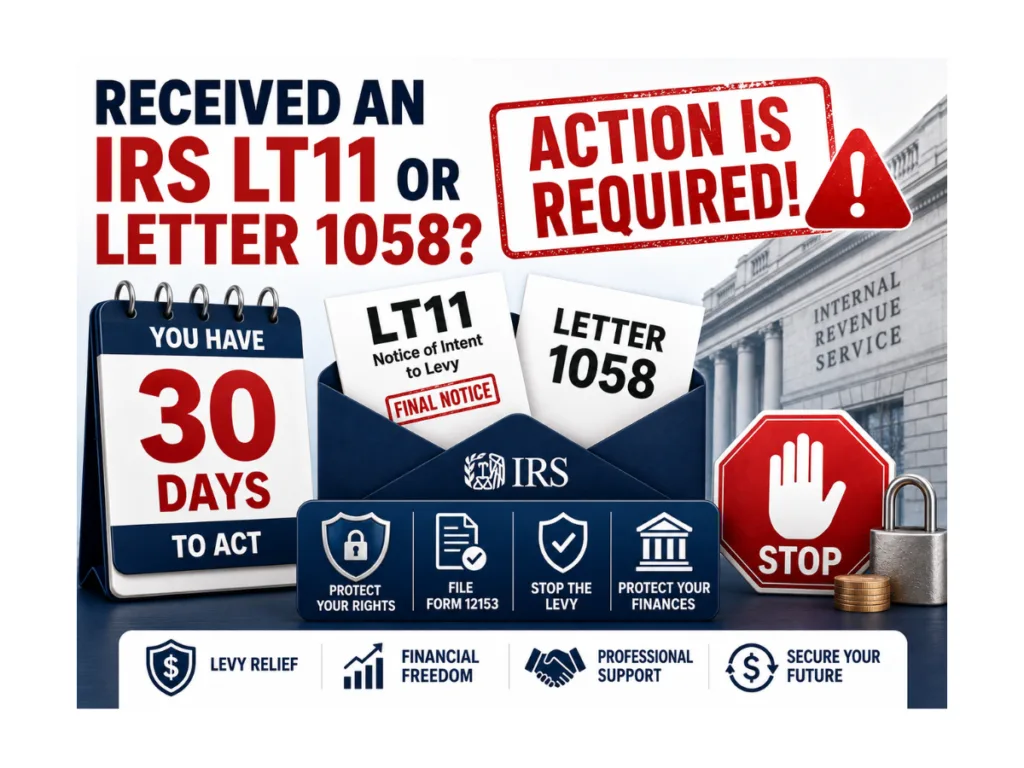
An LT11 (also called Letter 1058) is the IRS’s final notice before it seizes your wages, bank accounts, or other assets through a levy. You have 30 days from the date on the notice to request a Collection Due Process (CDP) hearing by filing Form 12153. Missing that window means the IRS can levy without further warning.
If you’ve pulled your mail open and found an LT11 or Letter 1058 staring back at you, take a breath – but don’t take your time. This letter isn’t another reminder. It’s the IRS telling you, in plain terms, that collection action is imminent. It’s also one of the most important pieces of mail a taxpayer can receive, because it unlocks rights that disappear if you don’t act within the deadline.
At Ed Parsons CPA, we work with taxpayers across the country who are dealing with these exact notices. Below is everything you need to know about what the LT11 means, how Collection Due Process works, and the real steps involved in stopping or releasing a levy.
Why the IRS Sends an LT11 or Letter 1058?
The IRS doesn’t jump straight to levying your paycheck. Before it reaches the LT11 stage, the agency has typically sent a series of earlier notices – CP14, CP501, CP503, and CP504 – each escalating in urgency. By the time the LT11 arrives, you’ve either missed or ignored previous correspondence, or the mail simply didn’t reach you due to an outdated address on file.
The LT11 serves a specific legal purpose: it satisfies the IRS’s obligation under Internal Revenue Code Section 6330 to provide a “final notice of intent to levy and notice of your right to a hearing.” Without this notice, the IRS cannot legally proceed with most types of levies.
LT11 vs. CP504 – What’s the Difference?
| Feature | CP504 Notice | LT11 / Letter 1058 |
|---|---|---|
| Stage in collection | Pre-final warning | Final notice before levy |
| Levy authority triggered? | State tax refunds only | Yes – wages, bank accounts, Social Security, accounts receivable |
| CDP hearing rights? | No | Yes – 30-day window to file Form 12153 |
| Can the IRS seize your bank account? | Not yet | Yes, after the 30-day period expires |
| Urgency level | High | Critical – immediate action required |
The critical distinction is that the LT11 triggers your right to a CDP hearing – a formal legal process that temporarily halts all collection activity while your case is reviewed. The CP504 does not offer this protection.
What Is a Collection Due Process (CDP) Hearing?
A CDP hearing is a formal review conducted by the IRS Office of Appeals (now called the Independent Office of Appeals). During this hearing, you can challenge the proposed levy action, propose alternative payment arrangements, or dispute the underlying tax liability itself if you haven’t had a prior opportunity to do so.
Here’s what matters most: once you file a timely CDP request, the IRS is legally prohibited from levying your assets until the hearing process is complete. That includes any subsequent appeal to the U.S. Tax Court. This is the strongest taxpayer protection available at this stage, and it’s only available because you received the LT11.
What You Can Raise at a CDP Hearing?
- Installment agreement – Propose a monthly payment plan the IRS hasn’t previously considered or rejected.
- Offer in Compromise – Settle the tax debt for less than the full amount owed, based on your ability to pay.
- Currently Not Collectible (CNC) status – Demonstrate that paying would create economic hardship, pausing collection activity.
- Dispute the liability – If you never received a statutory notice of deficiency or didn’t have a prior chance to contest the amount, you can challenge the actual tax owed.
- Spousal defenses – Raise innocent spouse or injured spouse claims if appropriate.
- Procedural challenges – Argue the IRS failed to follow proper collection procedures.
How to File Form 12153 – Step by Step?
Form 12153, Request for a Collection Due Process or Equivalent Hearing, is the document that activates your CDP rights. Filing it correctly – and within the 30-day window printed on your LT11 – is non-negotiable.
- Locate the deadline on your notice. The 30-day clock starts from the date printed on the LT11, not the date you received it. If your notice is dated January 15, your deadline is February 14.
- Complete Form 12153 accurately. Include the tax periods listed on the LT11, check the boxes for the collection alternatives you want to propose, and explain the reason you disagree with the levy.
- Mail or fax it to the address on the notice. Use certified mail with return receipt for proof of timely filing. Keep a copy of everything.
- Follow up within 2–3 weeks to confirm the IRS received and processed your request.
Received an LT11 and unsure how to respond? Don’t let the 30-day window close.Talk to Ed Parsons CPA – Call (786) 265-8578
What Happens If You Miss the 30-Day CDP Deadline?
Missing the deadline doesn’t mean you’re completely out of options, but your position weakens considerably. After the 30-day window, you may still request an “equivalent hearing” within one year of the notice date. However, an equivalent hearing does not stop levy action, and the decision cannot be appealed to Tax Court. The IRS can – and often does – proceed with levying bank accounts and wages while an equivalent hearing is pending.
If you have unfiled tax returns from prior years, resolving those should also be part of your overall strategy. The IRS frequently requires compliance with all filing obligations before approving any resolution plan.
CDP vs. CAP – Understanding the Difference
Taxpayers sometimes confuse CDP hearings with Collection Appeals Program (CAP) requests. They’re different mechanisms with different consequences.
| Feature | CDP Hearing | CAP Request |
|---|---|---|
| Legal authority | IRC § 6320/6330 | IRS internal procedure |
| Stops levy action? | Yes – legally binding | Sometimes, at IRS discretion |
| Tax Court appeal? | Yes | No |
| Filing form | Form 12153 | Form 9423 |
| Deadline | 30 days from LT11 date | Varies – before or after collection action |
In most situations, the CDP hearing is the stronger tool. It’s the only path that guarantees a legal freeze on collections and preserves your right to judicial review.
How Long Does a CDP Hearing Take?
As of early 2026, the IRS Independent Office of Appeals is experiencing significant backlogs. A CDP hearing typically takes 3 to 9 months from the date of your request to the date of a final determination, though complex cases can stretch beyond a year. During this entire period, the levy prohibition remains in effect – which provides valuable breathing room for taxpayers working toward a resolution.
It’s also worth noting that IRS staffing changes through 2025 and into 2026 have affected processing timelines across multiple departments, including Appeals. Working with a qualified tax resolution professional who understands current IRS operations can help you navigate these delays more effectively.
Getting a Levy Released After It’s Been Issued
If the IRS has already levied your wages or bank account, release is still possible – but you’ll need to demonstrate specific circumstances. Under IRC § 6343, the IRS must release a levy if any of the following conditions apply:
- The tax liability has been satisfied or is no longer legally enforceable.
- The levy is creating an economic hardship that prevents you from meeting basic living expenses.
- Releasing the levy will facilitate collecting the full amount owed (for example, by allowing you to enter into an installment agreement).
- An installment agreement has been established and the terms do not require the levy to remain in place.
In practice, hardship claims supported by documented financials – pay stubs, rent or mortgage statements, medical bills – tend to move fastest. Your CPA or enrolled agent can prepare and submit this documentation on your behalf using a power of attorney (Form 2848).

Frequently Asked Questions
Can the IRS levy my bank account without sending an LT11?
In most cases, no. The IRS is required to issue a final notice of intent to levy (LT11 or Letter 1058) and provide 30 days for you to respond before seizing bank funds or wages. However, the IRS can levy state tax refunds after a CP504 notice without an LT11.
What if I never received the LT11 because the IRS had a wrong address?
The IRS is required to send the notice to your “last known address.” If they used an outdated address, you may have grounds to challenge the levy or request a late CDP hearing. Keeping your address current with the IRS using Form 8822 is critical.
Can I file Form 12153 myself, or do I need a CPA?
You can file it yourself. However, the hearing itself involves negotiating with an Appeals officer about complex alternatives like installment agreements or offers in compromise. Professional representation significantly improves outcomes, especially when dealing with multiple tax years or large balances.
Does a CDP hearing affect my credit or create a public record?
The CDP hearing itself doesn’t affect your credit. However, a federal tax lien – which often accompanies levies – is a matter of public record and can appear on credit reports. Resolving the underlying balance is the path to lien withdrawal.
Not sure which IRS notice or letter you received? Use our free IRS notice lookup tool to identify your letter and understand your next steps.
Ed Parsons CPA – IRS Tax Resolution for Taxpayers Who Need Answers, Not Anxiety Call (786) 265-8578 | Schedule a Consultation