Skip to content

Florida businesses reduce reemployment tax audit risk by maintaining accurate payroll records, correctly classifying workers as employees or independent contractors. Filing quarterly returns on time. The Florida Department of Revenue treats audits as educational reviews. Consistent documentation of wages, exemptions, and taxable payments gives auditors clear evidence of proper compliance.
Key Takeaways
Accurate worker classification separates employees from contractors and prevents the most common audit triggers.
Florida businesses may have varying reemployment tax rates based on claims history; consult the Florida Department of Revenue for specific details.
The Florida Department of Revenue reviews payroll records, tax filings, and wage reports during audits.
Hiring a CPA like Edward Parsons in Doral ensures proper recordkeeping and reduces audit risk significantly.
- Accurate worker classification separates employees from contractors and prevents the most common audit triggers.
- Florida businesses may have varying reemployment tax rates based on claims history; consult the Florida Department of Revenue for specific details.
- The Florida Department of Revenue reviews payroll records, tax filings, and wage reports during audits.
- Hiring a CPA like Edward Parsons in Doral ensures proper recordkeeping and reduces audit risk significantly.
Why Do Florida Businesses Get Reemployment Tax Audits?
The Florida Department of Revenue conducts reemployment tax audits as required by the U.S. Department of Labor to enforce Florida tax laws uniformly across all employers. How to Avoid Reemployment Tax Audits starts with understanding why audits happen in the first place. And the triggers are more predictable than most business owners realize.
A Florida reemployment tax audit is a formal examination of payroll practices, worker classification decisions. Compliance with one of the state’s most actively enforced tax regimes. This is not a routine paperwork check. Auditors look closely at how a business categorizes its workforce and whether the correct taxes were reported and paid.
What Most Commonly Triggers a Florida Reemployment Tax Audit?
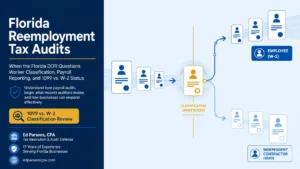
The most frequent trigger is worker classification. When a business treats workers as independent contractors rather than employees, the Florida Department of Revenue examines whether employment taxes should have been withheld on those payments. Small and mid-sized businesses, startups. Professional services firms that rely heavily on contractors carry elevated audit risk for exactly this reason.
What Happens After a Florida Reemployment Tax Audit Finding?
The consequences extend beyond the state level. Florida reemployment tax audits are conducted by the Florida Department of Revenue, with findings that can be reported to the IRS. A state-level finding can open the door to federal exposure back taxes, penalties, and interest at both levels simultaneously.
Common audit triggers Florida businesses should recognize:
Workers classified as contractors who perform core business functions
Inconsistent payroll records or missing documentation
Discrepancies between reported wages and actual payments
High contractor-to-employee ratios relative to industry norms
How Does Worker Classification Drive Audit Risk in Florida?
How to Avoid Reemployment Tax Audits starts with understanding what triggers them. Florida reemployment tax audits center on how businesses classify, pay, and report their workers and misclassification is the single most common entry point for an audit examination.
Which Types of Florida Businesses Face the Highest Audit Risk?
Businesses that rely heavily on independent contractors carry elevated audit risk in Florida. Startups, tech companies, and professional services firms are among the most frequently examined, precisely because contractor-heavy models create the classification gaps that auditors are trained to find. A software firm in Tampa that pays a dozen developers as 1099 contractors looks very different to an auditor than a traditional employer with W-2 staff. Even if the day-to-day work is identical.
The pattern is consistent across industries. Small and mid-sized businesses in Florida that shift payroll costs off the books through contractor arrangements often discover, too late, that the Florida Department of Revenue sees those arrangements differently.
What Are the Real Stakes of Getting Worker Classification Wrong?
The consequences extend well beyond a corrected tax bill. A Florida reemployment tax audit can produce:
Back taxes owed on wages that were never reported as payroll
Penalties and interest that compound the original liability
Loss of the business’s earned tax rate, which can significantly increase future reemployment tax costs
Felony exposure in the most serious cases of willful misclassification
These outcomes are not theoretical. They represent the documented range of consequences that Florida businesses face when an audit concludes unfavorably.
Worker classification is not a paperwork formality. It is a substantive legal determination, and Florida enforces it aggressively. Businesses that treat contractor status as a default cost-saving choice. Rather than a defensible compliance position are the ones most likely to receive a Notice of Intent to Audit.
What Recordkeeping Practices Reduce Florida Audit Exposure?
Strong recordkeeping is the single most effective defense against a Florida reemployment tax audit. Businesses that maintain organized, accurate payroll records give auditors less room to find discrepancies. And give themselves a clear path to resolving any questions that do arise.
Every Florida business carries a legal obligation to contribute to the state’s reemployment tax fund. That obligation varies based on payroll size and the history of claims filed by former employees. Means the records a business keeps directly shape its tax rate and its audit risk. Gaps in documentation do not just create inconvenience they create liability.
Why Does Accurate Payroll Documentation Matter for Florida Businesses?
The Florida Department of Revenue treats audits as an opportunity to help businesses identify. Correct bookkeeping problems before those problems compound into larger tax liabilities. Businesses that file reports late, pay incorrectly. Fail to document worker classifications accurately face penalties and interest that proper recordkeeping prevents. The Department’s stated goal is to help Florida businesses avoid those costs. But that help only works when records exist to review.
What Records Should Florida Employers Maintain?
Consistent documentation across the following areas reduces audit exposure significantly:
Payroll records – gross wages, pay periods, and employee counts for every quarter
Worker classification files-contracts, invoices, and evidence supporting independent contractor status
Tax filing history – copies of all reemployment tax returns and payment confirmations
Claim history – records of former employees who filed for reemployment benefits
Disorganized records are the most common trigger for expanded audit scope. Florida businesses that treat recordkeeping as an ongoing discipline rather than a pre-audit scramble. Position themselves to respond to any Department inquiry with confidence. Ed Parsons CPA, based in Doral, FL, assists Florida businesses in reconstructing filing history. Organizing compliance documentation before an audit escalates.
Which Filing and Reporting Habits Prevent Florida Audit Triggers?
Consistent, accurate filing habits are the most direct way businesses reduce exposure to a Florida reemployment tax audit. The Florida Department of Revenue conducts these audits as systematic checks on payroll practices, worker classification. Tax reporting and disorganized records are the fastest path to scrutiny.
Reemployment tax– formerly called unemployment tax funds temporary financial support for Florida workers who lose their jobs. Every Florida business contributes to that fund, and the Department of Revenue audits to confirm those contributions are calculated and reported correctly.
What Does the Florida Department of Revenue Actually Look For?
Auditors focus on whether reported payroll figures match actual compensation paid, whether worker classifications are consistent. Whether quarterly filings align with underlying records. Gaps between these data points are what trigger deeper examination.
How to Avoid Reemployment Tax Audits Through Better Record-Keeping
Strong filing habits address the most common audit triggers before an auditor ever arrives. Businesses that treat compliance as an ongoing practice. Rather than a quarterly scramble build a defensible record over time.
Key habits that reduce audit risk include:
Filing quarterly reemployment tax returns on time, without gaps or amended corrections that draw attention
Maintaining consistent worker classification records that match how workers are actually paid and supervised
Reconciling payroll totals across all internal records before each filing period closes
Retaining supporting documentation payroll registers, contractor agreements, and payment records for each reporting period
The Florida Department of Revenue frames audits as an educational process, designed to help businesses identify bookkeeping problems before those problems compound into larger liabilities. Businesses that approach compliance with that same mindset treating each filing as a structured review of their own records. Are far less likely to surface the inconsistencies that prompt a formal audit notice.
When Should Florida Businesses Seek Professional Tax Guidance?
Florida businesses should seek professional tax guidance the moment a Notice of Intent to Audit arrives from the Florida Department of Revenue for reemployment tax. Waiting to respond, or treating the notice as routine paperwork, puts the business at a serious disadvantage before the audit even begins.
Is a Florida Reemployment Tax Audit More Serious Than a Standard Tax Review?
A Florida reemployment tax audit is not a routine paperwork review. The stakes are real back taxes, penalties, interest, loss of an earned tax rate. In some cases felony exposure. Businesses that arrive unprepared face consequences that compound quickly and are difficult to reverse once the audit is underway.
What Types of Issues Warrant Outside Help?
Not every payroll question requires outside assistance, but certain situations clearly do:
Receipt of a formal Notice of Intent to Audit from the Florida Department of Revenue
Worker classification decisions that may not hold up under scrutiny
Gaps in payroll records or inconsistent reporting across prior periods
Uncertainty about which workers should have been reported as employees
Edward Parsons, CPA is a Doral, FL-based practice available to serve Florida businesses navigating reemployment tax audits and related payroll compliance issues. The firm provides senior-level guidance directly, without routing clients through junior staff. A meaningful advantage when the facts are complex and the timeline is short.
Understanding how to avoid reemployment tax audits starts with recognizing when the situation has moved beyond internal handling.
Reemployment tax audits rarely arrive without warning signs. Misclassified workers, inconsistent wage reporting, and late filings are the patterns that draw scrutiny. Addressing those vulnerabilities before an auditor does is the clearest path to staying out of trouble. Accurate worker classification, timely returns, and clean payroll records form the foundation of a defensible position. When the facts are organized and the filings are current, an audit becomes a manageable review rather than an open-ended exposure.
FAQ
What is the most common trigger for a Florida reemployment tax audit?
Worker misclassification triggers audits most often. The Florida Department of Revenue examines whether businesses that treat workers as independent contractors owe unpaid employment taxes on those payments.
What records does the Florida Department of Revenue review during an audit?
Auditors review payroll records, tax filings, and wage reports. They look closely at worker classification decisions and whether the correct taxes were reported and paid.
How does Edward Parsons CPA help Florida businesses avoid reemployment tax audits?
Edward Parsons, a CPA based in Doral, FL, ensures proper recordkeeping. Reduces audit risk significantly for Florida businesses facing reemployment tax compliance challenges.