Skip to content
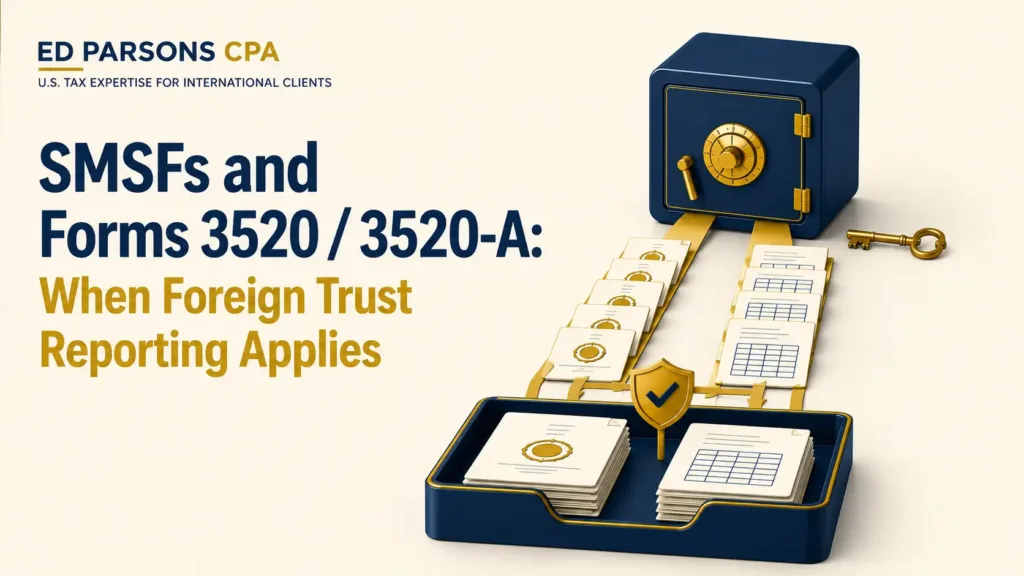
An SMSF is frequently analyzed as a foreign trust for U.S. purposes because it is a trust organized and controlled outside the United States. When a U.S. person is treated as its owner, Form 3520 and Form 3520-A can both apply, unless an IRS relief framework excuses them. The answer is condition by condition, not automatic. How the U.S. treats the fund itself is in U.S. tax on Australian superannuation.
You set up an SMSF because control made sense in Australia. Then someone mentioned that the U.S. may treat your fund as a foreign trust, and suddenly two forms you had never heard of, Form 3520 and Form 3520-A, entered the conversation.
The concern is legitimate, but it is not a reason to panic. The analysis runs in a specific order: is the fund a foreign trust, who is treated as its owner, which forms apply, and does a relief framework excuse them. This article walks that order.
Why the U.S. Asks Whether Your SMSF Is a Foreign Trust?
U.S. rules classify arrangements by structure, not by the label another country uses. An SMSF is, in legal form, a trust: there is a deed, a trustee, and members who benefit. It is organized in Australia, administered under Australian law, and sits outside the supervision of any U.S. court.
Stack those facts together and the common starting point for U.S. purposes is a foreign trust. That starting point is one branch of the broader question of how the U.S. classifies Australian super funds, where mainstream APRA-regulated funds and SMSFs can head in different directions.
Grantor Trust Status: Why Control and Contributions Matter
Calling the fund a foreign trust does not, by itself, decide who reports what. The grantor trust rules ask a second set of questions: who put the money in, and who controls it. For a typical SMSF, the facts tend to stack the same way:
- You transferred your own money into the fund, and contributions and rollovers both count as transfers.
- You serve as trustee, or as a director of the corporate trustee.
- You and your family are the members who benefit from the fund.
- The fund operates entirely under Australian law, outside U.S. court supervision.
When those facts line up, the frequent result is that the member is treated as the owner of some or all of the fund’s income, and the two forms come into scope. Amounts traceable to an employer can point parts of the analysis in a different direction, which is one reason mixed funds deserve careful review rather than a blanket answer.
Form 3520 and Form 3520-A: Who Files What
The two forms are a pair, and the IRS describes the framework on its foreign trust reporting page. Form 3520 is the U.S. person’s report: transfers into the trust, ownership under the grantor rules, and distributions received. Form 3520-A is the trust’s own annual return, covering its income, its balance sheet, and statements for its owners and beneficiaries.
Here is the mechanic that catches SMSF members. A foreign trust rarely files Form 3520-A on its own, and when it does not, the Form 3520-A instructions put the job on the U.S. owner, who attaches a substitute Form 3520-A to their own Form 3520. When you are the trustee, both reports land on your desk either way. The trust’s return also runs on an earlier clock than most personal filings, which is where the first missed deadline usually happens.
Here is how the two filings compare side by side.
| Factor | Form 3520 | Form 3520-A |
| Who files it | The U.S. person who owns or transacts with the trust. | The foreign trust itself, through its trustee. |
| What it reports | Transfers into the trust, ownership under the grantor rules, and distributions out. | The trust’s income, balance sheet, and statements for owners and beneficiaries. |
| Typical due date | Runs with your income tax return timeline. | The 15th day of the 3rd month after the trust’s year end. |
| If the trust does not file | Not applicable. This is your own filing. | The U.S. owner attaches a substitute Form 3520-A to Form 3520. |
| Penalty base if missed | Greater of $10,000 or 35 percent of certain reportable amounts. | Greater of $10,000 or 5 percent of trust assets treated as owned. |
| Measurement | Measures the owner’s transactions and ownership for the year. | Measures the trust’s own tax year from the inside. |
The Relief Framework: Rev. Proc. 2020-17
The IRS created a relief framework, Rev. Proc. 2020-17, that can excuse eligible individuals from filing Forms 3520 and 3520-A for certain tax-favored foreign retirement trusts. The conditions include, among others, that the fund is tax-favored under local law, that it reports annually to the local tax authority, that withdrawals are tied to retirement, disability, or hardship, and that contributions are limited, whether by reference to earned income or by caps such as USD 50,000 per year or USD 1,000,000 over a lifetime.
Some SMSF fact patterns can fit. Many strain against the conditions, and contribution activity is a frequent friction point, since large super contributions can affect eligibility on their own. Eligibility also depends on the individual’s own compliance history, not just the fund’s design.
One more distinction matters: this is reporting relief, not tax relief. A fund that qualifies can still raise U.S. income questions. Whether the fund’s earnings are taxable to you is a separate analysis with its own facts. Higher earners should also read high income, large super contributions and Form 3520-A risk, because contribution levels can switch that relief off.
What Missing These Forms Can Cost
The penalty structure is why the question deserves attention, even though fear is the wrong frame. If a filing was required and missed, the initial penalty for Form 3520 can be the greater of $10,000 or 35 percent of certain reportable amounts, and for Form 3520-A the greater of $10,000 or 5 percent of the trust assets treated as owned. Each form and each year stands on its own.
A required but unfiled foreign trust form can also hold the audit window open on the entire return until it is filed. Reasonable cause relief exists, but it is narrow and fact-driven, not a form you tick.
Those penalties attach to forms most SMSF members have never heard of, and Form 3520-A is rarely the only one. The same fund can pull its investments into the PFIC rules, and the same family often has a company or trust sitting beside it. I cover those three, and the route back for years already missed, in a series of six short emails. Send me the Australia and U.S. tax emails if you would like them. You will get a confirmation email first; the series starts only once you click it, and you can unsubscribe at any point.
Common Mistakes SMSF Members Make With These Forms
- Assuming the super fund label means retirement account rather than trust for U.S. purposes.
- Treating Rev. Proc. 2020-17 as automatic coverage for every SMSF instead of a condition by condition test.
- Filing Form 3520 but skipping the substitute Form 3520-A, or the reverse.
- Missing the trust return’s earlier due date because it does not match the personal filing calendar.
- Reading reporting relief as tax relief and leaving fund income off the analysis entirely.
- Correcting the current year while prior unfiled years sit untouched.
How to Approach This Before the IRS Does
Assemble the facts in order: the trust deed and trustee structure, contribution history by source, rollovers, what the fund holds, and which years were filed without this analysis. The holdings matter more than most members expect, because PFICs inside superannuation and SMSFs can add a separate filing layer on top of the trust forms.
If several years are already missing, quietly attaching forms going forward is rarely the answer. Multi-year gaps are usually addressed through a structured catch-up path, and the order of corrections matters.

This is exactly the work behind a Form 3520 CPA Filing engagement: classify the fund, determine who is treated as owner, apply the relief conditions honestly, and prepare the filings that survive review. Ed Parsons, CPA handles this analysis for SMSF members across the U.S. and abroad.