Skip to content
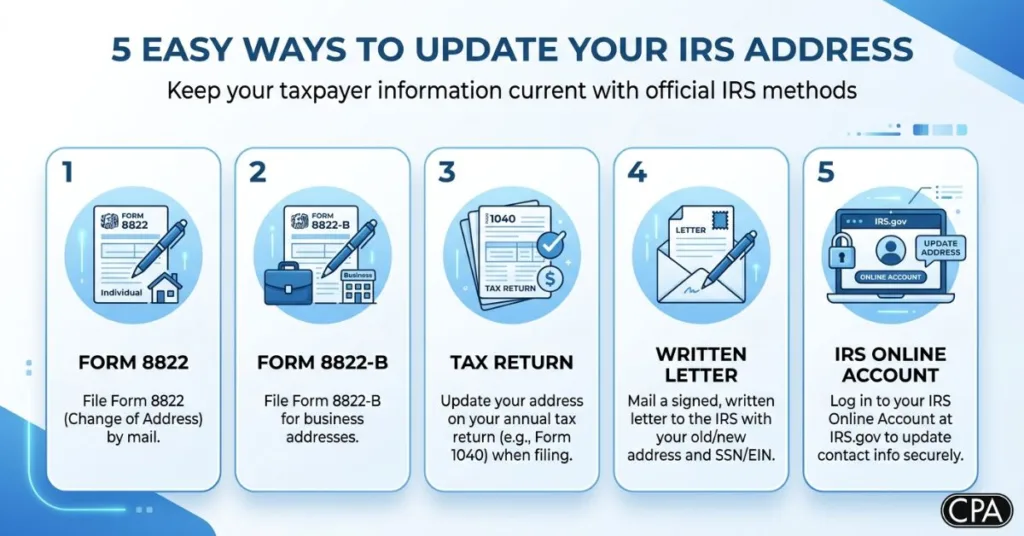
An outdated address on file with the IRS can cause you to miss critical notices about audits, balances due, liens, and levies. You can update your address by filing IRS Form 8822, entering your new address on your next federal tax return, notifying the IRS in writing, or updating it through your IRS Online Account.
Every year, the IRS sends more than 200 million notices and letters to individual and business taxpayers. These mailings range from routine refund confirmations to urgent collection actions that carry strict response deadlines. When a taxpayer’s address is outdated, that correspondence goes to the wrong place, and the consequences can escalate quickly.
A Treasury Inspector General for Tax Administration (TIGTA) report found that approximately 14.4 million pieces of undeliverable mail were returned to the IRS in a single fiscal year, costing an estimated $43 million in postage and processing alone. For the taxpayers on the receiving end of those lost notices, the financial impact can be far greater: missed deadlines, mounting penalties, and enforcement actions that could have been avoided.
This guide explains why keeping your address current with the IRS is essential, the real-world risks of failing to do so, and the specific steps you can take to update your records.
Why Your IRS Address Matters More Than You Think?
The IRS relies on your address of record to deliver every piece of official correspondence. Unlike a private company, the IRS is not required to call, email, or track you down through social media. Mail is the agency’s primary communication method, and your legal obligations often begin the moment a notice is sent, not when you actually read it.
This means that if the IRS mails a notice to your last known address and you never receive it, you can still be held responsible for any deadlines, payments, or responses outlined in that notice. Courts have consistently upheld this standard. The IRS satisfies its notification obligation by sending correspondence to the taxpayer’s last known address on file.
What Can Go Wrong When Your Address Is Outdated?
The risks of an outdated IRS address extend well beyond a delayed refund check. Here are the most common consequences:
Missed Audit Notices
If the IRS initiates a correspondence audit and your initial contact letter is sent to an old address, you may never know the audit is happening. According to the National Taxpayer Advocate, approximately 14 percent of taxpayers who did not respond to IRS correspondence audits may not have received the initial notice because it was returned as undeliverable. Without a response, the IRS proceeds to assess the proposed changes and issues a Statutory Notice of Deficiency, which can result in additional taxes, penalties, and interest.
Escalating Collection Actions
When collection notices go to an invalid address, the IRS continues sending subsequent notices in the collection stream to the same address. This includes the Final Notice of Intent to Levy and your Collection Due Process (CDP) hearing rights notice. If you never receive these, you lose the opportunity to negotiate a payment plan, request an Offer in Compromise, or exercise your appeal rights before enforcement begins. The IRS can then use your lack of response as justification for lien and levy action. Understanding your rights under the Collection Statute Expiration Date (CSED) becomes critical at this stage, because tolling events triggered by missed deadlines can extend the IRS’s collection window.
Lost or Delayed Tax Refunds
If you are owed a refund and the check is mailed to an old address, it may be returned to the IRS as undeliverable. While the IRS makes efforts to locate taxpayers with pending refunds, the process can take months. During that time, you are without money that rightfully belongs to you.
Federal Tax Lien Filing Without Your Knowledge
The IRS can file a Notice of Federal Tax Lien without advance approval from a court. Letter 3172 notifies you of the lien filing and your right to request a CDP hearing within 30 days. If that letter goes to the wrong address, you may not learn about the lien until it surfaces on a credit report or blocks a real estate transaction. The Taxpayer Advocate Service recommends that taxpayers keep their address current with the IRS to preserve their right to appeal lien filings.
How to Update Your Address with the IRS?
The IRS offers several ways to update your address. The most common method for individuals is IRS Form 8822. Choose the method that best fits your situation.
| Method | How It Works | Best For |
| IRS Form 8822 | Mail completed form to the IRS address listed in the instructions based on your old state of residence. Processing takes 4 to 6 weeks. | Individuals updating a personal address separate from a tax return filing |
| IRS Form 8822-B | Used for businesses and entities with an EIN. Changes in responsible parties must be reported within 60 days. | Business owners, LLCs, corporations, partnerships, and nonprofits |
| Your Next Tax Return | Enter your new address on your federal return (Form 1040). The IRS updates your records when the return is processed. | Taxpayers whose next filing is coming up soon |
| Written Notification | Send a signed letter with your full name, SSN or ITIN, old address, and new address to the IRS service center where you filed your last return. | Taxpayers who prefer a simple written request |
| IRS Online Account | Log in at IRS.gov, verify your identity, and update your address electronically. | Taxpayers comfortable with digital tools who want faster processing |
Special Situations That Require Extra Attention
Joint Filers with Separate Addresses
If you filed a joint return and now live at separate addresses, each spouse should submit a separate Form 8822 or written notification. Indicate on the form that you filed jointly for the most recent tax year and that each spouse now has a different address.
Power of Attorney or Third-Party Designees
If you have authorized a CPA or tax professional to act on your behalf using Form 2848 (Power of Attorney), that representative can submit the address change for you. This is especially useful when you are already working with a professional on an active IRS matter such as an installment agreement, audit, or lien negotiation.
International and Expat Taxpayers
U.S. citizens living abroad face additional address challenges. The IRS does not always have reliable foreign address data, and international mail delivery adds transit time. Expat taxpayers should update their address promptly and consider authorizing a stateside representative to receive and respond to IRS correspondence on their behalf.
Why a USPS Change of Address Is Not Enough?
Many taxpayers assume that filing a change of address with the United States Postal Service (USPS) will automatically update their IRS records. It does not. While the IRS does receive some address updates from the USPS National Change of Address (NCOA) database, this process is not comprehensive.
USPS mail forwarding typically expires after 12 months. After that, IRS correspondence sent to your old address will be returned to the agency as undeliverable. The IRS may then continue to send subsequent notices to the same invalid address, including time-sensitive collection and appeal notifications. Updating your address directly with the IRS ensures your records are current regardless of your USPS forwarding status.
Proactive Steps to Stay Ahead of IRS Communications
Keeping your IRS address updated is one piece of a larger compliance strategy. Consider these additional steps to ensure you never miss important correspondence:
- Monitor your IRS Online Account regularly to check for new notices, account balances, and payment activity.
- Enroll in electronic notifications through your IRS Online Account to receive alerts when new correspondence is available.
- Keep copies of all address change submissions (Form 8822, letters, or online confirmations) as proof of notification.
- Request and review your IRS account transcripts periodically to verify that your address, filing status, and payment history are accurate.
- Work with a qualified CPA experienced in IRS tax resolution who can monitor your IRS account and respond to notices on your behalf.
Frequently Asked Questions
Can I update my IRS address online?
Yes. Taxpayers with a verified IRS Online Account at IRS.gov can update their address electronically. You will need to complete identity verification to access your account.
How long does it take the IRS to process an address change?
Form 8822 and Form 8822-B typically take 4 to 6 weeks to process. Address changes submitted on a tax return are processed when the return is filed. Online updates may be reflected more quickly.
What if I already missed an IRS notice because of a wrong address?
Contact a qualified tax professional immediately. Depending on the notice type, you may be able to request a penalty abatement, reopen an audit through reconsideration, or exercise late appeal rights. The sooner you act, the more options are available.
Do I need to update my address with both the IRS and my state tax agency?
Yes. The IRS and state tax authorities maintain separate records. You should update your address with each agency individually.