Skip to content
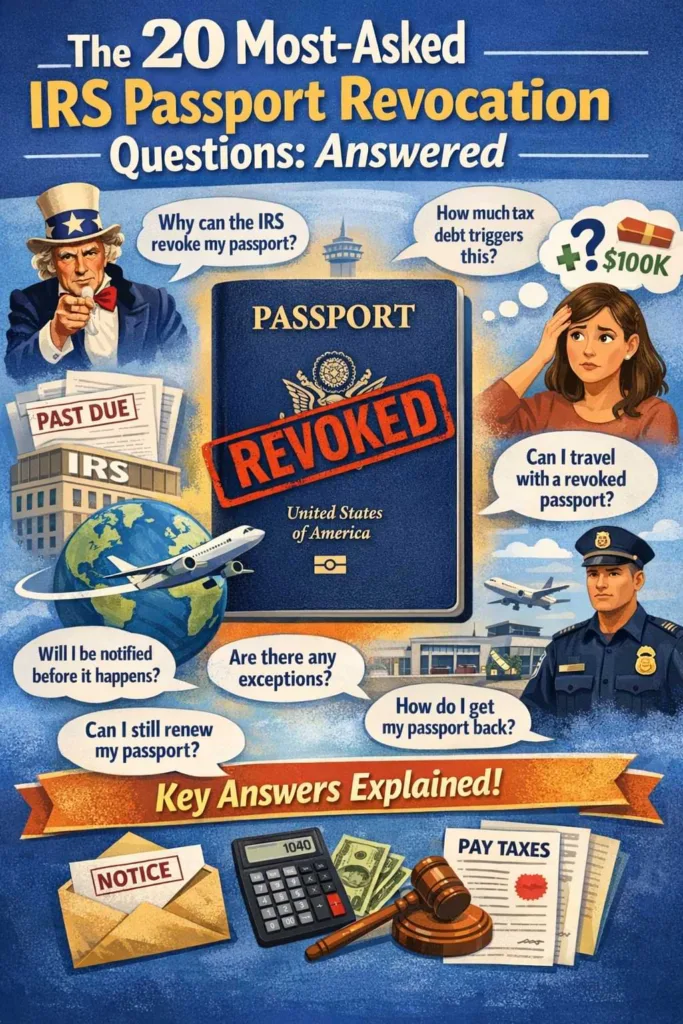
The IRS passport revocation program blindsides more Americans every year. People show up at airports and consulates abroad only to discover their travel privileges are frozen over an unresolved tax debt. The 20 questions below are drawn from real community discussions on Reddit, Quora, and taxpayer forums. If you received a CP508C notice or a Letter 6152, read every word.
The 20 Most-Asked IRS Passport Revocation Questions: Answered
1. What exactly is IRS passport revocation?
Passport revocation means the U.S. Department of State cancels your existing passport because the IRS has certified you as having a “seriously delinquent tax debt.” The IRS does not revoke the passport itself; it certifies the debt to the State Department, which then acts. Authority comes from IRC Section 7345, enacted under the FAST Act of 2015.
2. How much do I have to owe before the IRS can do this?
For 2025, the threshold is $64,000 in total unpaid federal tax debt, including all assessed penalties and interest. This amount is adjusted annually for inflation. It is not just income tax; it also includes Trust Fund Recovery Penalties, business taxes you are personally liable for, and civil penalties. Source: IRS.gov Passport Program
3. I owe $70,000 but I’m on a payment plan. Will my passport be revoked?
No, and this is one of the biggest misunderstandings in every forum thread. If you have an IRS-approved installment agreement in good standing, your debt is no longer classified as “seriously delinquent.” The IRS is legally required to decertify your debt to the State Department once a payment plan is accepted. The key word is accepted; a pending application alone does not protect you.
4. What is Notice CP508C and what do I do when I get it?
CP508C is the IRS’s formal written notification that your tax debt has been certified to the State Department. Your passport may be denied or revoked. Do not ignore it. Call the number printed on the notice, arrange resolution (payment in full, installment agreement, or Offer in Compromise), and request confirmation in writing. Acting within 30 days is critical. Full details at IRS.gov: Understanding your CP508C notice
5. What is Letter 6152 and is it different from CP508C?
Yes. Letter 6152 (Notice of Intent to Request U.S. Department of State Revoke Your Passport) comes before the State Department is contacted about revocation. It gives you 30 days to call the IRS and resolve your account. CP508C confirms the certification has already been sent to the State Department. If you received a 6152, you still have a window to stop revocation from happening.
6. Can the IRS take my passport away without any warning?
Not in the standard process. The IRS is required to issue CP508C before any passport action is taken on new or renewal applications. Before pursuing revocation of an existing passport, they must also send Letter 6152, giving you at least 30 days to respond. The exception: the State Department retains sole authority to revoke a passport on its own initiative without additional notice.
7. My passport was revoked and I’m currently abroad. What happens now?
If you are overseas when your passport is revoked, the State Department may issue you a limited-validity passport that permits return travel directly to the United States only. You will not be able to use it for onward international travel. Contact the nearest U.S. embassy or consulate immediately and contact the IRS at the international line: 1-267-941-1004. Source: travel.state.gov – Passports and Unpaid Federal Taxes
8. I just received CP508C. Can I still use my current passport today?
Yes: receiving CP508C does not immediately cancel your existing passport. You will receive written notification from the State Department separately if and when your passport is actually revoked or denied. However, do not delay. The longer you wait, the more likely revocation becomes. See our dedicated page on IRS Passport Revocation Help for next steps.
9. How long does it take to get decertified after I set up an installment agreement?
The standard timeline is 30 days from the date the IRS processes your agreement in their system (confirmed by a TC 971 AC 063 transaction code in IDRS). After the IRS sends decertification to the State Department, allow an additional 2–3 weeks for the State Department to update its systems. Total realistic timeline: 6–10 weeks from the date you enter the agreement.
10. I have an urgent flight in 3 weeks. Is there a faster process?
Yes. If your international travel is within 45 days, you may qualify for expedited decertification. The IRS can shorten the normal 30-day processing window to 9–16 days. You must provide: (1) proof of travel: a flight itinerary, hotel reservation, or cruise ticket, and (2) a copy of the State Department’s denial or revocation letter if one has been issued. Call the IRS passport line at 855-519-4965 and tell them explicitly about your travel date. IRS IRM 5.19.25
11. Will paying my balance down below $64,000 automatically fix the problem?
No, this is a costly misconception that circulates in tax forums. Paying down below the threshold does not trigger automatic decertification once you have already been certified. To reverse certification, you must either pay the debt in full, make it legally unenforceable, or enter a formal resolution: an installment agreement, Offer in Compromise, or a Department of Justice settlement.
12. Does an Offer in Compromise stop passport revocation?
Yes, both an accepted Offer in Compromise and an OIC that is actively under IRS consideration can stop certification or trigger decertification. This is one of the reasons submitting a well-documented OIC promptly is so valuable. Be aware that an OIC takes months to be accepted, so this is not an immediate fix if your travel is imminent. If you also have a federal tax lien, read our guide: Federal Tax Lien: Now What?
13. What are the statutory exceptions: situations where the IRS cannot certify me?
The IRS is prohibited from certifying your debt if any of the following apply:
- You have an open installment agreement in good standing
- You have an accepted or pending OIC
- Collection is suspended due to a CDP (Collection Due Process) hearing
- You have requested innocent spouse relief related to the same debt
- You are a victim of IRS-identified tax-related identity theft
- You are serving in a designated combat zone
- The IRS has determined you are Currently Not Collectible (CNC) due to hardship
- A federally declared disaster has suspended collection in your area
If one of these applies to your situation and the IRS certified you anyway, that is an erroneous certification; see Question 16.
14. Does Currently Not Collectible (CNC) status protect my passport?
Yes. CNC status (where the IRS determines you cannot currently pay) is a statutory exclusion from passport certification. If you are already CNC and received a CP508C, that may be an erroneous certification that needs to be challenged. Note that CNC does not forgive the debt; it suspends active collection while the balance continues to accrue interest.
15. What is a Collection Due Process (CDP) hearing and how does it relate to passport revocation?
A CDP hearing, triggered by filing Form 12153 in response to a levy notice, suspends IRS collection activity, including passport certification. While a CDP is pending, the debt is excluded from the seriously delinquent category. This is a legitimate time-buying strategy, but it must be requested within the deadline on your levy notice. Learn more in our LT11 / Letter 1058 CDP Ultimate FAQ.
16. What if the IRS certified me by mistake: the debt is wrong?
File suit in U.S. Tax Court or a U.S. District Court under IRC Section 7345(e). There is no internal IRS administrative appeal process for passport certification errors; the statute does not provide one. The State Department cannot be sued for acting on an erroneous IRS certification. Contact the IRS on the CP508C number first to try to resolve informally, but court is your backstop.
17. If I pay in full today, how long before I can renew my passport?
Once the IRS processes your payment and confirms the debt is satisfied, they must notify the State Department within 30 days (CP508R, the Reversal of Certification notice). After that, the State Department typically takes 2–3 additional weeks to update its systems. Realistically, budget 6–8 weeks from full payment to a clean passport application. For expedited situations, submit proof of payment via the IRS Document Upload Tool for faster processing.
18. Can my spouse’s passport be revoked for my tax debt on a joint return?
The certification applies to the individual taxpayer named on the delinquent tax debt. If both spouses filed jointly and both are assessed the same liability, both could potentially be certified. However, if your spouse has no personal liability for the debt (for example, through innocent spouse relief), their passport should not be affected. If you are dealing with this scenario, also review the CSED implications in our IRS CSED Ultimate FAQ
19. I moved and never got the CP508C. Can the IRS still certify me?
Yes, the IRS certifies based on the address of record on your tax account. This is why many taxpayers first learn about certification at the passport office or airport. If you have moved, update your address immediately using Form 8822. The law does not require the IRS to confirm delivery before certifying.
20. Is the IRS using this program more aggressively in 2025 and 2026?
Yes. Practitioners are reporting that the IRS is applying the passport program to lower effective balances than in prior years, and AI-assisted collection matching is accelerating certification referrals. The program has collected billions since its 2018 launch. Do not assume that a balance “just over” the threshold is too small to trigger action. For a deeper look at advanced resolution strategies, see IRS Passport Revocation: Definitive Guide, Part II.
Bottom Line
IRS passport revocation is not a scare tactic; it is an active, expanding enforcement program that affects everyday taxpayers, expats, and business owners alike. Every situation above has a resolution path, but most require moving fast with paperwork the IRS will actually accept.
If you received a CP508C or Letter 6152, the time to act is today, not when your flight is three days away.
Authoritative References
- IRS – Revocation or Denial of Passport in Cases of Certain Unpaid Taxes
- IRS – Understanding Your CP508C Notice
- IRS Internal Revenue Manual 5.19.25 – Passport Program
- Taxpayer Advocate Service – Don’t Let a Passport Revocation Ruin Your International Travel Plans
- U.S. Department of State – Passports and Unpaid Federal Taxes
- U.S. Code – IRC Section 7345, Revocation or Denial of Passport in Case of Certain Tax Delinquencies
- IRS – Understanding Your CP508R Notice (Reversal of Certification)