Skip to content
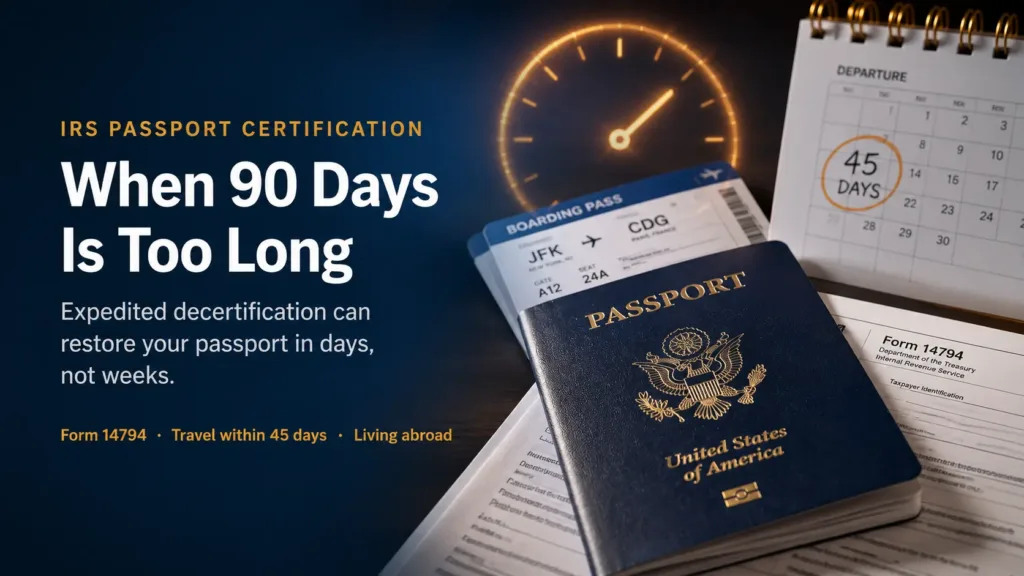
After the IRS certifies seriously delinquent tax debt, the State Department typically holds a passport application open for 90 days to allow resolution. But standard decertification can take up to 30 days after the qualifying event, plus State Department processing time, which can run past an imminent trip. Expedited decertification using Form 14794 compresses that timeline to a matter of days, and is available to taxpayers with travel scheduled within 45 days or those living abroad. When travel is close, the standard 90-day cushion is not the safety net it appears to be, and the order in which steps are completed determines whether you make your flight.
The 90-Day Clock Is Not as Generous as It Sounds
When the State Department receives a tax debt certification and you apply for a passport or renewal, it generally holds the application open for 90 days. That window exists to let you resolve the debt or correct an error.
On paper, 90 days sounds like plenty. In practice, the clock is consumed by the steps required to qualify for reversal: pulling transcripts, choosing a resolution path, getting it approved, and waiting for the IRS to post the reversal.
The 90-day window starts from the State Department’s action, not from the CP508C notice itself. For what that notice means when it arrives, see Received a CP508C Notice? Your Passport May Be Revoked or Denied.
Why Standard Decertification Can Still Be Too Slow?
Reversal is a two-agency process. First, you must put your debt into a qualifying status. Then the IRS posts the reversal and notifies the State Department, which processes the removal.
The IRS aims to reverse certification within 30 days of the qualifying event. After that, the State Department receives systemic notification roughly two processing cycles later. Stacked together, weeks can pass between resolving your debt and actually holding a usable passport.
The qualifying event has to happen first. The five paths that trigger reversal are covered in CP508R Reversal: The Five IRS Resolution Paths That Restore Your Passport. Expedited decertification only helps once one of those paths is in place.
How Expedited Decertification Works?
Expedited decertification is handled through Form 14794, Expedited Passport Decertification. Once a taxpayer qualifies for reversal and has an urgent need, the IRS prepares and submits the form with managerial approval, and the State Department processes the removal in roughly 24 to 48 hours.
The form is not something a taxpayer files independently in the usual sense. It is prepared by the IRS function handling the case, which is exactly why early and organized engagement matters: someone has to drive the request, confirm the qualifying status posted, and supply the required identifiers.
The mechanics of how the IRS and State Department exchange certification data are covered in How the IRS Certifies Tax Debt to the State Department, which helps explain why timing the reversal correctly is so important.
The Two Situations That Qualify for Expedited Processing
Not everyone gets expedited treatment. Two situations qualify.
- Travel scheduled within 45 days. The taxpayer must provide proof of travel and the State Department denial letter, which contains the passport application number needed to process the request.
- Residence outside the United States. Taxpayers living abroad with an urgent need do not have to provide proof of travel or a denial letter, because the loss of a passport while abroad is treated as an inherent emergency.
For taxpayers building their life around a foreign passport, this distinction is critical. The full picture of how revocation hits expats is in Living Abroad With IRS Debt: When Passport Revocation Hits Hardest.
Standard vs Expedited: The Timeline Compared
| Stage | Standard Decertification | Expedited (Form 14794) | Measurement |
| IRS reversal after qualifying event | Up to 30 days | Requested as soon as criteria met | Days to IRS action |
| State Department processing | About two cycles after the IRS posts the reversal | Around 24 to 48 hours once received | Days to passport release |
| Proof of travel required | Not applicable | Yes, if in the U.S.; no, if abroad | Documentation burden |
| Best for | No imminent travel | Travel within 45 days or living abroad | Urgency fit |
| Risk if you wait | Travel window may close | Minimized when filed early | Schedule protection |
The expedited path does not skip the work of qualifying for reversal. It compresses the agency processing time that comes after, which is usually where an imminent trip is lost.
Conversational Questions From Taxpayers Racing the Clock
- “I have a wedding abroad in three weeks and my passport was just denied. Is 90 days going to help me?”
- “I already set up an installment agreement. Why isn’t my passport back yet?”
- “I live in Spain and my passport expired. How do I get expedited handling without a trip booked?”
- “My resolution posted last week. How long until the State Department actually clears me?”
Common Mistakes That Cost Taxpayers Their Travel Window
- Treating the 90-day window as the time you have to start, rather than the time you have to finish
- Resolving the debt but not following up to confirm the IRS posted the reversal
- Failing to request expedited handling as soon as the qualifying status is in place
- Not having the State Department denial letter and passport application number ready (required for U.S. residents)
- Assuming the IRS will automatically expedite without anyone driving the Form 14794 request
- Booking travel before the reversal is confirmed and assuming it will all work out in time
Some taxpayers also discover that an exclusion would have prevented the block altogether. Those hardship paths are detailed in Hardship Exceptions to IRS Passport Revocation: Humanitarian and Emergency Cases.
What a Coordinated CPA Engagement Looks Like?
Expedited decertification is a race against a fixed travel date, and it has moving parts across two federal agencies. A CPA who handles these cases works the timeline backward from your trip.
That means pulling your transcripts immediately, confirming the certified balance and the qualifying exclusions, selecting the fastest resolution path your facts support, and getting the qualifying status posted. Only then does the expedited request make sense, with the passport application number and any required proof of travel assembled in advance.
The value is in sequencing. Resolving the debt and requesting expedited handling in the wrong order, or with missing identifiers, is how taxpayers lose days they cannot spare. A coordinated engagement keeps the steps in the right order and the documentation ready.
For a focused working session on your timeline and the fastest path for your situation, Personal IRS Tax Debt Coaching Call. For a full review of your account before you act, Personal CPA Tax Resolution Case Analysis.

Expedited Decertification FAQs

Talk to a CPA Before Your Travel Window Closes
Expedited decertification is a race against a fixed date, and the order of the steps decides the outcome. If you have travel approaching or you live abroad and your passport is at risk, the time to map the fastest path is now, not after the trip is days away.
Call (786) 265-8578 or visit the contact page to schedule a working session with Ed Parsons, CPA, who has 25+ years of IRS representation experience and can map your decertification timeline against your travel date.
External references: IRM 5.19.25 Passport Program and IRS Passport Revocation and Denial Program.