Skip to content

For U.S. citizens living abroad, IRS passport revocation under IRC Section 7345 is not just a travel inconvenience. A revoked passport can void a foreign residency permit, block a visa renewal, and end a foreign job within weeks. Expats also face a hidden risk: the CP508C notice is mailed to a last known U.S. address many of them no longer use, so the first sign of trouble can be a denied renewal at a consulate.
For most taxpayers, a revoked passport is a future travel problem. For a U.S. citizen living overseas, it can be an immediate threat to the legal right to stay where they live and work. If you are overseas and need the fastest route to a clean record, expedited decertification is the part to read first.
Expats are uniquely exposed to IRS passport certification, not because the rules differ, but because the consequences land harder and faster abroad. This article explains why, and what to do when you are thousands of miles from the IRS.
Why Expats Face the Sharpest Edge of Section 7345?
A passport is just a travel document for someone living in the United States. For an expat, it is often the legal foundation of their entire life abroad.
Many foreign residency permits, work visas, and bank accounts require a valid, unexpired U.S. passport. When the State Department revokes or limits that passport, the downstream effects can cascade through every part of an overseas life within weeks.
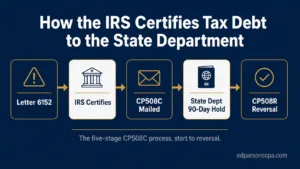
The underlying mechanism is the same one described in CP508C notice can lead to passport revocation. What changes for expats is the speed and severity of the fallout.
The Notice You May Never See
The IRS mails Notice CP508C to your last known address. For an expat who moved abroad years ago, that address may be a former home, a relative’s house, or a closed mailbox.
Because the IRS does not copy a power of attorney and does not email the notice, many expats learn about certification only when a consulate denies a passport renewal. By then, the certification is already active.
That is the version of this I see most often from overseas: nobody was hiding anything, the letter simply went to a house somebody sold a long time ago. Distance costs time at the far end too, because a reversal is not instant once the debt is dealt with and the wider timeline runs longer still. I wrote six emails on that timing and the rest of it, and you can have them sent to you. Confirming your address is the only step in between, and every email that follows has an unsubscribe link at the foot. If you are abroad and overdue a renewal, the consulate should not be where you find out.
The Limited-Validity Passport Trap
If you are outside the United States when certification takes effect, the State Department may decline to issue a full passport and instead offer a limited-validity passport good only for direct return to the United States.
That sounds like a safety valve, but for an expat it can be the opposite. Returning to the U.S. may mean abandoning a job, a lease, a residency permit, or a family situation that cannot simply be paused.
How the Same Notice Hits Differently Abroad?
The table below contrasts the experience of a domestic taxpayer with that of an expat facing the identical certification.
| Factor | Taxpayer Living in the U.S. | Taxpayer Living Abroad |
| Notice delivery | CP508C reaches the current home address | CP508C often goes to an old U.S. address the taxpayer no longer checks |
| First sign of trouble | The mailed notice itself | A denied renewal or application at a consulate or embassy |
| Travel impact | Blocks future international trips | Can strand the taxpayer or force a limited-validity return passport |
| Residency impact | None directly | Can void a residency permit or work visa tied to a valid passport |
| Measurement | Days to weeks before an upcoming trip | Often immediate, tied to a visa or residency renewal deadline |
| Resolution logistics | Standard IRS contact during business hours | Time zone gaps, mail delays, and limited consular help complicate the response |
The threshold and statute are identical in both columns. The difference is entirely in the consequences, which is why expats cannot afford to treat certification as a problem they will deal with on their next trip home.
Why Expat Tax Debt Builds Quietly?
Expats often accumulate seriously delinquent balances without realizing it. The foreign earned income exclusion, foreign tax credits, and foreign reporting forms create complexity that leads to missed filings and unexpected assessments.
Common sources of expat IRS debt:
- Returns filed late or not at all while living abroad
- Foreign income that was assumed to be fully excluded but was not
- Penalties for unfiled FBAR or foreign asset reporting forms
- Self-employment tax that the foreign earned income exclusion does not cover
- Years of accrued penalties and interest pushing the balance over the threshold
Because the threshold counts the total running balance, these accruals matter, seriously delinquent threshold is calculated for the full picture.
Common Mistakes Expats Make
- Assuming the IRS cannot reach a taxpayer living abroad
- Believing the foreign earned income exclusion eliminates all U.S. tax obligations
- Ignoring U.S. mail because the address is outdated
- Waiting until a passport renewal to address known IRS debt
- Accepting a limited-validity return passport without first exploring decertification
- Trying to negotiate with the consulate, which has no authority over the tax debt
Questions Expats Actually Ask
“I have lived abroad for years. Can the IRS still certify my debt?”
Yes. Section 7345 applies to U.S. citizens regardless of where they live. Living abroad does not exempt you from certification.
“My passport renewal was just denied at the embassy. What happened?”
A denial often means the IRS has already certified your debt. The consulate cannot fix it; only the IRS can reverse certification.
“Can I be forced to return to the United States?”
The State Department may offer only a limited-validity passport for direct return. You are not physically forced, but your travel options narrow sharply.
“I never received any IRS notice. Is that normal for expats?”
Unfortunately yes. The notice goes to your last known address, which is often outdated. Pulling current account transcripts is the only reliable way to confirm status.
What to Do From Overseas?
Distance does not change the resolution path, but it does raise the stakes on speed. The first move is to confirm whether certification has occurred and whether the underlying balance and collection actions actually meet the statutory requirements.
The review can be handled entirely remotely. It pulls current IRS account transcripts, confirms whether the debt was properly certified, and maps the fastest qualifying path to decertification, without requiring travel back to the United States. How certification actually happens is where that check starts. For the statutory basis behind the program, see what Section 7345 actually says, and for broader expat compliance support, the IRS tax resolution CPA service covers the underlying filings. The IRS maintains its passport revocation program page, and the State Department publishes its guidance for taxpayers abroad with delinquent tax debt.