Skip to content

What Are Key IRS Deadlines for International Tax Compliance?

Key IRS Deadlines for International Tax Compliance Explained
By Edward Parsons, CPA, Edward Parsons, CPA
If you hold foreign financial accounts, meeting IRS deadlines matters. Missed filings increase penalties and invite enforcement. This guide lays out the essential dates and reporting rules for FBAR and FATCA, explains the Streamlined Filing Procedures for late filers, and describes practical steps to limit exposure. Sections address FBAR and FATCA deadlines, Streamlined timelines, penalty risks, and mitigation options. For official IRS information on FBAR and FATCA compliance, visit the IRS FBAR Information Page.
Key Takeaways
What Are the Critical FBAR Filing Deadlines for U.S. Taxpayers?

The FBAR is reported on FinCEN Form 114 and is required when the aggregate value of foreign financial accounts exceeds $10,000 at any time in the calendar year. The return is due with a filing deadline of April 15, and the IRS provides an automatic extension to October 15. File the Form 114 on time to avoid civil penalties and enforcement risk. Official IRS guidance on FBAR filing deadlines can be found at the Report of Foreign Bank and Financial Accounts (FBAR) page.
What penalties occur if FBAR filing deadlines are missed?
Penalties for FBAR failures are substantial. Non-willful violations can result in civil penalties up to $10,000 per account per year. Willful violations carry steeper sanctions—the greater of $100,000 or 50% of the highest account balance. The IRS may also increase scrutiny or pursue enforcement. Taxpayers who qualify can sometimes reduce exposure using the Streamlined Procedures.
How Do FATCA Reporting Deadlines Affect International Filers?

FATCA requires Form 8938 when reporting thresholds are met. You file Form 8938 with your annual income tax return; the deadline aligns with the return—typically April 15—with an extension available to October 15 when applicable. Detailed information on FATCA filing and deadlines is maintained at the IRS FATCA page: FATCA Reporting.
What IRS penalties result from late FATCA reporting?
Late FATCA reporting carries an initial $10,000 penalty for failure to file Form 8938, followed by additional $10,000 increments for each 30-day period of continued non-compliance. These penalties can escalate quickly, so timely filing and accurate disclosure are critical.
What IRS Deadlines Govern the Use of Streamlined Filing Procedures?
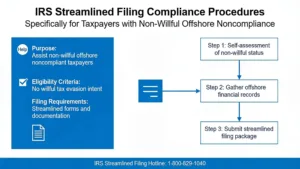
The Streamlined Filing Procedures offer a reduced-penalty path for taxpayers with non-willful omissions. Key filing requirements generally include three years of tax returns and six years of FBARs, with submissions due by the April 15 deadline and the usual extension to October 15. When properly used, Streamlined Filing can resolve past omissions without the heavier penalties tied to other programs.
When is it too late to use Streamlined Procedures for international filings?
Once the IRS opens contact about a potential non-compliance issue, the Streamlined route is typically no longer available. After IRS communication you must follow standard compliance channels, which often carry higher penalties. Act before any IRS outreach to preserve Streamlined options.
What Are the IRS Deadlines and Penalties for Delinquent International Tax Filings?
Delinquent international filings carry specific deadlines and fines. Forms like Form 5471 and Form 8938 are critical; failure to file can trigger substantial penalties, including a $10,000 penalty for each missing Form 5471. Not responding to IRS notices tends to increase fines and the likelihood of enforcement. Reviewing IRS notices will clarify deadlines and required actions.
What are typical IRS penalties and enforcement notices for ignored deadlines?
The IRS issues notices such as CP504 and CP508C to escalate collection. These notices can precede serious consequences, including passport-related actions for unresolved tax debt. Continued non-response raises the risk of larger penalties and potential criminal exposure. Respond promptly and document your actions.
How Can U.S. Taxpayers Protect Themselves Against International Tax Penalties?
Start by identifying all reportable accounts and deadlines. Use Streamlined Filing if you meet the criteria and have not been contacted by the IRS. Keep thorough records to support your disclosures. When liens, levies, or other collection issues arise, specialised relief procedures—such as those described in guidance on federal tax lien removal—may apply. The objective is to limit penalties and restore compliance in an organized way.
When should taxpayers seek professional assistance versus DIY filing?
Engage a qualified CPA or tax professional when your situation includes multiple foreign accounts, controlled foreign corporations, or unclear reporting history. Professional help reduces the risk of filing errors and missed disclosures that can trigger large penalties. For straightforward, low-risk cases, careful self-filing may suffice; for anything complex, obtain professional guidance early.
For tailored guidance, individuals may consider engaging the services of Edward Parsons, CPA, specializing in e-commerce and international tax compliance, to review personal situations and mitigate liability effectively.
Frequently Asked Questions
1. What are the consequences of not filing FBAR on time?
Failing to file FBAR on time can lead to large civil penalties. Non-willful failures may incur up to $10,000 per account per year. Willful failures can trigger penalties equal to the greater of $100,000 or 50% of the account’s highest balance. The IRS may also initiate audits or enforcement actions, so timely filing is the best protection.
2. Who qualifies for Streamlined Filing Procedures?
Streamlined Filing is intended for taxpayers whose omissions were non-willful and who have not been contacted by the IRS. Typical eligibility requires filing the last three years of tax returns and six years of FBARs. If you meet these conditions, Streamlined can reduce penalty exposure compared with other resolution options.
3. What should taxpayers do if they receive an IRS notice regarding overdue filings?
Respond to IRS notices without delay. Review the notice to identify required actions and deadlines, gather supporting documentation, and prepare a clear response. If the situation is complex, consult a tax professional to develop an appropriate resolution strategy and to communicate with the IRS on your behalf.
4. Are there any exemptions to FATCA reporting requirements?
Yes. Certain low‑value accounts, accounts held by specified foreign institutions, and some foreign retirement accounts may be exempt from FATCA reporting. Determine whether an account meets an exemption by reviewing the rules carefully and documenting your analysis to support your position if questioned.
5. How can taxpayers stay informed about changing IRS regulations for international compliance?
Monitor the IRS website and subscribe to its updates. Follow reputable tax publications, join professional tax organisations, and attend focused webinars or seminars on international taxation. Regular consultation with a tax professional helps ensure your filings reflect current rules.
6. What criteria determine if a penalty is classified as willful or non-willful?
Willfulness turns on intent and knowledge. A willful violation reflects a conscious decision not to comply despite knowing the filing obligation. Non-willful failures stem from negligence, oversight, or misunderstanding. Keep records showing efforts to comply; that documentation can be decisive in distinguishing non-willful from willful conduct.
7. What are the benefits of professional tax assistance for international filings?
A professional tax advisor helps ensure accurate reporting, meets deadlines, and navigates relief options such as Streamlined Procedures. They can reduce the risk of costly errors, advise on documentation needs, and represent you in communications with the IRS—practical benefits that often outweigh the cost of assistance.
Conclusion
Maintain awareness of FBAR and FATCA deadlines and organise your records to reduce penalty risk. When obligations are unclear or filings are complex, seek professional assistance early. Addressing issues promptly preserves relief options and limits enforcement exposure—protecting your finances and restoring compliance in a controlled, systematic way.