Skip to content

Mexico City is the biggest U.S. expat hub anywhere, and it is close enough to feel familiar, but your U.S. taxes do not get simpler when you move there. You still file a U.S. return on worldwide income, and two things trip people up most: Mexican bank and fintech accounts that must be reported on the FBAR, and rental income that is taxable in both countries. The U.S. and Mexico share a tax treaty that prevents most double taxation, but there is no totalization agreement, so self-employed Americans face a real Social Security trap. Ed Parsons, CPA represents Americans in Mexico City remotely, in English and Spanish.
Mexico City has become the center of gravity for Americans abroad, with neighborhoods like Roma and Condesa full of remote workers, founders, and retirees. It is close, affordable, and familiar. But the U.S. tax system follows you across the border, and two everyday things, a local bank account and rental income, create most of the reporting questions. Our guide to U.S. taxes for digital nomads frames the wider picture.
Quick Facts for Americans in Mexico City
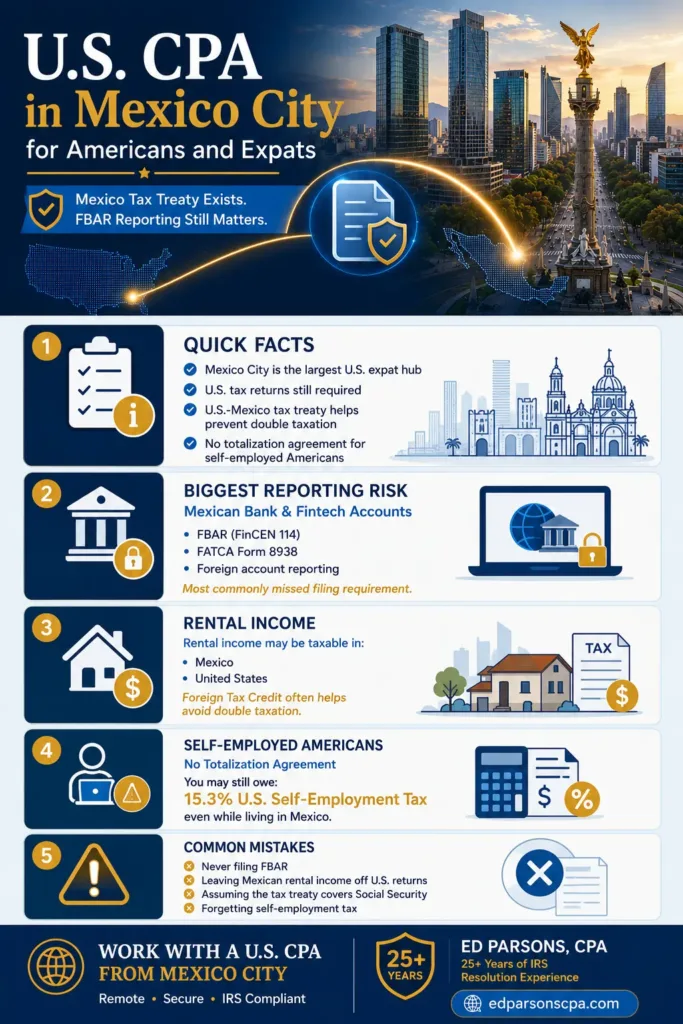
- Mexico City is the largest U.S. expat hub, but U.S. filing obligations continue there.
- Mexican bank and fintech accounts are commonly missed FBAR and Form 8938 filings.
- Rental income is taxable in both Mexico and the U.S., with a credit for Mexican tax.
- The U.S. and Mexico have a tax treaty but no totalization agreement.
- Self-employed Americans still owe U.S. self-employment tax, with no relief.
- Mexico City shares the U.S. workday, on U.S. Central time.
Your U.S. Taxes Do Not Get Simpler in Mexico City
Proximity is deceptive. Because Mexico is a short flight away and life there can feel almost domestic, many Americans assume the tax side is light. It is not. The United States taxes its citizens on worldwide income wherever they live, and once you spend more than 183 days in Mexico or make it your center of life, Mexico taxes you as a resident too.
The good news is that the two countries share an income tax treaty that prevents most true double taxation and lets Mexican income tax credit against your U.S. bill. The catch is everything the treaty does not cover, and that is where the common Mexico City problems live.
| Mexican accounts | Rental income | Self-employment | |
| U.S. form | FBAR and Form 8938 | Schedule E on your 1040 | Schedule C plus SE tax |
| Measurement (what triggers it) | Balances over the thresholds | Renting Mexican or U.S. property | Freelance or business net income |
| Mexican tax interaction | May be withheld; creditable via the FTC | Mexican ISR, creditable via the FTC | ISR or RESICO; no credit for SE tax |
| Common mistake | Never filed at all | Income left off the U.S. return | Forgetting U.S. SE tax |
The gold row is what brings each one into play. Two of these, the accounts and the rental income, are the questions that come up most for Americans in Mexico City.
Mexican Accounts Are the Most Missed Filing
Almost everyone living in Mexico City opens a local bank or fintech account for rent, utilities, and daily life, and almost no one realizes it can trigger U.S. reporting. If your foreign account balances together cross the threshold at any point in the year, you file the FBAR, and larger balances add Form 8938. Mexican banks report U.S. account holders to the IRS under FATCA, so a return that leaves these accounts off does not stay quiet, it creates a mismatch that is a known audit trigger.
Rental Income Is Taxable in Both Countries
The second common surprise is rent. Whether you rent out a place in Mexico or kept a property back in the States, that income is reportable on your U.S. return on Schedule E. Under the treaty, the country where the property sits gets to tax the rental income, so Mexican rent is taxed by Mexico, but your U.S. return obligation does not go away.
The two do connect. Mexican income tax paid on the rental is generally creditable against the U.S. tax on the same income through the foreign tax credit, which usually prevents true double taxation. The mistake is leaving the income off the U.S. side entirely because it was already taxed in Mexico. That is exactly the kind of gap that surfaces later.
A Treaty, But No Totalization Agreement
This is the one that catches the self-employed. The U.S. and Mexico do have a tax treaty, which gives tie-breaker rules for residency, reduced withholding on dividends and interest, and protection for U.S. Social Security from Mexican tax. What they do not have is a totalization agreement. One was signed years ago but never took effect.
The result is a gap with real cost. A self-employed American in Mexico City still owes U.S. self-employment tax of 15.3% on net earnings, and may owe Mexican social security on top, with no mechanism to credit one against the other. The foreign tax credit does not help here, because it applies to income taxes, not social insurance. Even a low Mexican regime like RESICO does not solve it, since the U.S. self-employment tax remains in full.
Exclusion or Credit? It Is a Real Choice Here
Unlike very high-tax countries where the credit almost always wins, Mexico makes the exclusion-versus-credit decision a genuine one. Mexico’s effective rates at middle incomes often sit below U.S. rates, so the exclusion can wipe out U.S. tax on a Mexican salary on its own, while higher earners and those with passive income often lean on the credit, sometimes layering both. Choosing well, rather than defaulting, is what keeps the bill low without losing benefits like the refundable Child Tax Credit or the ability to fund an IRA.
Collections Reach You in Mexico City
A U.S. balance does not stay behind at the border. IRS liens, levies, and passport certification for seriously delinquent tax debt all reach Americans in Mexico. For an expat whose residency and travel depend on a valid passport, a CP508C passport notice is a serious matter, which is why an unpaid balance is best resolved early rather than left to grow.
Remote Representation, Done Right
Here is the honest part. Ed Parsons, CPA is a U.S. CPA based in the Miami and Doral area, not a firm with an office in Mexico City. There is no Mexico City location, and for U.S. tax work there does not need to be. Americans across Mexico and around the world are represented the same way: remotely, securely, and completely.
The work runs through an encrypted document portal, video calls, and electronic signatures. Mexico City is on U.S. Central time, an hour or two behind the East Coast depending on the season, so it shares almost the entire U.S. workday, which makes scheduling effortless, and the whole engagement can be handled in English or Spanish.
If You Are Behind on U.S. Taxes
Because the accounts and rental rules are so easy to miss, many Americans in Mexico City find they are a few years behind without ever intending to be. There is usually a clean way back. Non-willful taxpayers can often catch up through the Streamlined Filing Compliance Procedures, bringing past years current with reduced or no penalties, which beats waiting for a FATCA mismatch to surface the issue first.
Rental income, Mexican accounts, and a couple of quiet years are the three things that most often change what this work costs. Send me the details and the number stops being a guess. You will be asked how many years are open, what you earn on each side of the border, which accounts exist in either country, and whether a notice has already landed. We share almost the whole working day here, so a call is easy to arrange later on, but there is no reason at all for the pricing to wait on one.
Common Mistakes Americans in Mexico City Make
- Keeping a Mexican bank or fintech account for daily life and never filing the FBAR.
- Leaving Mexican rental income off the U.S. return because it was taxed in Mexico.
- Assuming the tax treaty covers Social Security. It does not, and there is no totalization agreement.
- Forgetting U.S. self-employment tax while on a low Mexican regime like RESICO.
- Defaulting to one of the exclusion or the credit without comparing them.
- Ignoring an IRS notice because Mexico feels close and informal.
For the official overview of U.S. tax obligations while living abroad and the FBAR rules, the IRS publishes guidance, though neither replaces advice on your own situation.

Work with a U.S. CPA from Mexico City
Between the account reporting, rental income, and the self-employment trap, Mexico City has more U.S. tax edges than it looks. Ed Parsons, CPA represents Americans in Mexico City remotely. Start with a Personal CPA Tax Resolution Case Analysis, or go straight to the Streamlined Filing package if you are catching up.
contact us to get started.
Personal CPA Tax Resolution Case AnalysisIRS Streamlined Filing CPA Package