Skip to content

If you are a U.S. citizen, dual citizen, or green card holder living in Colombia and you have unfiled U.S. returns or unreported Colombian accounts, the Streamlined Foreign Offshore Procedures (SFOP) are the IRS-sanctioned compliance path for qualifying expats. SFOP carries a $0 miscellaneous offshore penalty when eligibility is met. The procedures are only available before the IRS opens a compliance case against you.
The IRS already has your Colombian account balances. Colombian banks, brokerages, fiduciaria administrators, and pension fund custodians report U.S. person account data to DIAN. DIAN exchanges that data with the IRS annually through the Common Reporting Standard and the FATCA Intergovernmental Agreement. The era when living in Colombia put you out of reach of U.S. tax enforcement ended around 2018, when the IRS began acting on FATCA exchange data in volume.
If you are behind on your U.S. returns or have never filed the FBAR (FinCEN Form 114), Form 8938 (FATCA), Form 5471 for a Colombian SAS, or Form 8621 for Colombian fondos de inversion colectiva, the exposure is real and it grows each year the forms stay unfiled. The Streamlined Foreign Offshore Procedures exist for exactly this fact pattern.
Why FATCA Makes Living in Colombia Different
The Common Reporting Standard and the bilateral FATCA Intergovernmental Agreement together created a data pipeline that did not exist before 2014. Bancolombia, Davivienda, BBVA Colombia, Banco de Bogota, Itau Colombia, Citibank Colombia, Scotiabank Colpatria, and every other reporting institution sends U.S. account holder balance data to DIAN. DIAN forwards it to the IRS. The IRS matches it against your filed U.S. returns.
When the match fails, when the FATCA-reported balance does not appear on a return as an FBAR account or on Form 8938, the file enters the IRS international compliance pipeline. From there, the file may sit for years before action. But once an Information Document Request or examination opens, the streamlined door closes. Compliance options narrow from voluntary remediation with a $0 penalty to a negotiated penalty with the IRS examining your case.
What “Behind on U.S. Taxes” Actually Means When You Live in Colombia
For Americans living in Colombia, behind typically means one or more of the following:
- Unfiled U.S. income tax returns (Form 1040) for one or more years, despite a U.S. filing obligation that does not stop when you move abroad
- Unreported foreign financial accounts above the $10,000 aggregate FBAR threshold (cuentas de ahorro, corrientes, CDT, fiducia accounts, cesantias, pension obligatoria)
- Unreported foreign financial assets above the $200,000 Form 8938 threshold for joint filers living abroad, or $50,000 for single domestic filers
- Unreported Colombian SAS ownership at the 10% U.S. shareholder threshold that triggers Form 5471
- Unreported Colombian fondos de inversion colectiva that meet the PFIC tests under IRC Section 1297, requiring Form 8621
- Unreported distributions or gifts from a fiducia mercantil or from a Colombian family member above the Form 3520 threshold
Each triggers a separate penalty regime. Each has its own statute. None resolve on their own. For more on which Colombian accounts are reportable on FBAR vs Form 8938, see FBAR vs Form 8938 for Colombian accounts.
The Penalty Math: What Non-Compliance Costs
The penalty exposure depends on which form was missed and whether the failure is considered non-willful or willful:
- FBAR (FinCEN 114). Non-willful: $10,000 per violation, per year. Willful: the greater of $100,000 or 50% of the highest aggregate account balance, per year.
- Form 8938. $10,000 per failure, with continuation penalties of $10,000 for each 30 days after IRS notice. No statutory cap.
- Form 5471. $10,000 per form, per year. The statute of limitations on the entire return does not start running until the form is filed.
- Form 8621. The PFIC excess distribution regime taxes gains at the highest ordinary rate plus an interest charge running back to the first year of ownership.
- Form 3520. The greater of $10,000 or 35% of the value of the unreported distribution or gift.
Five years of FBAR non-compliance alone is $50,000 in exposure. Add Form 8938 and a Form 5471 for a Colombian SAS, and the exposure passes $100,000 quickly. For more on how Form 8938 penalties interact with a streamlined submission, see streamlined filing and Form 8938 penalties.
How Streamlined Foreign Offshore Procedures (SFOP) Fit Expat Filers
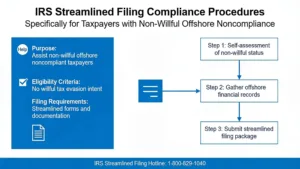
The Streamlined Foreign Offshore Procedures are the IRS-sanctioned compliance path for non-willful non-compliance by qualifying U.S. taxpayers residing outside the United States. When eligibility is met, SFOP carries a $0 miscellaneous offshore penalty. That is the practical difference between SFOP and almost every other compliance path.
Eligibility centers on two things:
- Residency. The taxpayer must meet the IRS test for non-U.S. residency (a 330-day physical presence test or a no-U.S.-abode bona fide residence test). Each test has technical content that determines who qualifies.
- Non-willfulness. The taxpayer certifies under penalty of perjury on Form 14653 that prior non-compliance was due to negligence, inadvertence, mistake, or good-faith misunderstanding. The certification must be detailed and supported by specific facts.
Beyond eligibility, the SFOP submission requires three years of amended or original returns and six years of delinquent FBARs, all with the foreign reporting forms attached and aligned. The technical work is substantial. The certification statement is the highest-risk component, because a poorly drafted narrative is one of the most common reasons the IRS rejects submissions. For the underlying procedure and eligibility framework, see the IRS Streamlined Filing Compliance Procedures page. For the domestic-versus-foreign track choice, see the existing piece on Streamlined Filing Domestic Offshore.
Doing Nothing vs Streamlined Foreign vs Waiting for the IRS
| Measurement | Doing Nothing | Streamlined Foreign (SFOP) | Wait for IRS to Open Case |
| Penalty for unreported accounts | Accrues. Each year compounds. | $0 miscellaneous offshore penalty when eligible | Negotiated FBAR penalty: non-willful $10K per year or willful 50% of balance |
| Statute of limitations | Does not run on unfiled international forms (5471, 3520, 8938, 8621) | Resolves through filing | Does not run until forms filed |
| Eligibility for streamlined | Erodes as time passes | Available now | Lost once IRS opens a case |
| Cost to remediate | Grows annually | Defined scope | Unknown, often higher than SFOP |

Common Questions From Americans Behind on U.S. Taxes in Colombia

The Streamlined Window Closes Once the IRS Opens a Case
Streamlined Foreign Offshore Procedures are not a permanent program. The IRS has signaled multiple times that the program will eventually end or change. More importantly, individual eligibility ends the moment the IRS notifies you of an examination or opens an Information Document Request on your foreign accounts. The data pipeline that flagged your file is already running.
To begin the eligibility analysis and the streamlined preparation work with a CPA who has 17 years of IRS tax resolution and international tax experience, request the Streamlined Filing CPA Package.