Skip to content
The IRS has never issued guidance that settles how Australian superannuation is taxed in the U.S. Retail and industry funds are often analyzed as employer-based foreign retirement arrangements, while SMSFs are frequently viewed as foreign trusts controlled by the member. That classification, not the Australian label, drives U.S. taxability, reporting, and penalty exposure. If your fund is an SMSF or holds pooled funds, tell me what is inside it and I will scope the U.S. reporting.
Your Australian accountant may have handled the Australian side perfectly. Contributions and earnings taxed concessionally inside the fund, withdrawals tax free after age 60 for most members. None of that answers the U.S. question.
If you are a U.S. citizen, green card holder, or U.S. tax resident with an Australian super balance, your U.S. outcome turns on something Australia never asks: what does U.S. law think your fund actually is? A pension arrangement? A trust you own? Something in between?
The answer can shift depending on whether you hold a mainstream retail or industry fund or run a self managed super fund, and the difference shows up in taxability, reporting, and penalty exposure.
Why the U.S. Has No Single Answer for Super?
The U.S.-Australia income tax treaty was written decades ago and last updated before compulsory super matured into the system Australians know today. The treaty does not clearly settle how superannuation is classified, and the IRS has never published a ruling that resolves the question for every fund type.
That silence forces a facts and circumstances analysis, and it helps to keep four issues separate: whether the fund creates taxable income, what information reporting applies, whether a treaty position changes anything, and what penalties attach to missed filings. They are related, but they are not the same question.
The scale of the problem is easy to underestimate:
- Compulsory employer contributions currently run at 12 percent of ordinary earnings.
- Australians hold more than AUD 4 trillion in superannuation assets.
- More than 600,000 SMSFs operate today, holding roughly a quarter of all super money.
- The treaty text does not mention the word superannuation at all.
When the written law is quiet, classification does the work. And classification often turns on one thing: control.
Retail and Industry Funds: When Someone Else Holds the Keys
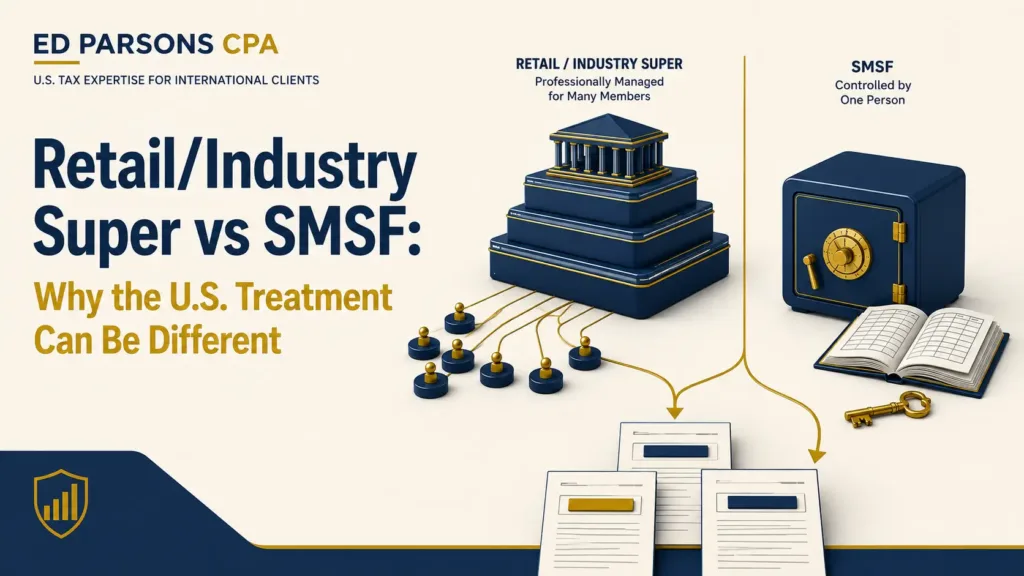
Retail and industry funds are APRA-regulated. A professional trustee runs the fund, owes duties to millions of members, and controls the investments. You can pick an option from a menu, but you cannot direct the fund.
That lack of member control is a key reason these funds are often analyzed as employer-based foreign retirement arrangements rather than trusts you personally own. Under that lens, the facts that matter most are how much of the money came from your employer versus your own salary sacrifice or after tax contributions, when amounts vest, and your income level.
The IRS has also created a reporting relief framework for certain tax-favored, employer-based foreign retirement trusts under Rev. Proc. 2020-17. Many mainstream super funds can fit, but the relief is condition by condition, and large super contributions can affect that eligibility for higher earners. Two members of the same industry fund can land in different places.
SMSFs: When You Hold the Keys
An SMSF flips the control question. You serve as trustee, or as a director of the corporate trustee. You choose the assets, sign the paperwork, and answer to the regulator.
For U.S. purposes, that control frequently pushes the analysis toward foreign trust territory, often a grantor trust, which can mean the U.S. treats you as owning the fund’s income personally, year by year, even if you never withdraw a dollar. It is also why the question of when Forms 3520 and 3520-A apply to an SMSF deserves its own analysis, and why the reporting relief conditions are harder for SMSFs to establish.
There is a second layer inside the fund itself. Australian managed funds and many ETFs are ordinary local investments, but under U.S. rules they can be passive foreign investment companies. PFICs inside superannuation and SMSFs can each carry a Form 8621 requirement of their own.
Who holds the keys changes the U.S. answer for the same balance, and that is only the start of what super does on a U.S. return. I follow it further in a short email series: the forms an SMSF can bring, what happens to the funds held inside it, how franking credits and the family company or trust sit alongside it, and the streamlined route when years were filed without any of it. Put my email on the list and you will receive a confirmation email first; the six emails begin when you click it, and each one carries an unsubscribe link.
Side by Side: How the U.S. Lens Shifts
Here is how the two structures tend to compare through U.S. rules rather than Australian labels.
| Factor | Retail or Industry Fund | SMSF |
| Who directs the investments | A professional APRA-regulated trustee. The member chooses from a menu. | The member, acting as trustee or as director of the corporate trustee. |
| Common U.S. analysis | Often analyzed as an employer-based foreign retirement arrangement. | Often analyzed as a foreign trust the member controls. |
| U.S. tax on fund earnings | Fact-sensitive. Depends on classification, contribution mix, and vesting. | Frequently taxed to the member each year under a grantor trust view. |
| Forms 3520 and 3520-A | May be excused under IRS reporting relief when every condition is met. | Relief is harder to establish. The forms are frequently in scope. |
| PFIC exposure (Form 8621) | Possible, depending on how the fund is structured. | Common when the fund holds Australian managed funds or ETFs. |
| Measurement | The IRS lens measures contribution mix, limits, and vesting. | The IRS lens measures the member’s degree of control. |
Where Penalty Exposure Comes From
Penalties follow the classification. If a filing was required and missed, the numbers escalate quickly, and each fund, each form, and each year is a separate exposure:
- Form 3520: the initial penalty can be the greater of $10,000 or 35 percent of certain amounts treated as trust contributions or distributions.
- Form 3520-A: the greater of $10,000 or 5 percent of the trust assets treated as owned by the U.S. person.
- Form 8621: no fixed dollar amount, but a missing form can hold the audit window open on the entire return.
Separate from all of this, account-level disclosure generally still applies once balances cross the thresholds, including the FBAR and Form 8938. They sit in the background of this series but do not go away. If years have already been missed, the catch-up route is in streamlined filing for Australians.

Common Mistakes With Australian Super on a U.S. Return
- Assuming the Australian label decides the U.S. answer. A fund can be ordinary in Australia and technically difficult under U.S. rules.
- Treating tax free after age 60 in Australia as if it carries over to a U.S. return.
- Assuming the treaty settles superannuation. It is a position to analyze, not a default.
- Rolling a retail balance into an SMSF without rechecking the U.S. analysis, because control changes it.
- Ignoring what the fund holds. PFIC exposure hides inside ordinary Australian managed funds and ETFs.
- Letting a clean Australian return stand in for the U.S. analysis. The two systems ask different questions.
That last mistake, ignoring what the fund holds, is the one I can scope without any classification argument at all. Whatever the trustee structure turns out to be, the pooled products inside it are countable today. List the funds and the years and I will tell you the size of the Form 8621 job. The questions cover how many holdings sit inside the super or SMSF and which years went out unexamined, plus space to describe the rest. No confirmation email comes back from this form, because I answer it myself.
What to Pin Down Before You File or Fix Anything
The order of operations matters: classify the fund first, then determine the reporting, then consider any treaty position, then measure exposure for missed years. Skipping straight to the forms is how filers overpay on one side or underreport on the other.
The facts a reviewer needs are specific: fund type, who contributed and how much by source, vesting terms, trustee arrangements, what the fund holds, and which years went out without this analysis.

If prior U.S. returns were filed without that review, the gap does not close on its own. A Personal CPA Tax Resolution Case Analysis maps your fund type, contribution history, and past filings into a defensible U.S. position before the IRS frames the issue for you. Ed Parsons, CPA handles these reviews for U.S. citizens and dual citizens nationwide.