Skip to content
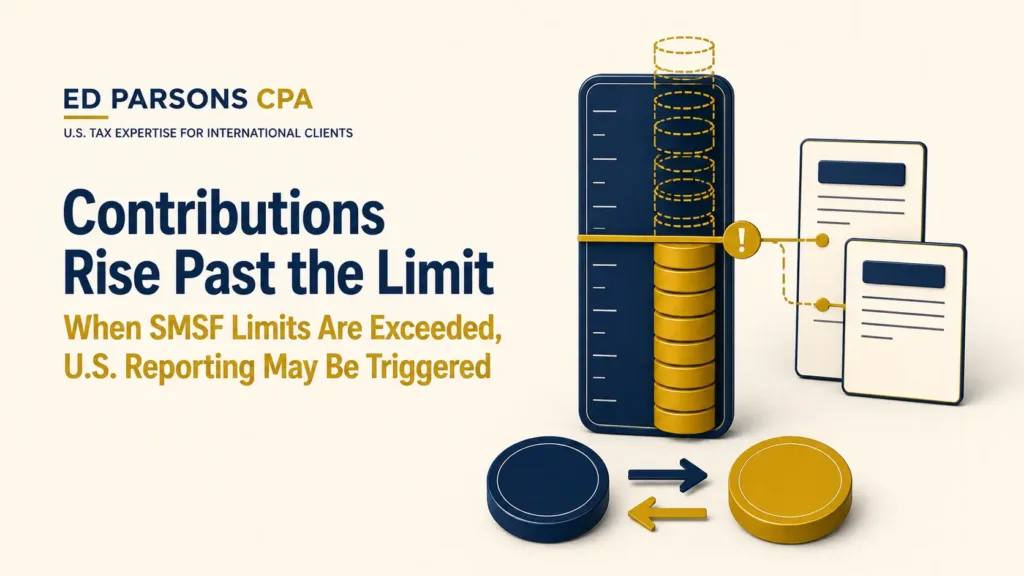
There is no U.S. rule that makes Form 3520-A apply at a specific salary. The risk runs through Rev. Proc. 2020-17, whose reporting relief depends on contribution limits measured in U.S. dollars. High earners break those limits through salary sacrifice and non-concessional contributions, which can put the default foreign trust filings back in scope. How an SMSF sits alongside the other family structures under U.S. rules is in Australian structures and U.S. tax problems.
A strong income changes how super behaves. Employer contributions arrive at the top of the scale, salary sacrifice tops up the concessional cap, and surplus cash tends to flow into after-tax contributions because an Australian adviser called it efficient.
Then a U.S. tax question lands: do high super contributions trigger Form 3520-A? The honest answer is that the salary itself never does. The contribution pattern your salary makes possible is what puts the reporting relief at risk, and that distinction changes how you review your own position.
There Is No Salary Threshold for Form 3520-A
Nothing in U.S. law says earn above a certain amount and file trust returns. The chain runs differently. First comes classification, the question of how the U.S. views your super fund at all. If the fund is analyzed as a foreign trust you are treated as owning, Forms 3520 and 3520-A come into scope as the default filings.
The IRS then offers an exit ramp: a relief framework that can excuse those forms for certain tax-favored foreign retirement trusts. High earners matter to this story because their contribution patterns are the most likely to fail the conditions that keep the exit ramp open. Income is the fuel. The conditions are the mechanism.
That is also why the question cannot be answered from a payslip. It is answered from the fund’s terms and from the contribution record, year by year.
The Contribution Conditions Inside Rev. Proc. 2020-17
The relief framework, Rev. Proc. 2020-17, defines a tax-favored foreign retirement trust through a set of conditions. Several concern the fund’s design: tax-favored status under local law, annual reporting to the local tax authority, and withdrawals tied to retirement, disability, or hardship. The conditions that catch high earners concern contributions.
In broad terms, the framework expects contributions to relate to income from personal services, and it expects them to be limited: by reference to a percentage of earned income, or by an annual limit of USD 50,000 or less, or by a lifetime limit of USD 1,000,000 or less. The limits are set in U.S. dollars, while every Australian cap is set in AUD, so exchange rates quietly participate in the analysis.
Notice what the conditions test. They look at how the trust limits contributions, not at how much you earn. Two colleagues on identical salaries can land differently because one only ever received employer contributions while the other moved a property sale into super.
The currency layer deserves its own sentence. Australian caps are indexed periodically in AUD, while the relief limits stay fixed in USD, so the same contribution pattern can sit inside the annual limit in one year and outside it in another purely because the exchange rate moved. A serious review converts year by year at the rates that applied, not once at today’s rate.
How High Earners Break the Conditions Without Noticing
The pressure builds in a predictable sequence, and none of it feels aggressive from the Australian side:
- The concessional cap currently sits at AUD 30,000 per year, roughly USD 20,000 at recent exchange rates. On its own, comfortably inside the annual limit.
- A strong salary plus salary sacrifice fills that cap early, so surplus savings get redirected into after-tax contributions.
- The non-concessional cap currently allows AUD 120,000 per year, roughly USD 78,000 at recent rates, already past the USD 50,000 annual mark on its own.
- A bring-forward election can concentrate up to AUD 360,000 into a short window, several multiples of the USD annual limit in a single year.
- After-tax contributions often come from a bonus, an inheritance, or a property sale, money that strains the personal services condition regardless of size.
- If you pay Division 293 tax on your concessional contributions, you are, almost by definition, in the population this analysis is written for.
Here is how the main contribution types compare once you view them through the relief conditions rather than the Australian caps.
| Contribution Type | Typical Australian Treatment | Pressure on the U.S. Relief Conditions |
| Employer superannuation guarantee | Compulsory, set as a percentage of ordinary earnings. | Lowest pressure. Tied to earned income by design. |
| Salary sacrifice | Elective pre-tax amounts that count toward the concessional cap. | Moderate. Still salary-linked, but it raises the annual total quickly. |
| Personal after-tax (non-concessional) | Capped at AUD 120,000 per year currently. | High. Not tied to earned income, and can exceed USD 50,000 on its own. |
| Bring-forward election | Up to AUD 360,000 concentrated across three years. | Highest. A single year can dwarf the USD annual limit. |
| Measurement | Australia measures caps in AUD against your balance and age. | The relief measures USD limits against the trust’s own terms. |
A Worked Pattern: Where the Limits Break
Consider a pattern rather than a person. An executive earns AUD 300,000. Employer guarantee contributions arrive near the top of the scale, and salary sacrifice fills the rest of the AUD 30,000 concessional cap. So far the annual total sits around USD 20,000 at recent rates, inside the USD 50,000 limit and tied to salary besides.
Then a property sells. AUD 240,000 moves into super under a bring-forward election, exactly as the Australian adviser suggested. In that year, contributions total roughly AUD 270,000, in the neighborhood of USD 175,000 at recent rates. The annual limit is gone several times over, the money did not come from personal services, and the lifetime math has taken a permanent step forward.
Nothing about the Australian side was aggressive. Every cap was respected. The U.S. relief conditions simply measure different things, and in that year they were not met. Whether earlier and later years survive depends on their own numbers, which is why the review is always year by year.
The Overlooked Condition: Your Own Filing History
The relief is available to an eligible individual, and eligibility is personal. It generally requires being compliant with U.S. return filing obligations and having reported the fund’s income to the extent the rules required. A high earner with a complex return has more places for a defect to hide, and a defect in one area can undermine eligibility even when the fund’s design looks clean.
This is also why the relief is not a set and forget position. Funds change their terms, contribution patterns change with income, and eligibility is tested against facts, not against last year’s conclusion.

What Losing the Relief Actually Means
Failing a condition does not create an automatic penalty. It removes the excuse, which returns you to the default analysis: a foreign trust, an owner, and the Form 3520 instructions governing what gets reported. If the filings were required and missed, the initial penalties can reach the greater of $10,000 or 35 percent of certain reportable amounts for Form 3520, and the greater of $10,000 or 5 percent of trust assets treated as owned for Form 3520-A, with each form and each year standing alone. A required but unfiled trust form can also hold the audit window open on the entire return until it is filed.
Keep the issues separate, because they are separate. This article is about information reporting. Whether the contributions themselves are taxable income in the U.S. is its own question, with its own analysis, and a clean answer on one does not settle the other.
Losing the relief does not announce itself, and nothing on the Australian side will tell you it has happened. If your contributions have been large, put my email on the list and I will send you a short series written for people with serious money on both sides of the Pacific. It goes through how the U.S. reads super in the first place, what happens to the funds held inside it, and how the streamlined procedures work when forms were missed for years. A confirmation email comes first and the six emails begin when you click it. Each one has an unsubscribe link.
Common Mistakes High Earners Make Here
- Treating the relief as permanent once claimed. Eligibility is a year by year, condition by condition test.
- Assuming an employer-only fund and a fund topped up with personal money get the same answer.
- Comparing AUD caps to USD limits without converting, or converting once and never revisiting the rate.
- Letting one non-compliant year quietly poison personal eligibility for the years that follow.
- Maxing a bring-forward election on Australian advice that never mentioned a U.S. dimension.
- Assuming salary sacrifice is invisible because the employer remits it. It still shapes the contribution picture.
How to Review Your Own Exposure
Start with the contribution history, not the salary. Pull the fund’s records and sort every contribution by year, by type, and by source: employer guarantee, salary sacrifice, personal after-tax, spouse, and anything moved in from a sale or inheritance. Add the fund’s terms, and note which U.S. returns went out while this question sat unexamined.
The output of that review is a position, not a feeling: which years qualify for relief, which do not, and what each non-qualifying year requires. High earners rarely have identical years, and the analysis has to respect that.
If the pattern breaks a condition in one or more years, the fix is sequencing, not silence. Multi-year gaps are usually resolved through a structured catch-up path rather than attaching forms quietly going forward.

Mapping contributions against the relief conditions, and preparing the trust filings when the relief falls away, is the core of a Form 3520 CPA Filing engagement. Ed Parsons, CPA runs this analysis for high-income members of Australian funds across the U.S. and abroad, and the review starts with your numbers, not a generic threshold.