Skip to content
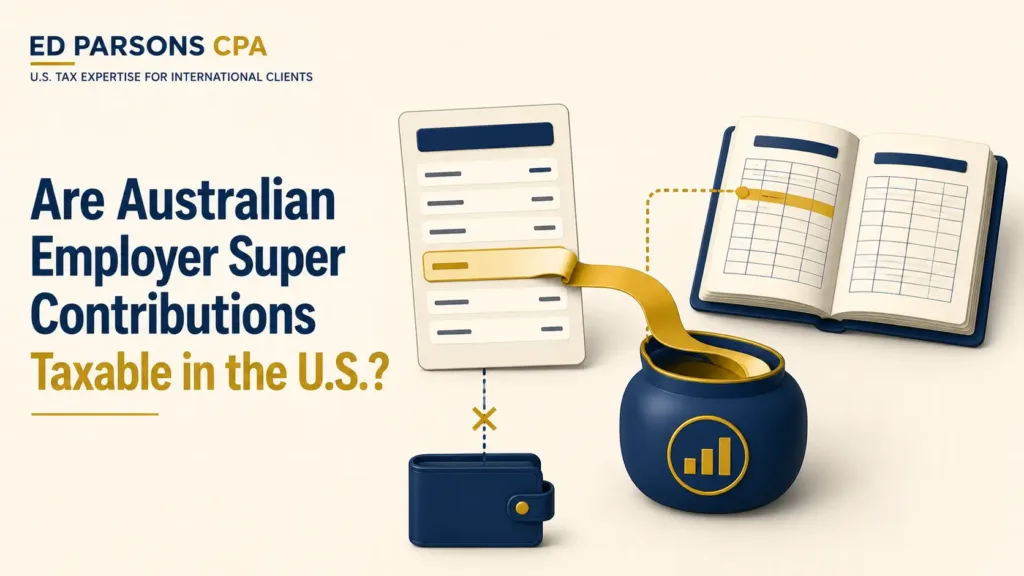
Often yes, at least in part. The U.S. taxes citizens and residents on worldwide income, and Australia’s concessional tax is paid by the fund, not by you. Whether employer contributions count as your income, and when, depends on how the fund is classified, on vesting, and on any treaty position, not on the Australian label.
Employer super never touches your take-home pay. Australia taxes it concessionally inside the fund, your payslip shows it as a separate line, and no U.S. form ever arrives for it. It is easy to conclude the IRS simply cannot see it. The wider picture, super included, is in the Australia and U.S. tax guide.
That conclusion mixes up two different things: invisible paperwork and invisible income. The U.S. system asks its own questions about employer super, and none of them start with how Australia taxed it.
Why Australia Already Taxed It Does Not Settle the U.S. Question?
The U.S. taxes its citizens and residents on worldwide income. The concessional tax on your contributions is paid by the fund, on the fund’s own return, at the fund level. You did not pay it, which is also why it generally cannot be claimed as your own foreign tax credit.
So the Australian tax does not remove the U.S. question. It just answers a different one. Keeping four issues separate makes the rest of the analysis readable:
- Income inclusion: does the contribution count as your U.S. income, and in which year?
- Information reporting: which disclosure forms apply, regardless of how the income question lands?
- Treaty position: does the U.S.-Australia treaty change inclusion or timing for your facts?
- Penalty exposure: what follows if a required filing or inclusion was missed?
Related questions, four different answers. This article is about the first one, with the others kept in view.
Who Earned the Money: How the U.S. Looks at Employer Contributions
Employer contributions are compensation-linked money. They exist because you worked, and Australian employer contributions generally vest in the member right away, which is one reason many analyses treat them as current compensation for U.S. purposes once they hit the fund. Other positions reach different timing, and the difference usually traces back to how the U.S. classifies the fund itself, which is where mainstream funds and SMSFs can split.
Salary sacrifice adds a wrinkle of its own. It is your salary, redirected before it reaches you, and many analyses treat redirected salary as your income when earned. The Australian system files it under employer contributions. The U.S. analysis asks whose paycheck it started as.
Notice the pattern: the payslip label never decides anything. Who earned the money, when it vested, and what the fund is decide the U.S. answer, and two employees with identical super statements can hold different positions honestly.
What Happens to Earnings Inside the Fund
The second half of the tax-free assumption concerns growth. In Australia, the fund pays concessional tax on earnings and members enjoy the compounding. For U.S. purposes, deferral is not automatic. Under some classifications it can be supported. Under a trust-ownership view, the kind that often attaches to SMSFs and their reporting forms, the fund’s earnings can land on your return every year, withdrawal or not.
The holdings add one more layer. Australian managed funds and many ETFs inside super can be passive foreign investment companies, and PFICs inside superannuation carry their own harsh rules and filings. Growth that felt sheltered can turn out to be the most technical part of the return.
Here is the mismatch at a glance.
| Question | The Australian Frame | The U.S. Frame |
| Who pays tax on the contribution | The fund, at a concessional rate. | Potentially you, depending on classification and vesting. |
| When tax happens | Inside the fund, in the year the contribution arrives. | Possibly when contributed or when vested. Position dependent. |
| Tax on fund earnings | Taxed to the fund at concessional rates. | May be deferred, or taxed to you annually under a trust view. |
| Paperwork you receive | Fund statements. Nothing goes to the IRS. | No W-2 line and no 1099, but no automatic exemption either. |
| Measurement | Measures the fund’s tax at the fund level. | Measures your income by who earned and who controls the money. |
Does the Treaty Change the Answer?
Sometimes people reach for the treaty as the fix. The U.S.-Australia treaty documents were written before compulsory super matured, and the treaty contains a saving clause that lets the U.S. tax its own citizens and residents largely as if the treaty were not there. That does not make the treaty useless. It makes treaty relief a position to analyze and disclose properly, not a default you inherit by having Australian super.
Treaties also vary by country, which is why the IRS keeps a full treaty list. What a colleague from another country was told about their pension says nothing reliable about yours.
So the treaty does not settle it, and neither does the tax the fund already paid. If that leaves you wondering what else in your Australian finances the U.S. is quietly counting, I wrote six short emails for exactly this reader: what the treaty really does, how super and self-managed funds are read, why franking credits rarely cross over, Australian funds under the PFIC rules, the family company and trust, and the way back if years are missing. Send me the Australia and U.S. tax emails. A confirmation email arrives first, and nothing follows until you click it. Every email carries an unsubscribe link.
Common Mistakes With Employer Super on a U.S. Return
- Treating the fund’s concessional tax as tax you paid, or claiming it as a personal foreign tax credit.
- Concluding that no W-2 line or 1099 means no obligation. The silence is a paperwork gap, not an exemption.
- Treating super like a 401(k). There is no U.S. qualification behind it, so classification does the work instead.
- Assuming the treaty exempts super by default instead of analyzing and disclosing a position.
- Ignoring salary sacrifice because the employer remits it. The U.S. analysis asks whose salary it was.
- Letting the earnings question ride on the Australian answer instead of the classification answer.
One more, because it is the quiet one: assuming a zero-income year means nothing to file. Reporting is a separate lane, and large contribution years can strip the relief that keeps foreign trust forms away, even in years where the income answer is small. That contribution risk is worked through in large super contributions and Form 3520-A risk.

What to Do With This
Gather the facts that actually drive the analysis: payslips separating guarantee amounts from salary sacrifice, fund statements, the fund type, vesting terms, and the list of U.S. returns filed while super sat unexamined. The question is rarely whether something should have been considered. It is which position fits your facts and how many years carry the same gap.

Classification, contribution history, and prior filings have to be worked through together, so the inclusion and reporting answers map to each other instead of guessing at one and hoping about the other. The Australia-US tax guide sets out how those pieces line up. Ed Parsons, CPA runs these reviews for U.S. citizens and dual citizens with Australian financial lives, wherever they live.