Skip to content
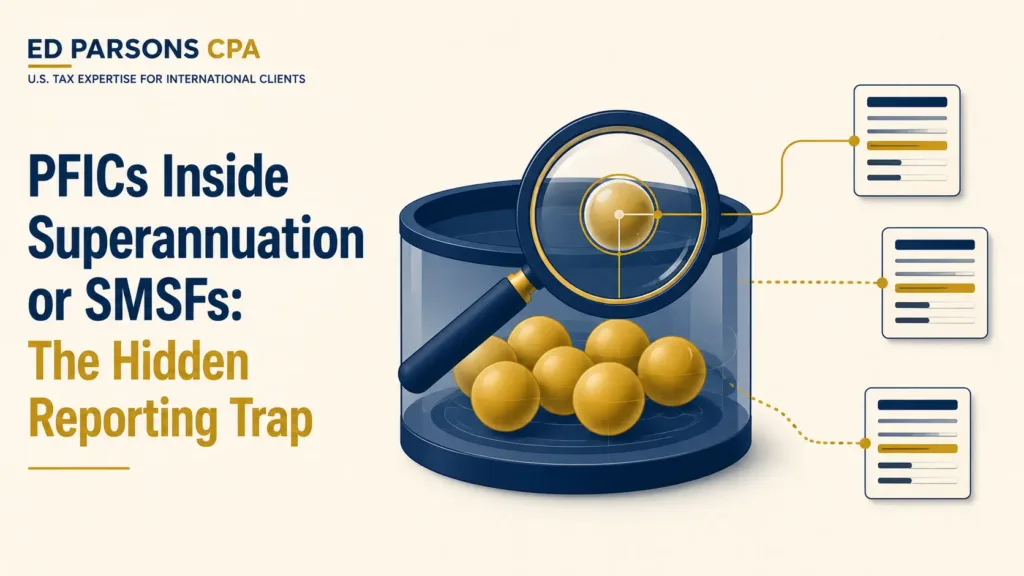
Australian managed funds, ETFs, and listed investment companies are commonly analyzed as passive foreign investment companies under U.S. rules. Holding them inside super does not automatically shield you: when you are treated as owning the fund’s investments, as SMSF members often are, each pooled holding can carry its own Form 8621 and its own harsh tax regime. The elections that can soften the default PFIC tax are compared in QEF vs mark-to-market vs Section 1291.
Open your super statement and nothing looks exotic. An index fund, a couple of ASX-listed ETFs, a managed international option, some cash. Every holding is ordinary by Australian standards, which is exactly why the trap works.
The trap is not the fund you can see. It is what the U.S. calls the things inside it, and whether those things count as yours. That second question is where superannuation and SMSFs part ways.
What Makes an Ordinary Australian Fund a PFIC?
A passive foreign investment company is a foreign corporation that fails either of two tests: an income test, met when 75 percent or more of its income is passive, and an asset test, met when 50 percent or more of its assets produce passive income. Dividends, interest, and gains are passive income, which is a problem for pooled products, because producing that kind of income is their entire job.
Australian managed funds, ETFs, and listed investment companies are commonly analyzed as corporations for U.S. purposes, which opens the PFIC gate, and their income mix walks straight through it. Nothing about ASX listing, franking, or local registration changes the analysis. The tests measure what the vehicle earns and holds, not where it is respectable.
Diversification does not rescue the analysis either. An ETF full of solid operating companies still earns dividends and gains at its own level, and to the vehicle, that income is passive. The tests look at the pool, not at what the pool bought.
The Gate: Whether the Fund’s Holdings Count as Yours
Here is why the same ETF can be a non-event for one member and a filing obligation for another. The PFIC rules reach investments you are treated as owning, directly or indirectly, and that ownership question runs through how the U.S. classifies your super fund in the first place.
Inside a mainstream retail or industry fund, where a professional trustee owns and controls the assets, the holdings may not be attributed to you, depending on the position taken. An SMSF is different. Under the trust-ownership view that frequently attaches to SMSFs, the U.S. can look straight through the fund and treat each pooled holding as your own PFIC, unit by unit.
That look-through also connects to the income side: whether and when the fund’s earnings reach your U.S. return is a classification question, and PFIC status decides how harshly any earnings that do arrive get taxed. If unreported years are already stacking up, streamlined filing for Australians covers the catch-up.
Why PFIC Treatment Hurts
The default regime, the excess distribution rules of Section 1291, is deliberately unpleasant. Gains and unusually large distributions are thrown back across your entire holding period, taxed at the highest ordinary rate for each year, and then charged interest on top, as if you had underpaid all along. The long-term capital gains rate never enters the room.
Picture a managed fund held for six years and sold at a healthy gain. The regime spreads that gain across all six years, taxes each slice at the top ordinary rate for its year, and then adds an interest charge to the earlier slices, as though the tax had been overdue the whole time. The math punishes exactly the thing super is designed to do: hold and compound.
Elections exist that can soften this. A QEF election needs data Australian funds rarely publish, and a mark-to-market election has its own costs and conditions. Both are time-sensitive, which is why the expensive version of this story usually begins with the words nobody mentioned it at the time.
Here is how common holdings inside a super or SMSF portfolio translate.
| Holding Inside the Fund | How It Looks in Australia | How the U.S. Lens Can Treat It |
| ASX-listed ETF | An ordinary diversified holding. | Frequently meets the PFIC tests. |
| Managed or index fund | An everyday unit trust investment. | Commonly analyzed as a PFIC. |
| Listed investment company | A share bought on the exchange. | Pooled and passive by design. High PFIC risk. |
| Direct shares in an operating company | A stock pick. | Generally sits outside the PFIC tests. |
| Cash and term deposits | The safe allocation. | Not a PFIC. The interest has its own rules. |
| Measurement | Measures diversification, fees, and returns. | Measures passive income and passive assets. |
Form 8621: The Multiplication Problem
PFIC reporting runs through Form 8621, and the form generally applies per PFIC, per year. An SMSF holding eight pooled products is not one filing question. It is eight, every year, each with its own computations under the Form 8621 instructions. Five unexamined years turn eight holdings into forty filings before anyone discusses the tax itself.
There is no fixed dollar penalty for a missed Form 8621, which lulls people. The real cost sits elsewhere: a required but unfiled form can hold the audit window open on the entire return until it is filed, and the default regime keeps compounding quietly in the background. A narrow filing exception exists for small aggregate holdings in some years, but it relieves paperwork in limited situations, not the regime itself.
Multiply eight holdings by five unexamined years and most people stop reading and start worrying. Before that turns into a decision, it helps to have the underlying rules straight, which is what my PFIC email series is for. Leave an email address, get five emails: why a pooled fund meets the passive tests almost automatically, what the default regime does to a gain built up over years, how QEF depends on information the fund has to supply and mark to market on the fund being traded, and how many years a missing Form 8621 can leave sitting open. You get a confirmation request before anything else, and clicking it is what starts the series. Unsubscribe any time.
Common Mistakes With PFICs in Super
- Assuming the super wrapper shields the holdings. The gate is ownership treatment, not the account label.
- Treating an ASX-listed ETF like a U.S. ETF because both trade on an exchange.
- Waiting for tax paperwork that never comes. No Australian fund statement maps itself onto Form 8621.
- Discovering elections after the window that made them attractive has closed.
- Counting a wrap or platform account as one holding when it quietly contains a dozen pooled products.
- Filing correctly going forward while earlier years sit open and compounding.

What to Do Before This Compounds Further
Start with a complete holdings list at the unit level, not the account level: every fund, ETF, and pooled product inside the super or SMSF, with purchase dates, sales, and distribution history. Add the fund type and trustee structure, because the ownership gate comes first, and note which U.S. returns went out while the holdings sat unexamined.
If several years are affected, the sequencing matters more than speed. Multi-year PFIC gaps usually travel with other missing international forms, and they are typically resolved together through a structured catch-up path rather than one form at a time.

Identifying which holdings are PFICs, choosing the least damaging method for each, and preparing the filings is the core of a Form 8621 PFIC Filing engagement. Ed Parsons, CPA handles PFIC identification and reporting for super and SMSF holdings nationwide and abroad, holding by holding, year by year.