Skip to content
Update: the IRS has withdrawn the Delinquent FBAR Submission Procedures. The programme’s page on irs.gov now returns an error, and the IRS list of options for taxpayers with undisclosed foreign financial assets names only three routes: the Criminal Investigation Voluntary Disclosure Practice, the Streamlined Filing Compliance Procedures, and the delinquent international information return submission procedures, which is a separate programme for information returns rather than FBARs. This page is kept for reference and describes the procedures as they operated while they were open. Having reported the income still cuts against willfulness, and that argument is unaffected. What has changed is the remedy it used to unlock, which is now the streamlined procedures instead. If you need this looked at on your own facts, request a quote or contact me directly.
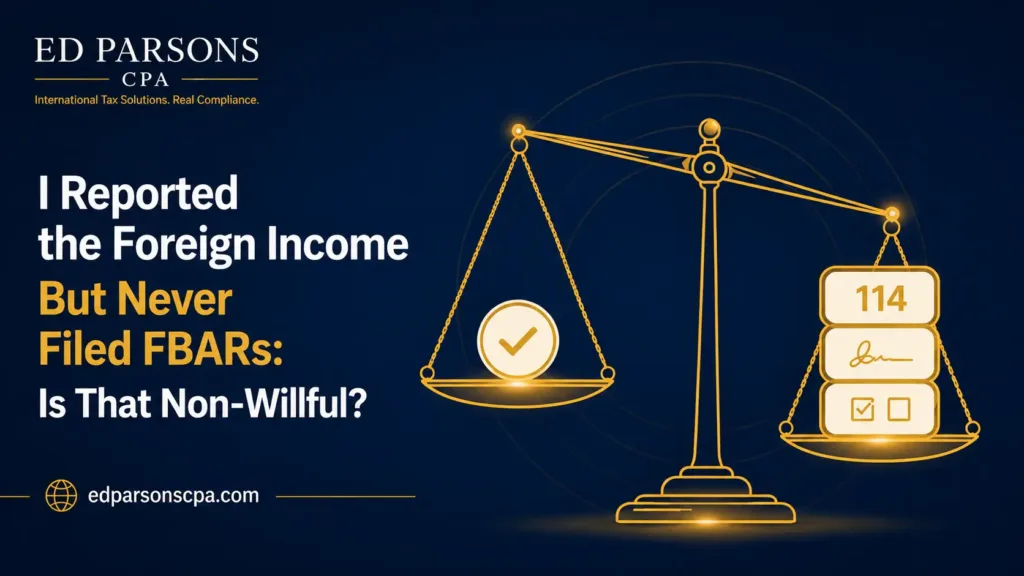
Reporting your foreign income helps, but it does not make a missed FBAR non-willful by itself. Willfulness turns on the complete record: what Schedule B said, what you signed, how the accounts were used, and what happened after you learned the rule. For taxpayers who reported everything and simply never filed FinCEN Form 114, a penalty-free correction path usually exists, if the facts are documented and the filing lands before the IRS makes contact.
The honest answer: probably, and probably is not a filing position
Most people in this situation are, in fact, non-willful. They paid tax on the interest and dividends, their accounts sat where they live or where they came from, and nobody, including their preparer, ever said the words FinCEN Form 114.
But non-willful is a legal conclusion, not a feeling. It gets tested against your returns, your signatures, your account behavior, and your timeline, and the government does not take your word for any of it.
Everything downstream rides on this one classification. It decides which correction lane exists for you, whether the penalty conversation starts at zero or at half the account balance, and how much of your story a court would ever believe. Get it right at the start and the rest is paperwork; get it wrong and the paperwork becomes evidence.
The worry usually arrives in one of three forms:
“I paid tax on all the interest. Doesn’t that prove I wasn’t hiding anything?”
“My accountant never mentioned the FBAR. Is that reasonable cause?”
“I just found out about FinCEN Form 114. What do I file first?”
Short answers: it helps, it does not prove. Sometimes, if the reliance was real and documented. And nothing, until the record is read the way an examiner would read it.
What willful actually means here?
A willful FBAR violation is the voluntary, intentional violation of a known legal duty. In the civil penalty context, courts have stretched that to cover recklessness and willful blindness: consciously avoiding a duty you had every reason to know about.
That stretch is what makes this analysis unforgiving. You do not need to have schemed to be treated as willful. You need only to have been reckless about a question your own tax return asked you every single year.
Preparer reliance deserves its own caution here. Reliance helps when the professional knew the accounts existed and gave advice you reasonably followed. A preparer who was never told about the accounts protects no one, and organizer questions you skipped cut the other way.
Facts that help you
- Every dollar of the foreign income appears on your filed returns, matching the account statements.
- No secrecy markers: no hold mail arrangements, no numbered accounts, no nominee names.
- The accounts are ordinary: a salary account where you lived, a pension from a former employer, family savings.
- You relied on a professional who knew about the accounts and never raised the filing.
- You are correcting voluntarily, before any IRS letter, audit, or FATCA-driven inquiry.
- Your Schedule B answers, where present, are consistent with the accounts you actually held.
Facts that hurt you
- Schedule B, Part III answered no while the accounts existed, under your signature.
- Large or patterned transfers between U.S. and foreign accounts without a documented purpose.
- Accounts in banking-secrecy jurisdictions, numbered accounts, or entity and nominee wrappers.
- A prior warning: a preparer note, a bank letter, an organizer question you skipped.
- The account was left off the organizer or questionnaire your preparer asked you to complete.
- An FBAR exists but is incomplete: one account reported, a larger one omitted.
Non-willful vs willful: the stakes side by side
| Non-willful | Willful | |
| Legal standard | Mistake, misunderstanding, or negligence without intent | Voluntary, intentional violation of a known duty, including recklessness and willful blindness |
| Typical evidence | Income reported, no secrecy, ordinary account use, prompt correction | False Schedule B answers, concealment, layered structures, partial reporting |
| Measurement | Up to $16,536 per report, per year | Greater of $165,353 or 50% of the balance, per account, per year |
| Lanes open | Delinquent FBAR procedures or streamlined filing | Voluntary disclosure practice, with counsel involved |
| Proof standard | IRS weighs your documented facts | Government proves willfulness by a preponderance of the evidence |
What six courtrooms teach about this exact question
These cases are why no honest professional will tell you that reported income settles the matter. Courts read conduct, and they read signatures.
In United States v. Williams, the Fourth Circuit sustained willfulness where the taxpayer had signed returns containing the foreign account question and then looked away from the duty. Willful blindness counted.
In United States v. McBride, a federal district court charged the taxpayer with constructive knowledge of everything in the returns he signed, and layered offshore structures read as concealment, not planning.
In United States v. Horowitz, the Fourth Circuit held that civil willfulness includes recklessness. Swiss accounts with held mail, and a Schedule B warning nobody read, were enough.
In Norman v. United States, the Federal Circuit applied that objective recklessness standard and upheld the willful penalty where the taxpayer’s testimony conflicted with her own documents.
In Kimble v. United States, never reading the return did not help. The false Schedule B answer she signed supported recklessness, because signing is adopting.
And in Bedrosian v. United States, the taxpayer filed an FBAR that listed the small account and omitted the large one. Partial reporting became the willfulness evidence.
The pattern across all six: what you signed and what you did carry more weight than what you meant.
Non-willful being a conclusion rather than a feeling is the part that changes what you should do next, because a conclusion has to be argued in writing and then signed. Five short emails from me are about that writing: what the certification asserts, what a reviewer needs to see in it, and why the computation sitting beside the narrative can undermine the narrative when the base is built wrong. That base is wider than a list of accounts. Send me the five streamlined emails. A confirmation email goes out ahead of them and nothing follows until you click. Unsubscribe at the foot of any email.
The numbers that frame the decision
- $0: the penalty the IRS ordinarily asserts under the delinquent FBAR procedures where all income was reported and no examination is open. The IRS is not bound to that result.
- $16,536: the current inflation adjusted non-willful ceiling, per report, per year.
- $165,353 or 50% of the balance: the willful exposure, per account, per year, and it stacks.
- 6 years: the FBAR lookback the correction programs expect, and the assessment window for non-willful violations.
- 1 signature: what ties you to every answer on every return you filed. The cases above turned on it.
The lane this pattern usually fits
When the income was fully reported and the tax was paid, the delinquent FBAR submission procedures exist for you: the missed FBARs are filed electronically with a statement explaining the failure, and the IRS ordinarily asserts no penalty.
Ordinarily is doing work in that sentence. The lane assumes the facts are what you believe they are: complete income reporting, clean Schedule B posture, no exam or inquiry already open. One bad fact moves the analysis.
The clock is not abstract either. Foreign institutions report U.S. account holders under FATCA, and IRS matching connects those feeds to the income lines on your returns. The practical window is set by when that data gets worked, not by the day you discovered the rule.
When review turns up income gaps, missed information forms, or funds with PFIC problems, the streamlined filing compliance procedures become the coordinated repair: returns, FBARs, and a non-willfulness certification together. How the lanes compare, and what each one costs, is covered in how foreign account mistakes are repaired.
Either way, eligibility for the friendly lanes ends at IRS contact, and your own trail is visible: FATCA data from the institutions and the income lines on your returns already point at the accounts. The penalty mechanics on the account side are covered in FBAR penalties after Bittner, and the full account rules live in our advanced FBAR reporting guide.
Common mistakes at this stage
- Treating reported income as a safe harbor instead of one favorable fact among many.
- Filing the missed FBARs before checking what the returns actually said on Schedule B.
- Writing I didn’t know as the entire explanation.
- Overclaiming innocence in a statement signed under penalty of perjury.
- Ignoring an incomplete FBAR already on file, the exact pattern that sank Bedrosian.
- Waiting. The friendly lanes close the day the IRS opens the file first.

Factual, specific and conservative is easier to describe than to write about your own years, which is why the statement is not usually where I start. Tell me what is still unfiled and I will start with the record instead. It asks which country you were living in across the period and leaves an open box for how the reports came to be missed, and those two together tell me more about the classification than a list of balances would. Attach whatever you hold. There is no automatic reply. I read these and write back.
Why the statement must be factual, specific, and conservative
Whichever lane fits, it runs through a written explanation signed under penalty of perjury. That document is evidence, permanently, and the IRS keeps it whether or not it accepts your submission.
A strong statement reads like a record, not a plea: when each account was opened and why, what the money was, who prepared the returns and what they were told, when and how you learned about the FBAR, and what you did in the days after.
This is what a professional read produces before anything is signed: an inventory of every Schedule B answer across the open years, income lines reconciled to account statements, a dated discovery timeline, and a narrative stress-tested against the documents rather than against your memory.
A weak statement generalizes, editorializes, or claims more innocence than the documents support. Every sentence that cannot be matched to a return, a statement, or a date is a sentence an examiner can use.

If your pattern matches this article: income reported, FBARs missing, no IRS contact yet: the window is open and the work is documentary. The IRS Streamlined Filing CPA Package handles the cases where income gaps surface during review, and the Personal CPA Tax Resolution Case Analysis is the right first step when the facts need a professional read before any lane is chosen.
Edparsons, CPA or reach Ed through the contact page and let the record be read the way an examiner would read it, before an examiner does.