Skip to content

Form 14653 is the certification for the Streamlined Foreign Offshore Procedures. It carries a narrative, signed under penalty of perjury, explaining why your noncompliance was non-willful. Vague or generic narratives are the leading cause of streamlined rejection, and a rejected submission has no appeal. A thin narrative is one of the ways a submission gets rejected, and what follows a rejection is in rejected streamlined filing.
These are the questions that usually bring people to this page:
“How much detail does the IRS actually want in the Form 14653 statement?”
“Is writing that I simply did not know about FBAR enough?”
“Can the IRS use my own certification against me?”
What Form 14653 Actually Certifies
Form 14653 is the Certification by U.S. Person Residing Outside of the United States. Every foreign track submission stands or falls on this one document.
By signing it, you certify three things at once: that you meet the non-residency requirement, that all required FBARs have now been filed, and that your failure to report income, pay tax, and file information returns came from non-willful conduct.
Non-willful means negligence, inadvertence, mistake, or a good faith misunderstanding of the law. The narrative is where you prove it, and the signature block places the entire statement under penalty of perjury.
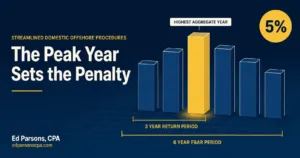
The form also carries the listing of your foreign financial assets, and the story it tells has to cover the full three year return period and six year FBAR period.
Picture a common fact pattern. A taxpayer inherits an account in Lisbon from a parent, assumes the local bank handles any tax duty because Portuguese tax is already withheld, and only learns about FBAR while applying for a mortgage stateside. Written well, that story establishes origin, belief, and discovery. Written as one sentence, it establishes nothing.
What the IRS Wants to See in the Narrative
The IRS instructions for the foreign offshore track ask for specific reasons, not conclusions. Reviewers want the whole story, including facts that do not help you.
A persuasive narrative reads like a factual timeline. It explains where each account came from, what you understood about your obligations and why, what event revealed the problem, and how quickly you acted once you knew.
If you relied on an accountant, a bank officer, or family guidance, the narrative should say who, when, and what advice was given. Professional reliance is one of the strongest non-willfulness facts available, but only when it is stated with specifics.
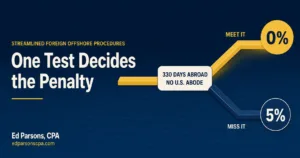
The narrative also has to agree with the rest of the certification. The residency section swears you had no U.S. abode and spent 330 full days abroad in at least one covered year, so a story built around daily life in the States quietly destroys the foreign track claim it sits inside.
| Factor | Weak Narrative | Strong Narrative |
| Measurement | Two or three generic sentences | A specific, factual account covering the full period of noncompliance |
| Timeline | No dates, no sequence of events | When accounts were opened, when income began, when the obligation was discovered |
| Source of misunderstanding | “I did not know I had to file” | Why you believed no filing was due: foreign upbringing, local tax paid, advisor guidance |
| Account origin | Accounts never explained | How each account came to exist: inheritance, employment, family, relocation |
| Unfavorable facts | Omitted | Disclosed and placed in context, as the instructions require |
| Discovery trigger | Unstated | The specific event that revealed the obligation, and what you did next |
The gap between the two columns is the gap between acceptance and a file the IRS can act on. Reviewers compare your statement against the FATCA data foreign banks already send, so the facts have to line up.
Common Rejection Triggers
These are the patterns that turn a certification into a problem:
- A bare “I did not know” with no explanation of why that belief was reasonable.
- A narrative that contradicts account records, wire history, or residency facts the IRS already holds.
- Omitting unfavorable facts the instructions explicitly require, such as periods when you were warned about filing duties.
- Template language copied from the internet, which reviewers recognize on sight.
- A story that quietly undercuts the non-residency test and pushes the filing into the wrong track.
- Joint filers signing one narrative that only explains one spouse’s conduct.
If you are drafting one of these, the thing worth holding onto is that a reviewer reads it as sworn evidence rather than as an explanation. My five short emails on streamlined filing come at the same point from the program side. They cover what the certification asserts, why a statement amounting to not knowing does not carry, what a reviewer looks for instead, and the fact that a rejected submission stays in the file and cannot be revised and sent back through the same door. The domestic form is the one they name. Send me the five streamlined emails. There is a confirmation email first, nothing follows until it is answered, and unsubscribing takes one click.
The Stakes on a Sworn Document
The certification is not a formality, and the downside is not just a rejected package:
- There is no appeal process for a streamlined submission the IRS declines to accept.
- Everything you submitted stays with the government and can support a later exam.
- A narrative that reads as willful invites FBAR penalties that can reach 50 percent of the account balance.
- A false statement on a perjury document creates exposure well beyond the tax file.
What an Accepted Certification Is Worth
The bar is high because the relief is total. These are the numbers an accepted Form 14653 makes go away:
- Non-willful FBAR penalties start at $10,000 per violation by statute, adjust upward for inflation, and can apply per account, per year.
- Form 8938 failures start at $10,000 and can add up to $50,000 more after IRS notice.
- Information return penalties for foreign trusts, gifts, and PFIC holdings stack on top of the account penalties.
- An accepted foreign track submission replaces all of it with a penalty of zero, plus the tax and interest you actually owed.
Why This Is Not a DIY Certification
Most people writing their own narrative either say too little to persuade or too much in the wrong direction. A rejected streamlined filing escalates quickly because your options narrow to voluntary disclosure or waiting for the audit, with your own sworn statement already in the file.
This is the point in the streamlined filing compliance procedures where professional judgment earns its keep. Our Streamlined Filing CPA Package builds the narrative from your actual facts, aligns it with the returns and FBARs in the same package, and files it once, correctly.