Skip to content

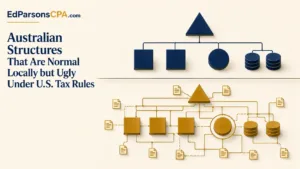
An Australian family trust is almost always a foreign trust for U.S. purposes, and the deed’s labels do not decide the rest. Who actually funded it drives grantor or non-grantor status, which then sets the forms: Form 3520 and Form 3520-A for owners, distribution reporting for U.S. beneficiaries, with loans and property use sometimes counting as distributions. Where the trust sits alongside a company and a super fund is in Australian structures that are routine locally and costly under U.S. rules.
In Australia, the family discretionary trust is furniture. The accountant set it up, a corporate trustee signs things, income gets streamed to the family every June, and nobody thinks about the deed between resolutions.
The U.S. reads the same deed as a foreign trust with unanswered questions attached, and it asks them of whichever family member became a U.S. person: settlor, funder, trustee, appointor, or beneficiary. The role you hold decides which problem you inherit.
Why the U.S. Almost Always Calls It a Foreign Trust?
U.S. rules treat a trust as domestic only when a U.S. court can supervise it and U.S. persons control its substantial decisions. An Australian family trust, with an Australian trustee, an Australian deed, and Australian administration, fails both prongs comfortably. Foreign trust is the near-universal starting point.
One definition to hold onto: U.S. person includes citizens and green card holders wherever they live, and dual citizens count in full. The analysis attaches the day the status does. It does not wait for anyone to feel American.
That label alone triggers nothing. It opens a cascade of further questions that the IRS frames on its foreign trust reporting page, and the cascade turns on facts the deed was never written to answer.
The Question That Decides Everything: Who Really Funded It
Australian practice separates the paper settlor from the real money. The settlor on the deed is often an accountant who contributed a nominal sum and walked away. The wealth arrived later, gifted or transferred in by the parents or the family company.
The U.S. ignores the ceremony and follows the funding. A person who gratuitously puts assets into the trust can be its grantor for U.S. purposes, whatever the deed calls them. From there the paths split.
Funding is also not a single moment. Later gifts, quiet top-ups, and assets parked in the trust over the years each re-ask the question, and one trust can end up with different people treated as owning different slices of it.
If a U.S. person funded the trust, and the trust has or can have U.S. beneficiaries, grantor trust status is the frequent result: that person may be treated as owning the trust’s income, and the familiar form pair arrives, the same Form 3520 and 3520-A framework that applies to SMSFs, with the owner responsible for a substitute return when the trustee does not file.
If the funders were Australian and never U.S. persons, the trust is frequently a foreign non-grantor trust from the perspective of its U.S. family members. That sounds gentler. For a U.S. beneficiary, it is often the harder regime.
Here is how the deed’s cast of characters translates.
| Your Role | What Australia Sees | What the U.S. May Ask |
| Settlor on the deed | A formality, often a nominal amount. | Who actually funded the trust, then and since. |
| The real funder | Mum, dad, or the family company. | Whether a U.S. person’s transfers create grantor status. |
| Trustee or director | The administration role. | Whether control and duties create U.S. filings of their own. |
| Appointor | A standby safeguard. | Whether the power to replace the trustee colors the analysis. |
| Beneficiary | A name in a wide discretionary class. | Whether distributions, loans, or property use were reported. |
| Measurement | Measures roles by the deed’s labels. | Measures funding, control, and what actually moved. |
If You Are a U.S. Beneficiary: The Distribution Regime
Every distribution from a foreign non-grantor trust to a U.S. beneficiary is reportable on Form 3520, and the tax result depends on what the money was: current income, accumulated income from earlier years, or corpus. Australian family trusts do not produce the U.S.-style accounting that proves the split, and when the data is missing, default methods apply that assume the worst.
Accumulated income is where the regime shows its teeth. Distributions of income the trust earned and retained in earlier years can trigger throwback treatment: ordinary rates for the years involved, plus an interest charge, a structure deliberately built to make accumulation offshore unattractive.
The definition of distribution is wider than the bank transfer. A loan from the trust to a U.S. beneficiary, and even the rent-free use of trust property, can be treated as a distribution. The family beach house owned by the trust is a tax question the moment the U.S. family member holds the keys.
Distributions are the moment a family trust stops being a purely Australian matter. To see how the rest of the family’s arrangements look from the U.S. side, put my email on the list. Over six short emails I set the trust next to the things that usually sit around it, the family company, the super fund, Australian investments and franked dividends, and finish with how people put earlier returns right when something was left out. The first thing you will receive is a confirmation email, and the series waits on your click. Unsubscribing is one click too.
One Family, Three U.S. Problems
Run a common pattern. Australian parents built the trust and funded it entirely; their daughter later moves to the U.S. on a green card; her brother stays in Australia. The trust changes nothing about how it operates. Her status changes everything about what it means.
The year the trust distributes AUD 60,000 to her, that distribution belongs on Form 3520, with a missed filing carrying the greater of $10,000 or 35 percent of the amount. The year the trust lends her AUD 150,000 toward a house deposit, the loan may itself be treated as a distribution. The summers she spends in the trust-owned holiday unit raise the same question in a quieter voice.
And behind all of it sits the accumulation history she never saw: income the trust earned and retained before she ever moved, waiting to color any distribution that reaches her now. Her brother, meanwhile, has no U.S. issue at all. Same trust, same deed, same trustee. The variable was never the trust.
If You Hold the Power: Trustees, Appointors, Controllers
A U.S. person serving as trustee, or as director of the corporate trustee, is standing inside a foreign trust’s control room, and the filings that follow attach to responsibility, not to benefit. Signing the resolutions is participation, whatever the economics.
The appointor role deserves its own sentence, because Australians treat it as a fire extinguisher behind glass. The power to remove and replace the trustee is real control in waiting, and powers of that kind can color the U.S. ownership analysis even while they sit unused. Nobody plans for the appointor to be the person with the U.S. problem. It happens anyway.
Where Australian Practice and U.S. Timing Collide
The trust’s engine is the June resolution: income streamed on paper to whichever beneficiaries the year favored, often taxed to them in Australia whether or not cash moved. The U.S. does not recognize the ceremony. It asks what was actually distributed, to whom, and when, and its answer can put income in a different year, or a different hands, than the Australian return shows.
Streaming into a bucket company adds a second entity with its own U.S. questions, which is where the trust stops being a trust problem and becomes a family group structure problem, with the pieces interacting.
The Penalty Frame
The numbers follow the role. A U.S. beneficiary who fails to report a distribution faces an initial penalty of the greater of $10,000 or 35 percent of the distribution, under the rules the Form 3520 instructions set out. An owner’s missed trust return runs to the greater of $10,000 or 5 percent of the trust assets treated as owned. Each person, each form, each year stands alone, and a required but unfiled form can hold the audit window open on the entire return. Reasonable cause relief exists, but it is narrow, and the trustee being foreign, busy, or unaware is not reasonable cause by itself.
Common Mistakes With Australian Family Trusts
- Reading the deed’s settlor line as the U.S. answer. The U.S. follows the money, not the ceremony.
- Assuming a discretionary interest means nothing to report until cash arrives. Loans and property use can count.
- Treating the June resolution as the U.S. timing. The U.S. asks what actually moved, and when.
- Letting the trustee’s silence decide the filings. The substitute return lands on the U.S. owner anyway.
- Ignoring the appointor role because it has never been exercised.
- Reporting this year’s distribution while prior years’ accumulations sit unexamined.

What to Assemble Before Anyone Files
The analysis runs on documents Australians rarely keep in one place: the deed and any variations, the true funding history from day one, trustee resolutions for every year, the distribution and loan record by beneficiary, any use of trust property by U.S. family members, and a list of which roles U.S. persons have held and when.
If distributions, loans, or ownership years have already gone unreported, the correction is sequenced across people and years together, usually through a structured catch-up path, because one family member’s fix exposes the shape of another’s.

Classifying the trust, identifying the true grantor, separating income from corpus, and preparing the filings each role requires is the core of a Form 3520 CPA Filing engagement. Ed Parsons, CPA works through Australian family trust structures for U.S. citizens and dual citizens, role by role, year by year.