Skip to content
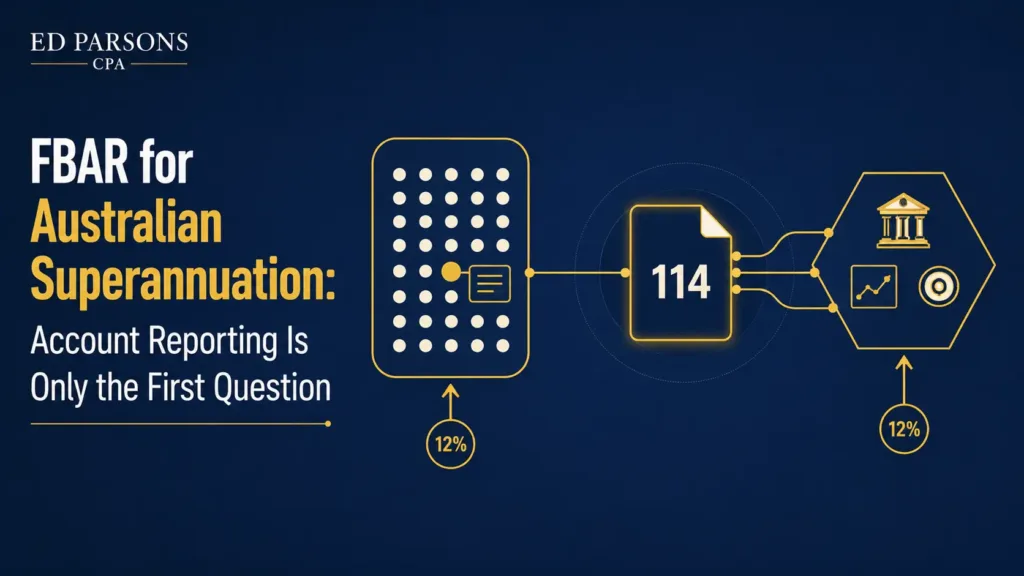
Australian superannuation accounts are generally reportable on the FBAR once your foreign accounts combined exceed $10,000, and a working balance clears that alone. But the account report is only the first of five U.S. questions: FBAR, Form 8938, foreign trust reporting, PFIC exposure, and income tax. The answers differ by structure. A retail or industry fund and a self-managed super fund are different animals under U.S. rules, and no single rule covers them all. How the U.S. classifies the fund itself, which drives the income tax answer, is the subject of U.S. tax on Australian superannuation.
Start with what you actually hold
Superannuation is compulsory: employers must pay 12% of ordinary earnings into a fund, the final legislated rate, and newly in effect payday rules deposit it with each pay run. So nearly every U.S. person who works in Australia builds a balance, usually without ever choosing to.
The U.S. analysis starts by naming what that balance actually is in your hands. Four answers are possible: an account in your name, an interest in someone else’s structure, authority over accounts you do not own, or only an entitlement to a future payment. Each answer routes to different forms.
The worry usually arrives as one of these:
“Do I report my super on the FBAR?”
“Is my SMSF a foreign trust?”
“My employer pays my super. Is it even mine yet?”
Short answers: generally yes, as your member account. Commonly analyzed that way, and the structure decides. And yes, for reporting purposes: mandatory contributions build your account whether or not you can touch it.
The five structures, kept separate
Industry funds. Large pooled funds run by professional trustees, historically tied to industries. You hold a member account with a statement balance and limited menu choices.
Retail funds. Commercially run pooled funds, often with broader investment menus. Same shape as industry funds for the account question; more member control raises the later questions.
Employer default arrangements. The fund your employer enrolled you in when you never chose one. Structurally a retail or industry membership; the point is that you may hold a reportable account you barely remember opening.
Choice and self-directed platforms. Member-directed investment options inside large funds, where you pick the shares and funds yourself. The account question stays simple; the PFIC question gets real.
Self-managed super funds. You are the trustee or a director of the corporate trustee, running your own fund with its own bank and brokerage accounts. This is a different structure, not a bigger version of retail super, and it earns its own analysis on every question.
Retail super vs SMSF: the guardrail in one table
| Retail and industry super | Self-managed super fund (SMSF) | |
| Who controls the fund | A professional trustee runs a pooled fund for many members | You are the trustee, or a director of the corporate trustee |
| What the member holds | An account balance inside someone else’s structure | The structure itself, plus its bank, brokerage, and asset accounts |
| Measurement | Typically one FBAR line: the member account at its highest annual value | Multiple FBAR lines are possible: the fund’s own accounts under your authority |
| Trust reporting pressure | Positions vary; employer-mandated funds are often argued outside the trust forms | Grantor trust analysis is common, and Forms 3520 and 3520-A enter the conversation |
| PFIC exposure | Depends on the platform and the investment menu you selected | Direct: every fund the SMSF buys is yours to classify |
This table is the article’s most important rule: never copy an answer across the columns. Two Australians with identical balances can carry entirely different U.S. filing obligations because one holds a member account and the other runs a fund.
The numbers that frame it
Five figures do most of the framing. The 12% contribution rate means balances grow whether anyone plans them. The $10,000 FBAR trigger under 31 C.F.R. 1010.350 is aggregate across all foreign accounts, so the super rarely travels alone. The current non-willful penalty runs to $16,536 per missed report. Five U.S. questions hang off one balance. And zero is the amount of binding IRS guidance squarely on superannuation’s U.S. characterization, which is the honest number behind every hedge in this guide.
The FBAR answer, structure by structure
For retail, industry, and platform members, the member account is generally the reportable item: highest balance during the year, converted at the Treasury year-end rate. Preservation rules that block withdrawal until retirement rarely change that; access limits and reportability are different questions.
For SMSF trustees, the analysis widens. The fund’s own bank and brokerage accounts sit under your authority and often your financial interest, so a single SMSF can put several lines on your FBAR, and a U.S. person serving as trustee for family money can owe reports on accounts that were never economically theirs.
The four questions behind the FBAR
Form 8938 almost always follows. The IRS Form 8938 guidance treats an interest in a foreign pension plan as a specified foreign financial asset, valued at fair market value or at distributions received, so the super appears there even in years the analysis of other forms is unsettled.
The trust question is the contested one. Superannuation funds are Australian trusts, and U.S. practitioners split between employees’ trust treatment for employer-mandated funds and grantor trust treatment where control and personal contributions dominate, which is where SMSFs usually land. IRS revenue procedure relief for tax-favored retirement trusts helps some funds and arguably not others, and it never touches the FBAR or Form 8938 either way.
The PFIC question follows the investment menu. Australian managed funds and ETFs inside a choice platform or an SMSF are classic PFIC candidates, and whether Form 8621 attaches interacts with the trust characterization. The account-versus-fund mechanics are covered in our FBAR and PFIC guide.
The income tax question stays genuinely unsettled: contributions and fund earnings may be currently taxable under some characterizations, the treaty does not clearly defer them, and practitioners run both a conservative annual-inclusion approach and a disclosed treaty position. The general law that governs all foreign pensions, exceptions, control tests, and the manual’s examples, lives in our foreign pension FBAR guide.

The FBAR is the one form here with a settled answer, which makes it the easy part. The harder questions are the ones it does not reach: whether contributions are income, whether an SMSF brings its own trust returns, whether the funds inside it are PFICs. Put my email on the list for six short emails that take those questions, and the family company, the treaty and the catch-up route, one at a time. Expect a confirmation email first; the series starts once you click it, and you can unsubscribe from any email.
Common mistakes with super
Six patterns produce most of the repairs we see. Copying an SMSF answer onto retail super, or the reverse. Treating preserved-until-retirement as not mine yet, when access limits rarely erase the account. Reporting the FBAR and stopping while the Form 8938 line stays blank. Assuming the treaty settled the tax, when the characterization is the unsettled part. Ignoring the investment menu, where the PFIC layer lives. And importing a friend’s position, because two funds with different structures earn different answers.
Questions clients ask about super and the FBAR

Classify first, then file
The full account map behind all of this, thresholds, categories, and control rules, lives in our advanced FBAR reporting guide, and when prior years are already missing, the correction lanes are compared in how foreign account mistakes are repaired. A dedicated Australia-U.S. tax series is on its way to this site, and this guide is the FBAR anchor it will build on.
At Ed Parsons CPA, super engagements start with classification: structure, control, and what you actually hold, before any form is chosen. The FinCEN Form 114 FBAR CPA Filing service carries the account side, including SMSF multi-account files, and the Form 8621 CPA PFIC Filing service classifies and files the fund layer inside choice platforms and SMSFs.