Skip to content
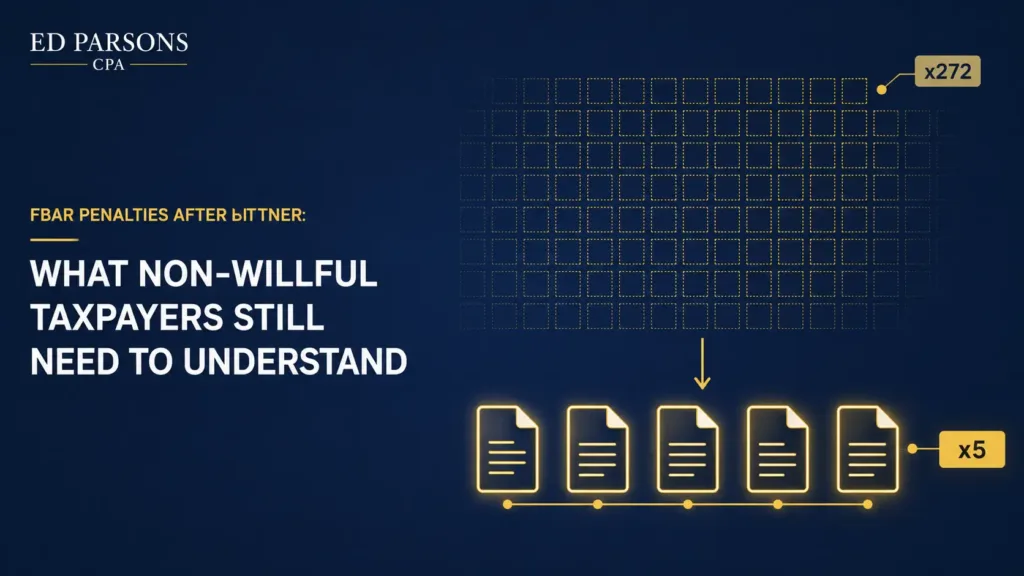
After Bittner v. United States, the non-willful FBAR penalty accrues per annual report, not per account: currently up to $16,536 for each missed year, inflation adjusted. Willful exposure was never touched: it remains the greater of $165,353 or 50% of each account’s balance, per year. The decision changed the arithmetic of honest mistakes. It changed nothing about willfulness, eligibility for the correction programs, or the need to repair the missed years the right way. How the willful side compares, statute of limitations included, is set out in FBAR penalties: non-willful vs willful.
One case, two readings, a $2.67 million difference
Alexandru Bittner, an immigrant who spent years abroad, came home to five missed FBARs covering dozens of accounts: 272 account-years in all. The government read the statute per account and demanded $2.72 million. He read it per report and offered $50,000. In Bittner v. United States, the Supreme Court agreed with him, five votes to four.
That is the whole holding, and it is worth stating precisely: a non-willful violation is the failure to file an accurate annual report. One missed report is one violation, whether it should have listed one account or sixty.
The case existed because the appeals courts had split. The Ninth Circuit had counted per form in United States v. Boyd; the Fifth Circuit had counted per account in Bittner’s own case, producing the $2.72 million demand. The Supreme Court took the case to end that split, and ended it in the taxpayer’s favor.
The question usually arrives in one of three forms:
“Is the FBAR penalty per account or per form?”
“I have eight foreign accounts. Is that eight penalties every year?”
“Did the Supreme Court cap FBAR penalties?”
Short answers: per form, if the failure was non-willful. No, one per missed year, if non-willful. And no: the Court counted violations, it did not cap penalties, and the willful framework never moved. That last distinction carries this entire article.
Non-willful vs willful: the framework after the decision
| Non-willful, after Bittner | Willful, unchanged | |
| How it accrues | Per annual report, however many accounts it should have listed | Per account, per year, tied to each account’s balance |
| Statutory base | $10,000, inflation adjusted | Greater of $100,000 or 50% of the account balance, inflation adjusted |
| Measurement | Currently up to $16,536 per report | Currently the greater of $165,353 or 50% of the balance |
| Five accounts, five missed years | Five penalties at most: up to $82,680 in total | Twenty-five potential penalties, each at the willful floor or half the balance |
| Constitutional posture | Settled at the Supreme Court | Excessive fines litigation ongoing; the circuits are split |
The statutory split lives in 31 U.S.C. 5321: the non-willful penalty attaches to the violation, which Bittner tied to the report, while the willful penalty is expressly measured against the balance in each account. Nothing in the opinion could shrink willful exposure, because the statute itself builds willful penalties account by account.
The numbers that matter now
- $2.72 million vs $50,000: the two readings of the same five missed reports that the Court chose between.
- 5 to 4: the margin. One vote separated per report from per account.
- $16,536: the current non-willful ceiling, per report, per year, adjusted for inflation.
- $165,353 or 50% of the balance: the willful floor, per account, per year, untouched by the decision.
- $300,000 out of $12.5 million: what the constitutional excessive fines argument actually removed in Schwarzbaum.
A worked example under both standards
Take a taxpayer with six foreign accounts, a checking account, a brokerage, an old pension, an insurance policy with cash value, and two savings accounts, across four missed years.
If the facts are non-willful, the exposure after Bittner is four potential penalties, one per missed report, capped at $66,144 in total at the current adjusted amount, and often assessed lower. The account count is irrelevant to the math.
Run the same facts as willful and the frame inverts: twenty-four account-year violations, each starting at the greater of $165,353 or half that account’s balance. The floor alone runs to seven figures before any balance is large.
Same accounts, same years, two different worlds. That is why the real fight in these cases is never the arithmetic. It is the classification, and the classification is decided by your record.
What per report changes in practice
For genuinely non-willful taxpayers with many accounts, the ceiling collapsed. Eight accounts across five missed years is five potential penalties now, not forty. The exposure that used to scale with your account count scales with your missed years.
Two softeners sit below that ceiling. The amount is up to $16,536, and examiners retain discretion to assess less under the mitigation framework. And the penalty is not automatic at all where reasonable cause exists and the record genuinely supports it.
Treat the ceiling as a ceiling, not a quote. IRS guidance and the examination manual’s mitigation thresholds give examiners room to land below it where cooperation, account sizes, and compliance history warrant, which is one more reason the record you build matters more than the statute you read.
One hard edge remains: the assessment window runs six years from each report’s due date, so the exposure ages off slowly, and a correction filed today still has to account for every year inside that window.
What Bittner did not touch
It did not touch the willfulness standard. Recklessness and willful blindness still satisfy it, the Schedule B question still puts filers on notice, and the conduct cases still control who counts as non-willful in the first place.
It did not touch correction eligibility. The streamlined programs still demand a truthful non-willfulness certification, the delinquent procedures still demand fully reported income, and IRS contact still closes both doors.
And it did not touch the willful arithmetic. A taxpayer whose facts read reckless does not get per-report counting; they get the balance-based framework, stacked across accounts and years, which is how nine-figure balances turn into eight-figure judgments.
It did not touch discovery either. FATCA feeds from foreign institutions and the income lines on your own returns still surface the accounts. The decision changed what a non-willful violation costs, not how it gets found.
Schwarzbaum and the constitutional trim
In United States v. Schwarzbaum, the Eleventh Circuit held that willful FBAR penalties are fines subject to the Eighth Amendment’s Excessive Fines Clause, then struck exactly $300,000 from a judgment above $12.5 million: three $100,000 minimum penalties stacked on one small account that never held more than about $16,000. Everything else stood.
The First Circuit reads the clause the opposite way, the government chose not to take the split to the Supreme Court, and courts elsewhere have adopted Schwarzbaum’s reasoning while still refusing to reduce penalties that were proportional to the accounts.
The proportionality lesson cuts against comfort. The only penalties struck were flat minimums stacked on an account worth a fraction of them; penalties set at half of large balances were called proportional and stood in full. The bigger the account, the less this argument will ever do.
Read that record honestly: the constitutional argument is a trim, available in some courtrooms, for the most lopsided line items. It is not a shield, and nobody should choose their correction strategy assuming a court will rescue the math later.
Counting violations correctly is not the same as repairing the years, and the second job is the one that decides what you actually pay. That is the ground the five short emails I send on streamlined filing cover. They deal with the route back for a failure that was not willful, the eligibility conditions attached to it, the certification you sign under penalty of perjury, and the reason a submission gets one attempt rather than a first draft. Nothing in them touches the case law above. Send me the five streamlined emails. A confirmation email goes first and the series stays put until you click it. Every email carries an unsubscribe link.
The strategy the arithmetic does not replace
Every number above is the cost of doing nothing. The correction programs exist to beat both columns of the table: the delinquent procedures ordinarily at zero, streamlined at 0% or 5%, each with conditions. Whether your facts qualify starts with the willfulness analysis in is that non-willful, and the lanes themselves are compared in how foreign account mistakes are repaired.
The penalty exposure also only counts the accounts the analysis finds. Pensions, insurance cash value, entity and trust accounts, and signature authority all feed the report count, and the full map lives in our advanced FBAR reporting guide.

Common mistakes with the new math
- Reading Bittner as a cap on willful exposure. It counted non-willful violations, nothing more.
- Running the old per-account arithmetic and panicking, or the new per-report arithmetic and relaxing.
- Treating the penalty as automatic and the classification as fixed. The facts decide both.
- Planning around the Excessive Fines Clause while the circuits disagree and the trims stay small.
- Letting penalty math replace correction analysis. The programs beat both numbers when you qualify.
- Forgetting reasonable cause exists for non-willful violations, if the record is built to support it.

At Ed Parsons CPA, the penalty conversation starts with an account inventory and ends with a lane, because the exposure is never just the statute times the years. The FinCEN Form 114 FBAR CPA Filing service handles current-year compliance across every account category, and the IRS Streamlined Filing CPA Package repairs the missed years as one coordinated file, before the per-report math ever becomes a bill.
Bittner made honest mistakes cheaper to fix. It made nothing safe to ignore. The taxpayers who benefit from the new math are the ones who move while the classification is still theirs to shape.