Skip to content

If you held a foreign bank account with a balance exceeding $10,000 at any point during the year, FBAR filing was required. Missing that deadline triggers IRS penalties starting at $10,000 per account, per year, for non-willful violations. Willful violations can reach 50% of the highest account balance per year. The IRS Streamlined Filing Compliance Procedures offer a legal path to come into compliance and significantly reduce penalty exposure before the IRS contacts you first.
Foreign banks are now required by federal law to report your account information directly to the IRS. If you have unreported foreign accounts and assumed no one would notice, that assumption has likely already failed. The way a missed FBAR is actually repaired is covered in FBAR and streamlined filing correction paths.
The Foreign Account Tax Compliance Act (FATCA) requires foreign financial institutions to identify and report U.S. account holders directly to the IRS. That data is being cross-referenced continuously. The question is not whether the IRS will find out. It is whether you address this before they contact you.
What Is FBAR and Who Must File?
FBAR stands for Foreign Bank Account Report, filed on FinCEN Form 114. It is separate from your federal income tax return and filed with the Financial Crimes Enforcement Network, not the IRS directly.
You are required to file an FBAR if you meet all three of these conditions:
- You are a U.S. person (citizen, resident, or entity formed in the U.S.)
- You have a financial interest in, or signature authority over, one or more foreign financial accounts
- The aggregate value of all those accounts exceeded $10,000 at any point during the calendar year
That last point matters. The $10,000 threshold is cumulative across all foreign accounts. Two accounts each averaging $6,000 both trigger the filing requirement. Many people miss this detail entirely.
Why the IRS Already Knows About Your Foreign Accounts?
FATCA, enacted in 2010, created a global reporting framework. Foreign financial institutions must register with the IRS and report account balances, interest, dividends, and proceeds for accounts held by U.S. persons.
The scale of this reporting network is significant:
- More than 110 countries currently participate in FATCA reporting
- Banks in Canada, the UK, Germany, India, the Philippines, and dozens of other nations are already reporting U.S. account holder information
- The IRS also receives data through the Common Reporting Standard (CRS) and bilateral tax treaties
For more information on how the IRS tracks foreign financial accounts, the IRS FBAR page outlines the legal framework and filing requirements in detail.
The Penalty Math: Non-Willful vs. Willful
FBAR penalties are calculated separately for each account, for each year of non-compliance. The distinction between non-willful and willful is the most important factor in determining your total exposure.
| Category | Penalty Per Account / Year | Cap | Notes |
| Non-Willful | Up to $10,000 | No statutory cap | Adjusted for inflation |
| Willful | Greater of $100,000 or 50% of balance | 50% per year | Can exceed account value |
| Criminal (Willful) | Up to $250,000 + 5 yrs imprisonment | Per violation | Rare but enforced |
A non-willful violation means you did not know about the filing requirement, or had a reasonable explanation for not filing. A willful violation means you knew and ignored the requirement, or deliberately concealed accounts.
The IRS does not need a formal audit to assess FBAR penalties. Five years of missed FBAR filings on two accounts could represent $100,000 or more in non-willful penalties alone. Willful classifications can dwarf that figure significantly.
The determination of willful vs. non-willful depends heavily on your personal facts, your financial history, and the narrative you present to the IRS.
What Is Streamlined Filing and How Does It Help?
The IRS Streamlined Filing Compliance Procedures were created specifically for U.S. taxpayers who have unreported foreign accounts and can demonstrate that the failure was non-willful.
There are two tracks:
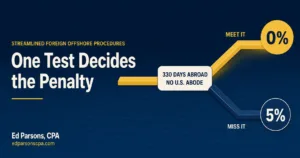
- Streamlined Foreign Offshore Procedures (SFOP): For U.S. persons who lived outside the U.S. during the relevant period. Penalty: zero.
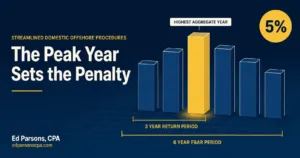
- Streamlined Domestic Offshore Procedures (SDOP): For U.S. residents. Penalty is 5% of the highest aggregate balance of all unreported foreign financial assets across the covered years.
Both tracks require amending or filing three years of federal income tax returns and filing six years of FBARs. Both also require a non-willful certification statement explaining why you did not comply.
The key benefit is a significant reduction in total penalty exposure compared to the standard FBAR penalty structure. That benefit disappears the moment the IRS opens an examination of your returns or contacts you about non-compliance. If you are considering your options, a structured review of your account history is what sets the correct streamlined track, and the FBAR rules for complicated accounts show what that review has to cover.

Setting the right track is the part nobody can do for you from a page, and it is where the five short emails I send on streamlined filing spend most of their time. One of them works through the two tracks and the residency test that separates them, the domestic side carrying a penalty on the highest year-end value of your foreign assets and the foreign side carrying none, and why green card holders and anyone who moved partway through a year so often read that test wrong. Send me the five streamlined emails. A confirmation note arrives before any of them and nothing follows until you answer it. Every email has an unsubscribe link at the foot.
Who Qualifies for Streamlined Filing?
Eligibility is based on several factors the IRS evaluates before accepting a submission:
- Your failure to file FBAR was non-willful, meaning no intentional concealment
- You are not currently under IRS civil examination or criminal investigation
- You did not previously use the Offshore Voluntary Disclosure Program (OVDP) for these accounts
- You meet the residency requirements for the program track you are applying under
The non-willful certification is the most scrutinized element of any streamlined submission. The IRS expects a specific, factual narrative that explains the source of your misunderstanding. Vague statements such as ‘I did not know’ are insufficient on their own. Which streamlined track fits turns on residency, as I set out in domestic vs foreign streamlined filing, and the same correction reaches Form 8938 penalties, Form 3520 penalties on foreign trust distributions and unreported PFICs.
Common Mistakes That Increase Your Exposure
Many people make their situation significantly harder by acting too quickly or without proper guidance:
- Amending returns without also filing missing FBARs creates an incomplete submission that does not qualify for streamlined treatment
- Filing FBARs through the standard delinquent procedure when streamlined eligibility exists leaves penalty reduction on the table
- Submitting a weak non-willful narrative that the IRS rejects turns your submission into a standard examination
- Disclosing accounts informally in a prior return, email, or conversation before building the proper narrative can complicate the willfulness analysis
- Waiting until the IRS contacts you removes streamlined eligibility entirely
What Happens If You Do Nothing?
Inaction does not stop the clock. The FBAR statute of limitations is six years from the filing due date. Willful violations carry an effectively unlimited lookback because penalties compound across every open year.
The IRS issues FBAR penalty notices through formal correspondence once an account holder is identified in reporting data. Once that contact occurs, streamlined eligibility is gone. You are left with standard penalty abatement arguments, which require demonstrated reasonable cause and are harder to win.
Criminal referrals for willful non-disclosure, while uncommon, have resulted in prosecutions for U.S. taxpayers with deliberately concealed offshore accounts. The Department of Justice has prosecuted cases involving relatively modest account balances when willfulness is clearly established.
If you have unreported foreign accounts, the lowest-risk path is to address the exposure before the IRS does it for you. Ed Parsons CPA is built for this situation: a CPA licensed since 2009, reviewing your account history, determining the correct streamlined track, and preparing the non-willful certification narrative the IRS requires. Start with the FBAR rules for complicated accounts.