Skip to content

Your business can owe its own FBAR. U.S. persons include domestic corporations, partnerships, LLCs, trusts, and estates, so a U.S. company with foreign accounts files for itself once those accounts top $10,000 combined. That filing never covers you. Majority owners and account signers carry separate, personal FBAR obligations over the same accounts, and the usual answer to entity or personal is both. Owners who find a missed entity FBAR are often tempted to just file it quietly, and I compare that with the formal route in quiet disclosure versus streamlined.
Your company is a U.S. person too
The FBAR statute defines U.S. persons broadly, and the IRS FBAR page lists them plainly: citizens and residents, and then corporations, partnerships, limited liability companies, trusts, and estates organized under U.S. law. Five kinds of entities, each a filer in its own right.
Tax classification changes none of it. A single-member LLC the tax code disregards is still a U.S. person under Title 31, with its own FBAR for its own foreign accounts, whatever your 1040 absorbed.
Founders rarely hear this because nothing in the formation process says it. The operating agreement speaks state law, the tax software speaks the Code, and no onboarding checklist anywhere mentions FinCEN. The obligation exists anyway, from the first foreign account forward.
The question walks in three ways:
“My LLC has the foreign account, not me. Who files the FBAR?”
“Our company’s overseas payroll account: is that mine to report too?”
“Does the merchant account with our foreign payment processor count?”
Short answers: probably both of you. Quite possibly, if you own most of the company or can sign on the account. And maybe, which is the honest answer, because processor balances turn on facts this article treats carefully below.
Entity FBAR vs personal FBAR, side by side
| The entity’s FBAR | Your personal FBAR | |
| Whose obligation | The company’s, as a U.S. person in its own right | Yours, through majority ownership or signing power |
| What it covers | The foreign accounts the entity holds | The same accounts again, through your interest or authority, plus everything personal |
| Measurement | $10,000 aggregate across the entity’s foreign accounts | $10,000 aggregate across everything you reach, business and personal combined |
| Who signs it | An authorized officer, for the entity | You, for yourself |
| One filing covers both? | Never. The obligations are separate | Never. Appearing on the entity’s report is not filing |
The numbers that frame it
- 5: kinds of U.S. persons beyond individuals: corporations, partnerships, LLCs, trusts, and estates.
- 2: FBARs one foreign account can generate before a single co-signer is added.
- $10,000: the trigger, and your personal aggregate combines business-reached accounts with everything personal.
- 100%: of each account’s maximum value reports on every filer’s FBAR. Nothing prorates.
- $16,536: the current non-willful penalty per missed report, per filer, per year.
The founder’s second FBAR
Own more than 50% of the company, by vote or value, and its foreign accounts become your indirect financial interest: the same accounts, at the same full maximum values, on your own report.
Sign on the accounts, and authority creates the duty even without the ownership. Every signer’s obligation is personal, and the company’s filing discharges none of them, no matter how many names its report lists.
The aggregation is where founders get surprised twice. Your personal $10,000 test combines the business accounts you reach with your own savings and investments abroad, so a modest company account can push a modest personal account over the line together.
The trust and estate variants are real too. A domestic trust holding a foreign account files as itself, its trustee may hold authority besides, and an estate mid-administration inherits the decedent’s foreign accounts along with the filing duty.
One company, count the FBARs
A Miami founder runs an e-commerce company through her U.S. LLC. The LLC holds a payroll account abroad for the overseas team and a merchant account at a foreign acquiring bank. She owns 100% and signs on both; her operations manager, also a U.S. person, signs too. She keeps a small savings account abroad from before the business.
Count the reports. The LLC files its own FBAR for the two business accounts. The founder files personally: the same two accounts through ownership and authority, plus her savings account, three lines, with the business balances pushing her personal aggregate over $10,000 even in a lean year.
The operations manager files a third FBAR, authority only, two lines, for money that was never his. Three filers, one small company, and every missed report carries its own penalty clock. None of this is exotic; it is the default arithmetic of a U.S. business banking abroad.
Default arithmetic is the right way to think about it, and the same counting catches the founder personally long before the company reaches a big number, because the test adds every foreign account you touch together rather than looking at each one alone. That is where my five FBAR emails begin, and they go on to the part that decides the cost of a missed year, which is how the failure gets characterised rather than how many accounts were involved. Send me the five FBAR emails. Confirming your address is the step in between and nothing arrives until you do. Every email has an unsubscribe link.
The four account types businesses actually hold abroad
Payroll accounts. The local account that pays your foreign team is a bank account of whoever holds it. If your U.S. entity holds it directly, it goes on the entity’s FBAR; the owners and signers run their own analysis on top.
Operating and escrow accounts. Escrow is where care starts earning its keep. Legal title may sit with an agent, contractual rights may sit with you, and control over disposition may sit somewhere else entirely. Whose account it is, and whether it is anyone’s here, comes out of the escrow agreement, not out of a rule of thumb.
Merchant accounts. A merchant account at a foreign acquiring bank often analyzes as an account of the business that opened it. The settlement flow and the agreement decide, and the balance counts at its highest point, not its usual one.
Payment processor balances. A balance sitting with a foreign processor is reportable when the arrangement functions as an account with a financial institution, and not every platform does. Courts have drawn the line at function: in United States v. Hom, a money transmitter account was reportable while the online cardroom balances in that case were not. The contract and the flow of funds decide, which is why often, may, and requires review are the only honest verbs in this paragraph.
Consolidated filing, at exactly the depth it deserves
A U.S. entity that owns more than 50% of other entities can file one consolidated FBAR covering the group. That is a paperwork option, and it changes only who assembles the report.
The option has edges. Only entities owned above the 50% line ride along; anything below it files, or fails to file, on its own, and the consolidation never reaches the individual owners and signers.
It erases nothing personal. The founder’s indirect interest, each signer’s authority, and every individual obligation sit on top of the consolidated filing exactly as before. The FinCEN filing page carries the mechanics; the analysis of who owes what comes first.

Common mistakes business owners make
- Assuming the entity’s FBAR covered the owners and signers, or the reverse.
- Forgetting the tax-disregarded LLC still files as a U.S. person.
- Leaving the overseas payroll and operating accounts off the entity’s aggregate.
- Calling every escrow or processor balance an account, or none of them, without reading the contract.
- Treating the consolidated option as erasing anyone’s personal obligation.
- Splitting the personal aggregate: business-reached accounts count toward your own $10,000 test.

What to do with this discovery
Inventory in two columns: the accounts your entities hold abroad, and the accounts you personally reach through ownership or signing power. Then run each column through the categories, thresholds, and valuation rules in our advanced FBAR reporting guide.
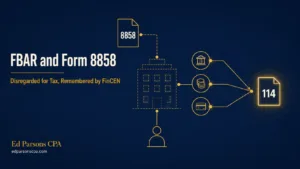
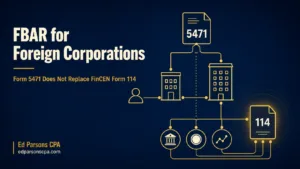
Structure decides the rest. Foreign corporations under your U.S. company bring the ownership-chain rules covered in foreign corporations and the FBAR, and foreign disregarded entities and branches bring the pairing covered in FBAR and Form 8858.
At Ed Parsons CPA, business FBAR engagements file both layers at once: the FinCEN Form 114 FBAR CPA Filing service builds the entity and personal reports from one account inventory, and where the structure includes foreign corporations, the Form 5471 CPA Filing service keeps the company-side reporting aligned with the accounts.