Skip to content
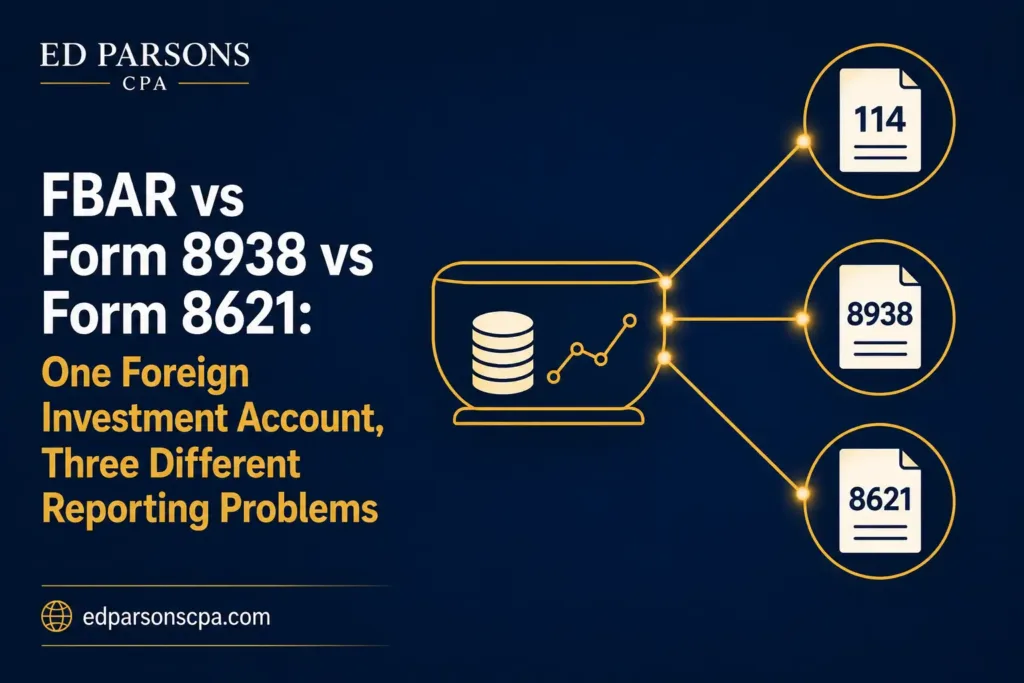
One foreign investment account can trigger three separate U.S. reports. The FBAR (FinCEN Form 114) discloses the account itself once all foreign accounts exceed $10,000 combined at any point in the year. Form 8938 discloses specified foreign financial assets on your tax return at thresholds starting at $50,000. Form 8621 reports and taxes each PFIC fund inside the account. Different agencies, different laws, different penalties. Filing any one of the three never satisfies the other two. If you already know one of these was missed, give me the accounts and the open years and I will scope the correction.
Three reports, three different questions
The FBAR asks where your accounts are. Form 8938 asks what foreign assets you hold. Form 8621 asks what your foreign funds earned and how the PFIC rules tax it.
The confusion usually arrives as a search box question:
“I filed my FBAR. Do I still need Form 8938?”
“My foreign broker only holds U.S. stocks. Is that still reportable?”
“Is Form 8621 the same thing as the FBAR for foreign funds?”
Short answers: yes, often. Yes, usually. No, not even close. The framework below shows why.
The stakes ride on the distinction. Each report carries its own penalty, assessed under its own law, and the agencies compare notes: FATCA data from foreign institutions, your own FBAR history, and the income lines on the return all describe the same money.
The side-by-side framework
| FBAR (FinCEN Form 114) | Form 8938 (FATCA) | Form 8621 (PFIC) | |
| Agency | FinCEN, a Treasury bureau | IRS | IRS |
| Authority | Title 31, Bank Secrecy Act | IRC Section 6038D (FATCA) | IRC Sections 1291 to 1298 |
| Reports | Foreign accounts you own or control | Specified foreign financial assets, including foreign accounts | Each PFIC fund’s income, gains, and elections |
| Where filed | BSA E-Filing System, separate from the return | Attached to your income tax return | Attached to your income tax return |
| Measurement | $10,000 combined maximum, any time in the year | $50,000 to $600,000, by status and residence | 75% passive income or 50% passive asset test |
| Penalty family | Up to $16,536 per report non-willful; greater of $165,353 or 50% of balance willful | $10,000, plus up to $50,000 after notice, plus a 40% accuracy penalty | Excess distribution tax at top rates plus interest; open assessment window |
The numbers at a glance
- $10,000: the FBAR trigger, all foreign accounts combined at any point in the year.
- $50,000 to $600,000: the Form 8938 range, set by filing status and residence.
- $16,536: the current inflation adjusted non-willful FBAR penalty, per report.
- $10,000 to $50,000, plus 40%: the Form 8938 penalty stack once the IRS sends notice.
- 75% or 50%: the income and asset tests that make a foreign fund a PFIC.
The account and the asset are not the same thing
The most misunderstood point in this comparison: Form 8938 looks at where the account is maintained, not where the investments were issued. The IRS Form 8938 questions and answers spell it out with examples: a financial account at a foreign institution is a specified foreign financial asset even when everything inside it is U.S. stocks and ETFs.
The FBAR reaches the same account for the same reason. Under 31 C.F.R. 1010.350, a foreign financial account is reportable regardless of what it holds.
The issuer question belongs to Form 8621 alone. U.S.-registered funds are never PFICs; Irish, Canadian, UK, and most other non-U.S. funds usually are.
So one brokerage account abroad holding both U.S. ETFs and Irish ETFs triggers all three analyses: the FBAR for the account, Form 8938 for the account, and Form 8621 for the Irish funds only.
Put numbers on it. A single U.S. resident holds one foreign brokerage account that peaked at $120,000 during the year. The FBAR applies because $10,000 was passed, Form 8938 applies because $75,000 was passed at some point in the year, and Form 8621 applies to every non-U.S. fund inside the account, one filing per fund.
Of the three reports on this page, the third is the one that carries actual tax rather than a disclosure penalty, and it is the one people understand least. If a foreign account of yours holds non-US funds, my PFIC email series is about that column alone. Give it an email address and five emails come back, dealing with the tests that make a fund a PFIC, the default regime that taxes gains at top ordinary rates with an interest charge running back over your holding period, what the QEF and mark to market elections each require, and what an unfiled Form 8621 does to the assessment window. Nothing is sent until you click the confirmation email. Unsubscribe any time.
Relief exists on Form 8938, never on the FBAR
The IRS does grant duplicative reporting relief, on one side only. Under Treas. Reg. 1.6038D-7, an asset already reported on Form 3520, 5471, 8621, or 8865 does not need full re-reporting on Form 8938; you identify the filed forms in Part IV instead.
Two catches travel with that relief. The asset’s value still counts toward your Form 8938 threshold, and the relief runs in one direction only.
Nothing comparable exists for the FBAR. No IRS form, schedule, or disclosure ever substitutes for the FinCEN filing, and recent legislation left both obligations in place despite speculation that the duplicate reporting would end. That asymmetry is why the FBAR is the report most often missed by people who believe they are fully compliant.
The statute of limitations enforces the split. Omit more than $5,000 of income tied to a foreign asset and the assessment window stretches to six years; skip a required Form 8938 entirely and the window stays open until the form arrives.
Common mistakes I correct
- Filing the FBAR and assuming Form 8938 is covered, or the reverse.
- Skipping Form 8938 because the foreign account holds only U.S. securities.
- Treating the Form 8621 relief on Form 8938 as if it also excused the FBAR.
- Reporting year-end balances on the FBAR instead of each account’s highest value.
- Letting software prompts decide: they routinely miss entity, PFIC, and trust overlays.
- Quietly filing missed years before the eligibility and willfulness questions are answered.

Mixed compliance is normal and it is also the hardest thing to price from a page. The variables are small in number though: how many non-US funds, and which years are missing what. Give me the funds and the missing years and I will come back with what your facts actually require across all three reports. The questions run to holdings and years, with room to write out the history in your own words, and none of them ask for an account number. Nothing auto-replies here, so the answer you get is one I wrote.
When one, two, or all three are missing
Who ends up filing all three? Mostly expats who invest where they live, and new U.S. residents who kept the funds they built at home. Both groups usually learn about the three regimes in the wrong order, one notice at a time.
Mixed compliance is the normal fact pattern: FBARs filed with no Form 8938 behind them, or both filed on top of unreported fund income. The right repair depends on which reports are missing, whether the income was picked up, and whether the facts actually read as non-willful. Each penalty runs independently, so fixing one report does not pause the clock on the others.
The correction programs and their trade-offs are compared in how foreign account mistakes are repaired, and the account categories feeding all three reports are mapped in our advanced FBAR reporting guide.

Ed Parsons, CPA prepares all three filings as one coordinated file: FinCEN Form 114 FBAR CPA Filing, Form 8938 CPA FATCA Filing, and Form 8621 CPA PFIC Filing, so the account, the asset, and the fund never tell the IRS three different stories.