Skip to content

Form 5471 has five filer categories under IRC Sections 6038 and 6046. Each category triggers a different combination of schedules, and filing under the wrong category leaves required schedules missing. The IRS treats an incomplete Form 5471 the same as an unfiled return: the same $10,000 initial penalty, the same $60,000 maximum per form per year, and the same indefinite open statute of limitations under IRC 6501(c)(8). For taxpayers who filed under the wrong category in prior years and qualify as non-willful, the Streamlined Filing Compliance Procedures can correct the prior submissions without triggering standalone Form 5471 penalties.
Why the Category Choice Decides Everything?
The Form 5471 instructions run more than 50 pages because the form is really six forms in one, governed by which category triggers your filing obligation.
Categories 1, 2, and 3 cover transactional and acquisition events. Categories 4 and 5 cover control and shareholder positions. The schedule load ranges from a handful of pages to over a dozen detailed schedules.
Pick the wrong category and you file the wrong schedules. Miss a required schedule and the IRS treats the filing as incomplete, which counts as not filed at all under Section 6038.
The Five Categories and What Each Triggers
| Category | Who Files | Triggering Event | Core Schedules |
| Category 1 | U.S. shareholders of Specified Foreign Corporations (SFCs) | Section 965 transition tax exposure | E, H, I-1, P, Q |
| Category 2 | U.S. citizens/residents who are officers or directors when a U.S. person acquires 10%+ stock | Acquisition event by another party | A, B, C, F |
| Category 3 | U.S. persons who acquire, dispose of, or change ownership crossing 10% thresholds | Personal acquisition or disposition | A, B, C, F, O |
| Category 4 | U.S. persons who had control (more than 50%) for 30+ consecutive days | Direct or constructive control | A, B, C, F, G, H, I, J, M, P, Q, R |
| Category 5 | U.S. shareholders (10%+) of a Controlled Foreign Corporation | CFC status during any part of year | A, B, C, F, G, H, I, I-1, J, P, Q, R |
| Measurement | Ownership facts and corporate position | Year-specific event vs. ongoing status | Schedule count and complexity |
Category 4 and 5 filers carry the heaviest burden. A combined Category 4/5 filing routinely runs 30+ pages by itself.
What Each Schedule Actually Covers?
Schedules are not interchangeable. Each captures a data set the IRS uses to assess CFC income inclusions, intercompany transactions, and foreign tax credit eligibility.
- Schedule E: Foreign taxes paid or accrued
- Schedule G: Hybrid arrangements and treaty positions
- Schedule H: Current earnings and profits (E&P) calculation
- Schedule I: Summary of U.S. shareholder’s income from the foreign corporation
- Schedule I-1: GILTI inclusion calculation (NCTI starting 2026 under OBBBA)
- Schedule J: Accumulated E&P, PTI, and dividend tracking
- Schedule M: Transactions between the CFC and related U.S. parties
- Schedule O: Organization, reorganization, or acquisition of foreign stock
- Schedule P: Previously Taxed Earnings and Profits (PTEP) by shareholder
- Schedule Q: CFC income by income group (Subpart F, GILTI, tested income)
- Schedule R: Distributions from the foreign corporation
What Happens When You File the Wrong Category?
The damage from a miscategorized filing usually surfaces months or years after the original submission.
The IRS reviews the form, sees missing schedules, and applies the $10,000 incomplete-filing penalty. Continuation penalties begin to accrue 90 days after the IRS sends notice. The statute of limitations on the entire tax return for that year stays open under IRC 6501(c)(8) because the filing is treated as incomplete.
For background on how those penalties cascade in unreported scenarios, see Unreported Foreign Corporation Ownership and Streamlined Filing.
Conversational Questions From Taxpayers Discovering the Error
- “My accountant filed me as a Category 3 for years, but I owned 60% of the company. Was that wrong?”
- “I filed Schedules A through F only. My new CPA says I should have included Schedule J. What does that mean?”
- “The IRS sent a letter asking why my Form 5471 has no Schedule M. What is at stake?”
Common Mistakes Behind Wrong-Category Filings
- Treating Category 2 (officer/director reporting at acquisition) and Category 3 (shareholder reporting at acquisition) as interchangeable
- Filing as Category 3 instead of Category 4 because direct ownership was under 50%, ignoring constructive ownership under IRC 958
- Omitting Schedule J (E&P) for a Category 4 or 5 filer, which compounds errors in every future year
- Missing Schedule M when the CFC has any related-party transactions (loans, royalties, services)
- Filing Schedule O once and assuming subsequent ownership changes need no separate reporting
- Filing Schedule Q at the entity level instead of by income group
- Using prior year filings as a template after an acquisition, sale, or restructuring changed the obligation
How Streamlined Filing Corrects Past Miscategorization?
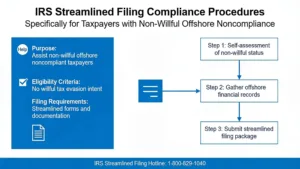
For taxpayers whose miscategorized filings stem from non-willful misunderstanding, the Streamlined Filing Compliance Procedures can absorb corrected Form 5471s into a broader compliance package covering three years of returns and six years of FBARs.
The submission requires a complete corrected Form 5471 for each year covered, all required schedules attached, and a non-willful certification under Form 14653 (SFOP) or Form 14654 (SDOP). SFOP carries no miscellaneous offshore penalty. SDOP applies 5% on the highest year-end aggregate balance.
The package replaces prior miscategorized filings rather than amending them. Standalone $10,000 incomplete-filing penalties are not assessed when the streamlined package is accepted.
For a structured engagement, see Form 5471 CPA Filing or the broader Streamlined Filing CPA Package.

Form 5471 Category FAQs

Next Step
If a prior Form 5471 was filed under the wrong category and the facts support non-willful failure, the streamlined correction path usually produces the lowest total exposure. The starting point is a category review against the IRC 958 ownership analysis and the schedule audit.
For a complete filing engagement, see Form 5471 CPA Filing. For the full streamlined package, see Streamlined Filing CPA Package.
External references: IRS Instructions for Form 5471 and About Form 5471.