Skip to content

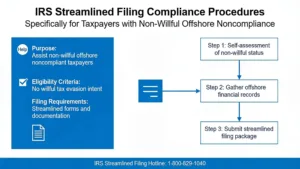
If you own 10% or more of a controlled foreign corporation and have not filed Form 5471, you face automatic IRS penalties of $10,000 per form, per year, per corporation, with continuation penalties pushing the maximum to $60,000 per form per year under IRC Section 6038(b). The statute of limitations on your entire tax return stays open under IRC 6501(c)(8) until the form is filed. For taxpayers who qualify as non-willful, the IRS Streamlined Filing Compliance Procedures may allow late Form 5471s to be filed alongside late returns at substantially reduced or zero penalty exposure compared to standard delinquent filing.
How the Form 5471 Penalty Actually Compounds?
The numbers are not small, and they do not stop accruing on their own.
- $10,000 initial penalty per foreign corporation, per annual accounting period, under IRC Section 6038(b)(1)
- Additional $10,000 for each 30-day period the failure continues after a 90-day IRS notice, capped at $50,000
- Maximum total: $60,000 per form, per year, per foreign corporation
- 10% reduction in foreign tax credits available under sections 901 and 960, plus an additional 5% per 3-month period of continued failure
- $10,000 per reportable transaction under Section 6046 for missing Schedule O information
The penalty is assessed automatically. No audit is required before the IRS issues the bill.
Who Actually Owes Form 5471?
Form 5471 reporting is broader than most U.S. taxpayers realize. The IRS defines five categories of filers, each triggering different schedules.
| Category | Who It Covers | Why It Matters |
| Category 1 | U.S. shareholders of Specified Foreign Corporations under Section 965 | Triggered by past transition tax exposure |
| Category 2 | U.S. citizens or residents serving as officers or directors when a U.S. person acquires 10%+ stock | Acquisition reporting, not ownership |
| Category 3 | U.S. persons who acquire or dispose of foreign corporation stock meeting thresholds | Transaction-based reporting |
| Category 4 | U.S. persons who held control (more than 50%) for 30+ consecutive days during the year | The heaviest schedule load |
| Category 5 | U.S. shareholders of a Controlled Foreign Corporation (CFC) | GILTI and Subpart F inclusions flow from here |
A Controlled Foreign Corporation exists when U.S. shareholders, each owning at least 10% by vote or value, collectively own more than 50% of the foreign corporation. Constructive ownership rules under IRC 958 sweep in family attribution and indirect interests.
Why $10,000 Is Not Where the Damage Ends?
The statute of limitations on the entire tax return for any year containing an unfiled Form 5471 stays open under IRC 6501(c)(8). A return from 2014 with a missing 5471 has the same assessment exposure as a return filed yesterday. Add unreported GILTI and Subpart F inclusions plus the foreign tax credit haircut, and the real cost runs well past the $10,000 sticker.
For 2026 the framework also shifted. The One Big Beautiful Bill Act renamed GILTI to NCTI, eliminated QBAI, and reset the Section 250 deduction to 40% with a 10% FTC haircut. Old unfiled years still follow prior rules; new years follow the updated rules. Either way the 5471 still has to be filed correctly.
Filing Path Comparison
| Path | Best Fit For | Penalty Exposure | Timeline | Measurement |
| Standard Delinquent Filing | Single missing year, clear reasonable cause | Full $10,000 to $60,000 per form | 30 to 120 days | Penalties assessed vs. reasonable cause granted |
| DIIRSP | Reasonable cause and no unreported income | Subject to penalty unless RC accepted | 90 to 180 days | RC defense strength |
| SFOP (Streamlined Foreign) | Non-U.S. resident, non-willful, unreported income | $0 miscellaneous offshore penalty | 60 to 120 days | Total penalty avoided |
| SDOP (Streamlined Domestic) | U.S. resident, non-willful, unreported income | 5% on highest year-end balance | 60 to 120 days | 5% penalty base vs. statutory exposure |
Choosing the right path is rarely obvious. The non-willful certification, the residency test, and the income inclusion calculations all interact, and the wrong selection can disqualify a submission.
Conversational Questions We Hear From Taxpayers
Real intake questions from taxpayers discovering Form 5471 obligations:
- “I started a software consulting LLC in Estonia three years ago. Do I really owe Form 5471?”
- “My father gifted me 30% of his Mexico-based manufacturing company. I had no idea this needed reporting.”
- “I am the only U.S. director on a Singapore tech startup’s board. Am I personally on the hook?”
- “My foreign company has not made distributions. Why does the IRS care about its income?”
Common Mistakes Made by Late Form 5471 Filers
- Filing late returns silently without invoking a disclosure program, hoping the IRS will not notice
- Claiming reasonable cause without documentation tied to specific facts and timeline
- Filing under the wrong category, which the IRS treats as not filing at all
- Missing Schedule J (E&P), Schedule P (PTI), or Schedule Q in a Category 4 or 5 filing
Failing to claim the PFIC overlap exclusion for a corporation that is both a CFC and a PFIC
- Treating the 10% threshold as direct ownership only, ignoring constructive ownership under IRC 958
- Submitting Streamlined paperwork without first running the residency and non-willfulness analysis
Where Streamlined Filing May Help?
For taxpayers who did not know about the Form 5471 obligation and can credibly certify non-willful non-compliance, the IRS Streamlined Filing Compliance Procedures can absorb late Form 5471s into a broader compliance package covering three years of returns and six years of FBARs.
The penalty structure is dramatically different from standard late filing. Under SFOP the miscellaneous offshore penalty is zero. Under SDOP it is 5% of the highest year-end aggregate balance of foreign financial accounts and assets. Compare that to $60,000 per form per year under the standard regime.
Credentialing matters. A weak non-willful narrative or a calculation error in the SDOP penalty base can sink an otherwise valid submission.
For a structured engagement covering Form 5471 inside or outside the streamlined framework, see Form 5471 CPA Filing. For the broader package that handles late returns, FBARs, and information returns together, see Streamlined Filing CPA Package.

Form 5471 and Streamlined Filing FAQs
There is no formal appeal. The documents you submitted stay with the IRS. Options narrow to voluntary disclosure or waiting for an audit. Getting the package right the first time is the only meaningful protection.

Next Step
If you have unfiled Form 5471s and the facts suggest non-willful failure, the streamlined path usually produces the lowest total exposure. The starting point is a confidential review of your ownership facts, the years involved, and the residency test results.
For a complete filing engagement, see Form 5471 CPA Filing. For the full streamlined package, see Streamlined Filing CPA Package.
External references: IRS Instructions for Form 5471 and IRS Streamlined Filing Compliance Procedures.