Skip to content
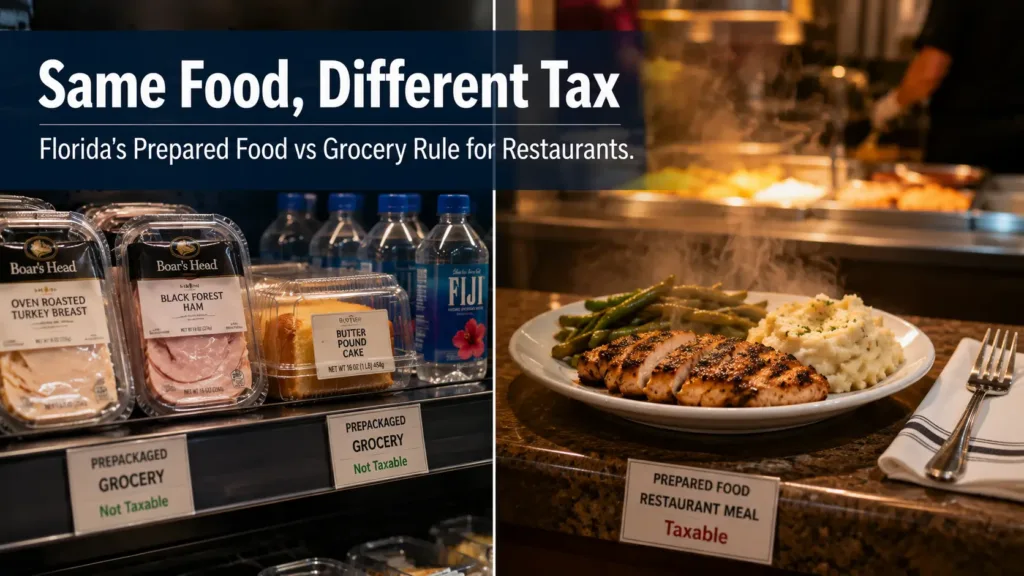
In Florida, grocery food products are generally exempt from sales tax, but food prepared, served, or sold by a restaurant is taxable. The line is set by how the item is sold, not just what it is. Under Florida Administrative Code Rule 12A-1.0115, a restaurant that also runs a separate grocery department can sell exempt food tax-free only when it keeps separate records for that department. Without that separation, the exemption falls away and the auditor can treat those sales as taxable. For any restaurant with a retail, market, bakery, or grab-and-go component, the tracking is the compliance.
A whole rotisserie chicken sold cold in sealed packaging can be exempt. The same chicken served hot on a plate is taxable. The food did not change. The way it was sold did, and in Florida that is what controls the tax.
For restaurants that sell anything beyond dine-in meals, a deli case, a market shelf, a bakery counter, packaged goods to go, this distinction is not academic. It is one of the most common places a Florida audit finds untaxed or mistaxed sales.
The Default Rule: Restaurant Food Is Taxable
Florida starts from a simple position. Food products for human consumption are generally exempt as groceries, but food served, prepared, or sold by restaurants, lunch counters, cafeterias, and similar businesses is taxable.
Anything furnished for consumption at tables, counters, or from trays and tableware is taxed. So is hot prepared food heated by the seller. For a traditional dine-in restaurant, nearly everything you sell falls on the taxable side by default.
When Groceries Stay Exempt: The Separate Records Rule?
The exemption does not disappear just because you are a restaurant. Rule 12A-1.0115 allows a restaurant that also maintains a separate department including groceries to sell those exempt food products without tax.
The condition is strict: you must keep separate records for that separate department. If a deli, market, or grocery section is not tracked separately, the Department is not required to honor the exemption, and prepared food sold through that department stays taxable regardless.
This is the single most important takeaway for mixed-format restaurants. The exemption is earned by your recordkeeping, not by the nature of the item alone.
Exempt Grocery vs Taxable Prepared Food
| Attribute | Exempt (Grocery / Food Product) | Taxable (Prepared Food) |
| Typical examples | Sealed cold cuts, packaged produce, bottled water, baking goods | Hot plates, sandwiches, dine-in meals, heated deli items |
| How it is sold | As a grocery item to take away | Served at tables, counters, or from tableware |
| Eating utensils included? | No, sold without utensils | Yes, packaged with a fork, napkin, or similar |
| Heated by the seller? | No | Yes, hot prepared food is taxable |
| Records needed | Separate department records to support exemption | Standard taxable sales records |
| Measurement (how the auditor quantifies it) | Verifies separate-department records and POS coding; if absent, the exemption is disallowed | Compares exempt-coded sales against the rules and taxes misclassified items across the audit period |
The Tests That Flip an Item to Taxable
Even classic grocery items become taxable when they are prepared or presented for immediate consumption. A few tests decide it:
- Eating utensils. A fresh salad sold without utensils as a grocery item is exempt. Pack it with a fork and napkin and it becomes taxable prepared food.
- Heat. Anything heated by the seller is a hot prepared food product and is taxable, even at a deli counter.
- Presentation. Food served at tables, counters, or on trays and dishes is taxable by how it is furnished.
- Specific taxable goods. Candy, chewing gum, and soft drinks are taxable even in a grocery setting.
Bakery and Grab-and-Go Traps
Bakeries face their own rules. Non-heated bakery products sold for off-premises consumption are exempt if the establishment has no eating facilities. Add tables and chairs, and a rebuttable presumption kicks in that the products are for on-premises consumption, which makes them taxable.
That presumption can be overcome, but only with the right packaging and separate register accounting that distinguishes exempt take-home sales from taxable on-premises sales. The mechanics matter, and like the tip and gratuity line, the issue is almost always how the sale is coded at the point of sale rather than the food itself.
Here is why the sorting work above is worth the trouble. A Florida auditor does not usually count your sales. They take your food cost, apply a markup they consider standard for your kind of operation, and call the result what you should have reported. Every item filed into the wrong bucket moves one side of that equation. I put six emails together on that arithmetic and what surrounds it, in the order an audit itself unfolds. Start the six emails and you will get a confirmation note first; the series only begins once you click the link in it. Unsubscribing later is one click as well.
Where Tracking Breaks Down
The failure point is rarely intent. It is the POS. When exempt grocery items and taxable prepared food share categories, or when a separate department exists on paper but not in the records, the exemption becomes impossible to prove after the fact.
That ambiguity is exactly what a markup-method projection and audit sampling feed on, because a single misclassified category can be magnified across the entire audit period. Reviewing your POS categories and department records against the rules before an audit does is the work that happens inside a Business CPA Tax Resolution Case Analysis.
Common Mistakes Restaurants Make
- Selling grocery items tax-free without keeping separate department records.
- Treating hot deli or rotisserie items as exempt because they started as groceries.
- Adding utensils to packaged salads or fruit without realizing it triggers tax.
- Running a bakery with seating but no register separation for take-home sales.
- Coding exempt and taxable items to the same POS category.
- Assuming to-go automatically means tax-free.
Questions Owners Actually Ask
Do I charge tax on a cold sandwich to go? What about my market shelf or the bottled drinks in the cooler? My cafe has a few tables, does that change my bakery sales? These questions decide real money, and they sit alongside the same classification risk found in use tax on equipment. If a notice has already arrived, start with what a Florida DR-840 audit notice means and what happens next.
What to Do Before an Audit Sorts It for You?
If your restaurant sells anything beyond dine-in meals, the safest move is to confirm your separate-department records exist, your POS categories match the rules, and your exempt sales can actually be proven. Doing that before a notice arrives is straightforward. Doing it under audit pressure rarely is.
A Business CPA Tax Resolution Case Analysis reviews how your prepared food and grocery sales are coded and recorded, identifies where the exemption is at risk, and quantifies the exposure before the Department does.

If the line has already been drawn against you — an auditor has reclassified items and produced a number — the work moves from classification to defence, and the two are not the same skill. How a Florida sales tax audit is actually defended covers what a documented rebuttal looks like once an assessment exists, including the markup calculation that usually carries it.
Frequently Asked Questions

Proactive Steps to Prepare for a Florida Sales Tax Audit
Sell both prepared food and groceries? Confirm your exempt sales can actually be proven before an audit. A Business CPA Tax Resolution Case Analysis reviews how those sales are coded and recorded and quantifies the exposure.