Skip to content

Florida’s state sales tax is 6%, plus a county discretionary surtax that pushes the combined rate to as much as 8% in some counties. It applies to most sales of goods and certain services. Use tax is the companion: 6% on taxable items used in Florida when sales tax was not paid. Any business with nexus in Florida, meaning a physical presence or more than $100,000 in taxable sales into the state, must register with the Florida Department of Revenue, collect the tax, file returns, and remit what it collects. This guide walks through the rate, what is taxable, use tax, nexus, registration, filing, and the problems that send businesses looking for help.
Florida has no state income tax, which is one of the reasons so many businesses choose to operate here. The trade-off is that the state leans heavily on sales tax revenue, and the Florida Department of Revenue enforces collection closely. For a business, sales and use tax is one of the most error-prone areas of compliance and one of the most aggressively audited. The rules are not complicated in theory, but the details, the county surtaxes, the nexus thresholds, the filing mechanics, and the exemptions, are where businesses get into trouble.
This guide covers what every Florida business needs to understand: the rate, what is taxable, the difference between sales tax and use tax, when you are required to register, how to collect and file, and the common mistakes that turn into audits and assessments.
What Is Florida Sales and Use Tax?
Sales tax and use tax are two halves of the same system. Sales tax is charged on taxable retail sales that happen in Florida. The seller collects it from the buyer at the point of sale and sends it to the state. Use tax is the backstop: it applies to taxable goods used, consumed, or stored in Florida when sales tax was not collected, most often on purchases from out-of-state sellers. Together they are designed so that the same purchase is taxed once, whether it was bought in Florida or brought in from elsewhere.
One point matters more than any other. The sales tax a business collects is not its money. It is collected on behalf of the state and held in trust until it is remitted. That distinction is the reason Florida treats unremitted sales tax so seriously, a theme this guide returns to at the end.
The Florida Sales Tax Rate
Florida’s general state sales tax rate is 6%, applied across the state on most taxable goods and many services. On top of that, each county may impose its own discretionary sales surtax. Those county surtaxes commonly run from 0.5% to 1.5%, and a few reach 2%, so the combined rate a customer pays ranges from 6% to roughly 8% depending on where the sale takes place.
Florida is a destination-based state, which means the rate is set by where the buyer takes delivery, not where the seller is located. A business shipping from one county to a customer in another applies the customer’s county rate. Because the 67 counties set and change their own surtaxes, a business selling across Florida cannot apply one flat rate to everything.
The $5,000 surtax cap
There is a quirk that trips up businesses making larger sales. For most transactions, the county discretionary surtax applies only to the first $5,000 of a single item of tangible personal property. The 6% state rate applies to the entire amount, but the surtax stops at $5,000. This cap does not apply to rentals of real property or to certain other categories, so it is easy to over-collect or under-collect on high-value sales without a system that handles it correctly.
Sales Tax vs. Use Tax
The two taxes share the same rate but apply in different situations. The table below lays out the distinction.
| Sales tax | Use tax | |
| What it is | Tax on a taxable sale made in Florida | Tax on taxable items used in Florida when no sales tax was paid |
| Measurement (what triggers it) | A taxable sale to a customer | Using or storing an untaxed item in Florida |
| Who remits it | Collected from the buyer, remitted by the seller | Owed and paid by the buyer or business directly |
| Rate | 6% state plus county surtax | 6% state plus county surtax |
| Common example | A Florida store selling furniture | Buying equipment out of state for use in Florida |
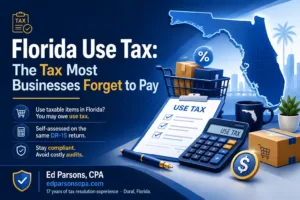
Use tax is the one businesses forget. If you buy equipment, fixtures, or supplies from an out-of-state seller and no Florida tax is charged, you generally owe use tax on it. For example, a restaurant that buys kitchen equipment from an out-of-state supplier without paying tax owes use tax on that purchase; our guide to use tax on restaurant equipment walks through that common trigger in detail.
What Is Taxable in Florida, and What Is Not
Florida taxes the sale of tangible personal property, meaning physical goods you can touch and move, along with a defined list of services. Common taxable items include retail merchandise, furniture, electronics, prepared food, and many rentals. Several categories of services are taxable as well, including nonresidential cleaning, pest control, and commercial detective or protection services.
Some important things are exempt. Most groceries, prescription medications, and many medical items are not taxed, and certain agricultural and manufacturing equipment is exempt. Software delivered electronically, including most software-as-a-service and digital products such as eBooks and streaming, is generally not taxable in Florida, though prewritten software delivered on physical media is.
Commercial rent is no longer taxed
This is a recent and consequential change. Until recently, Florida was the only state in the country that taxed commercial rent. That tax has now been repealed, so payments for leasing commercial office space, retail space, warehouses, and self-storage are no longer subject to state sales tax or county surtax. Many older guides still describe a tax on business rent. If your landlord is still charging it on current lease payments, that is a problem worth raising, and residential rent was never taxed in this way to begin with.
Do I Need to Collect Sales Tax in Florida?
This is the question most businesses arrive with, and it comes down to nexus, the connection between your business and the state that creates a duty to collect. There are two ways to have it.
Physical nexus
If your business has a physical presence in Florida, you have nexus. That includes an office, a store, a warehouse, employees working in the state, or inventory stored in Florida, including goods held in an in-state fulfillment center. Physical presence has always created a collection obligation, and it still does.
Economic nexus
A business with no physical presence in Florida can still be required to collect. Once your taxable sales delivered into Florida exceed $100,000 in a calendar year, you must register and begin collecting, even if you are based in another state. Florida’s threshold is measured by taxable sales, so exempt items do not count toward it, and there is no separate transaction-count test. The obligation begins on the first day of the month after you cross the threshold.
Marketplace sales sit slightly apart. If you sell through a marketplace that collects and remits Florida tax on your behalf, those sales are handled by the marketplace and do not count toward your own threshold. Sales through your own website still do. Many businesses selling on both a marketplace and their own store miss this split and either over-collect or fail to register when they should.
Florida Sales Tax Registration
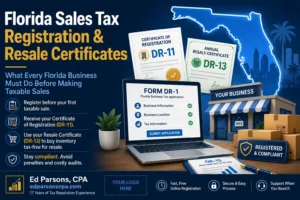
If you have nexus, you must register as a sales and use tax dealer before you begin conducting business. Registration is free and is done through the Florida Department of Revenue using the Florida Business Tax Application, Form DR-1. The online system walks you through a series of questions to determine exactly which taxes you need to register for.
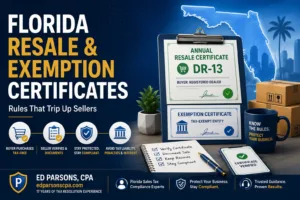
Once your application is approved, the Department issues two documents: a Certificate of Registration, Form DR-11, and a Florida Annual Resale Certificate for Sales Tax, Form DR-13. The Certificate of Registration must be displayed where you do business. The resale certificate lets you buy goods you intend to resell without paying tax on them, but it comes with a catch: if you buy something tax-free for resale and then use it yourself instead, you owe use tax on it, and misusing a resale certificate carries penalties. The Department also assigns you a filing frequency based on your expected volume.
Collecting, Filing, and Remitting
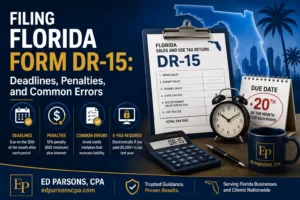
After you register, you collect the correct state and county tax on each taxable sale, then report and remit it on the Sales and Use Tax Return, Form DR-15. The Department assigns you a filing frequency, monthly, quarterly, twice a year, or annually, depending on how much tax you collect. Returns and payments are due on the 20th of the month following each reporting period, and if the 20th falls on a weekend or holiday, the deadline moves to the next business day. The Florida Department of Revenue’s sales and use tax pages set out the current forms and electronic filing options.
A few rules catch businesses off guard. You must file a return even for a period in which you had no sales, the so-called zero return. Businesses that paid $5,000 or more in sales tax during the prior state fiscal year are required to file and pay electronically. And there is a small reward for filing on time: a collection allowance of 2.5% of the first $1,200 of tax due, capped at $30 per reporting location, which you forfeit if you file or pay late.
Common Florida Sales Tax Problems
Most of the trouble businesses run into falls into a handful of categories, and they tend to compound quietly until an auditor or a notice brings them to the surface.
- Failing to register. Operating with nexus but no registration, often by out-of-state sellers who crossed the economic threshold without realizing it, builds up uncollected tax that the business itself becomes liable for.
- Charging the wrong rate. Applying a single rate statewide, ignoring the destination county surtax, or mishandling the $5,000 cap leads to under-collection that the business must make up out of pocket.
- Use tax that was never self-reported. Out-of-state equipment and supply purchases on which no tax was paid are a classic audit finding.
- Late or missing returns. A late return triggers a penalty of 10% of the tax due, with a $50 minimum, plus interest that accrues monthly. Small shortfalls grow.
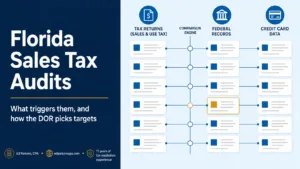
Florida sales tax audits are detailed, and certain industries draw extra scrutiny. The Department opens an audit with a Notice of Intent to Audit Books and Records, Form DR-840, and from there an auditor may use estimation methods that produce assessments far larger than a business expects. Restaurants, for instance, face particularly aggressive estimated audits; our guide to the Florida restaurant sales tax audit process shows how that unfolds and why the methodology matters.
The most serious issue is collected-but-unremitted tax. Because the sales tax you collect belongs to the state, Florida law treats it as state funds, and willfully failing to pay it over can be pursued criminally, not merely assessed as a civil penalty. A business that collected tax and used the money to cover operating costs is in a fundamentally different and more dangerous position than one that simply made a calculation error. This is exactly the situation where professional help is not optional.
When to Get Professional Help
Understanding the rules is one thing; resolving a problem is another. If you have received a DR-840 audit notice, fallen behind on returns, discovered years of unregistered sales, or collected tax you did not remit, the path forward is a strategy, not a form. A Business CPA Tax Resolution Case Analysis reviews your specific exposure, the assessments or notices you are facing, and the realistic options for resolving them, including how to limit the penalties and personal liability that Florida sales tax problems can create. The goal is to deal with the issue deliberately, before the Department does it for you.

That is the shape of the tax. Where it goes wrong is narrower than the rules suggest, and it repeats: the nexus threshold that started an obligation before anyone registered, the use tax nobody bills you for, the exempt sale without a certificate behind it, the filing patterns that attract a review, and the disclosure window that closes on first contact. I take one of those per email in a short series. Send it to my email. You will need to click the confirmation email before the first one goes out, and you can unsubscribe the moment it stops being worth reading.
Frequently Asked Questions

Facing a Florida Sales Tax Problem?
An audit notice, back returns, unregistered sales, or tax you collected but did not remit are all situations where the right move is a plan, not a form. Ed Parsons, CPA works with Florida businesses on sales tax exposure and resolution.
Start with a Business CPA Tax Resolution Case Analysis, which explicitly covers sales tax, payroll, and audit exposure. Prefer to talk it through first? Book a Business IRS Tax Debt Coaching Call.