Skip to content

The short answer
Any business that makes taxable sales in Florida must register as a sales and use tax dealer before it begins doing business, using the free online Florida Business Tax Application (Form DR-1). Once approved, you receive a Certificate of Registration (Form DR-11), which must be displayed at your business, and an Annual Resale Certificate (Form DR-13), which lets you buy inventory tax-free for resale. Operating with nexus but no registration leaves uncollected tax that the business itself becomes liable for.
Registration is the first compliance step for any Florida business that sells taxable goods or services. It is free and takes only a short time, but the timing matters, you must register before your first taxable sale, and the two documents it produces carry obligations of their own. This article walks through the process end to end. For the wider context, see our complete guide to Florida sales and use tax.
Registration at a Glance
- Registration is required before you make your first taxable sale in Florida.
- The Florida Business Tax Application (Form DR-1) is free and filed online.
- You receive a Certificate of Registration (DR-11) and an Annual Resale Certificate (DR-13).
- The Certificate of Registration must be displayed at your business location.
- Each Florida business location must be registered separately.
Who Must Register?
You must register if your business has nexus in Florida and makes taxable sales. Nexus comes from a physical presence in the state or, for a remote seller, from more than $100,000 in taxable Florida sales in the prior calendar year. In practice, the businesses that must register include:
- Retailers selling taxable goods or services in Florida.
- Businesses that rent or lease tangible personal property in the state.
- Providers of taxable services, such as nonresidential cleaning, pest control, or commercial protection.
- Out-of-state sellers with more than $100,000 in taxable Florida sales in the prior calendar year.
- Marketplace facilitators handling taxable sales delivered into Florida.
If either form of nexus applies and your sales are taxable, registration is mandatory rather than optional, and the obligation begins before the first sale, not after the Department notices you.
How to Register: Form DR-1
Registration is done through the Florida Department of Revenue using the Florida Business Tax Application, Form DR-1. It is free, and the online system walks you through an interactive set of questions to determine exactly which taxes you need to register for. There is no charge to register as a sales and use tax dealer. Because it is the same application used for other Florida taxes, the wizard may also ask about activities beyond sales tax, such as reemployment tax if you have employees.
You will need basic details about the business: its legal structure, federal employer identification number, business location, the date of your first taxable activity, and an estimate of your monthly sales. If you operate from more than one location in Florida, each location must be registered. The key rule is timing: you are expected to register before you begin conducting business, not after the sales start. During registration you can also enroll to file and pay electronically, which most businesses do, and you can save an unfinished application and resume it later.
What You Receive: Forms DR-11 and DR-13
Once your application is approved, usually within a few business days, the Department sends two documents and assigns you a filing frequency for your DR-15 sales and use tax return. The two documents do very different jobs.
| Certificate of Registration (DR-11) | Annual Resale Certificate (DR-13) | |
| What it is | Proof you are a registered dealer | Lets you buy inventory tax-free for resale |
| Measurement (what it does) | Authorizes you to collect and remit tax | Exempts qualifying resale purchases |
| What you do with it | Display it at your business | Give it to suppliers when buying for resale |
| The catch | Must be displayed and kept current | Use a resale item yourself and you owe use tax |
The Certificate of Registration must be displayed in a clearly visible place at your business. If you register to pay use tax only, you will not receive a resale certificate. Keep both documents on file; your certificate number is what you use to file returns.
The Resale Certificate’s Hidden Catch
The Annual Resale Certificate is a genuine benefit, it lets you buy goods you intend to resell without paying tax up front, so you are not taxed on inventory you will sell to a customer. But it comes with a trap. If you buy something tax-free for resale and then use it in your own business instead of selling it, you owe use tax on that item.
A common example is pulling a product from resale inventory to use in the shop, or buying supplies under the certificate that are really for internal use. The certificate is meant only for goods that will genuinely be resold, not for equipment, office supplies, or anything the business consumes itself. Florida also provides civil and criminal penalties for fraudulent use of a resale certificate, so it is not a document to use loosely. The rules around resale and exemption certificates are worth understanding before you start handing the certificate to suppliers.
The Real Risk: Nexus Without Registration
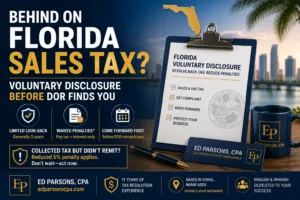
The most serious registration problem is not a paperwork error. It is operating with nexus in Florida and never registering at all. This happens most often to out-of-state and online sellers who cross the economic threshold without realizing it, but it also catches in-state businesses that simply never set up their account. By the time it surfaces, through an audit, a customer issue, or a routine cross-check, the unreported period can already span several years.
The danger is that the duty to collect tax existed whether or not you registered. Every taxable sale you made during that time generated tax you were supposed to collect, and if you did not, the business itself, not your customers, is liable for it, along with penalties and interest. Because there is no statute of limitations until you register and file, that exposure can reach back years. If your business has been operating unregistered, a Business CPA Tax Resolution Case Analysis reviews how far back the exposure runs and the cleanest way to get compliant while limiting the damage, which is far better than waiting for the Department to find the gap first.

Registering is the easy part. What follows it is where businesses get into trouble, and it is rarely one thing. The nexus threshold decides when you were supposed to start. Use tax covers what you bought rather than what you sold. Resale and exemption certificates decide whether an exempt sale survives an audit. Reporting patterns decide whether you are selected at all, and voluntary disclosure decides how much of it you can still fix on your own terms. I write about each in a short email series. Send it to my email. Watch for the confirmation email, because the series does not start until you click it. One at a time, unsubscribe whenever you like.
Common Registration Mistakes
- Making taxable sales before completing registration.
- Operating with nexus, including as a remote seller over the threshold, without registering at all.
- Failing to display the Certificate of Registration where it is required.
- Using a resale certificate for purchases you end up using yourself, then not paying use tax.
- Forgetting to register each separate Florida business location.
- Letting registration details go stale after a change in ownership or address.
For official guidance, the Florida Department of Revenue’s registration pages and its sales and use tax pages walk through the application and the certificates, though neither replaces advice on your own situation.

Been Selling in Florida Without Registering?
Unregistered sales build up tax the business itself has to cover, and the exposure grows the longer it goes unaddressed. Ed Parsons, CPA helps Florida and out-of-state businesses get registered and clean up back exposure before the Department of Revenue does. Start with a Business CPA Tax Resolution Case Analysis, which explicitly covers sales tax registration and exposure.