Skip to content
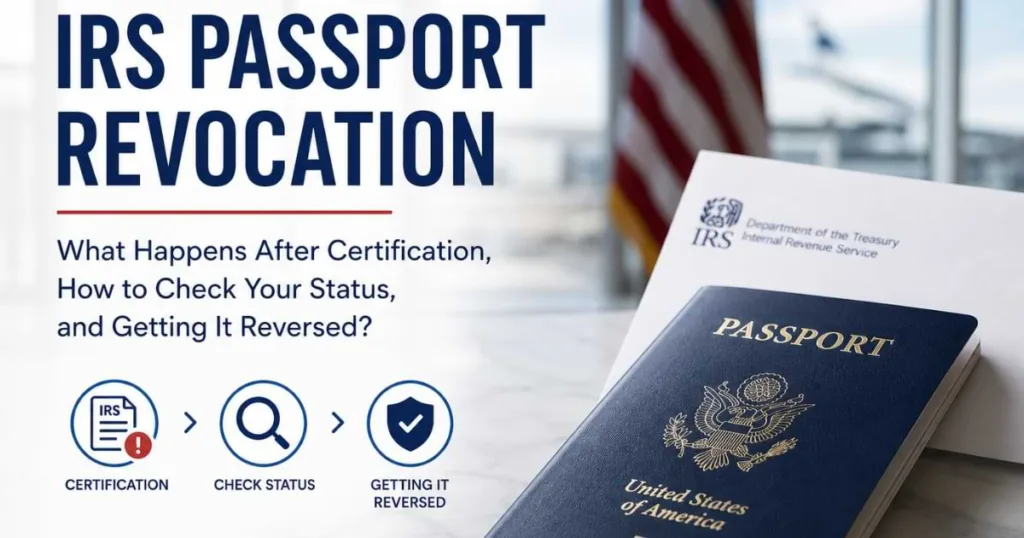
Can the IRS actually revoke your passport?
Yes. Under IRC Section 7345, the IRS certifies seriously delinquent tax debt to the State Department, which can then deny, revoke, or limit your passport. The current threshold is $62,000 in assessed tax debt, including penalties and interest. This amount is adjusted annually for inflation.
In Part I of this guide, we covered the basics of the seriously delinquent tax debt program and who qualifies for certification. This second installment goes deeper into the parts that taxpayers actually struggle with: what the certification process looks like from the inside, how to find out if you’re on the passport denial list, what happens to your travel plans once the State Department receives the certification, and the specific steps required to get the certification reversed.
At Ed Parsons CPA, we’ve helped taxpayers in the middle of this process protect their ability to travel while resolving the underlying tax debt. Here’s what you need to know.

How the IRS Passport Certification Process Actually Works?
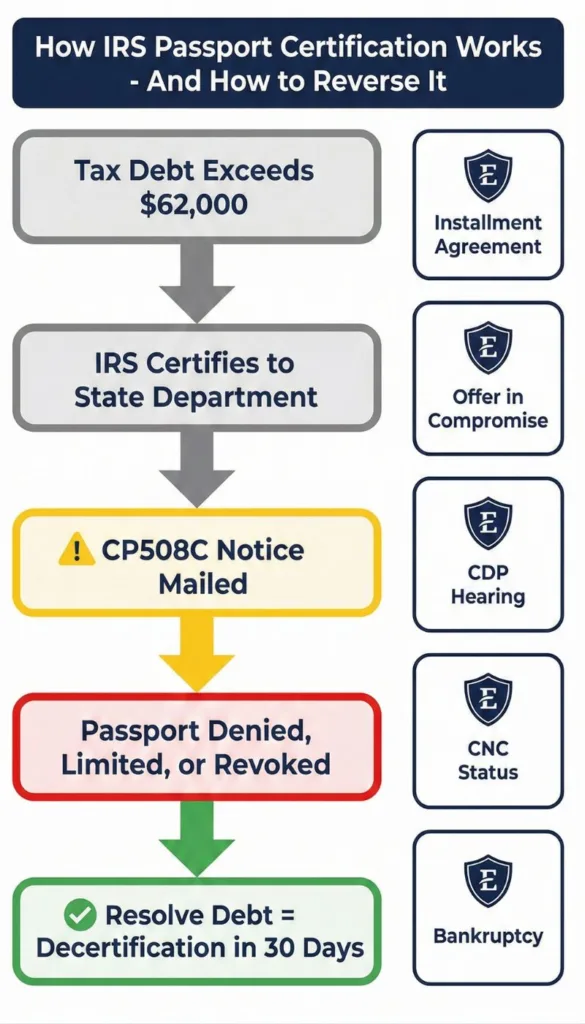
The process starts with the IRS, not the State Department. Once your assessed tax balance crosses the threshold and you haven’t entered into a qualifying resolution, the IRS certifies your debt by transmitting your information to the U.S. Department of State. There’s no hearing before this happens. There’s no phone call. In most cases, the first sign that certification has occurred is a CP508C notice sent to your last known address.
Here’s the timeline in practice:
- IRS identifies the balance. Your total assessed liability, including tax, penalties, and interest, exceeds the threshold and none of the statutory exceptions apply.
- IRS sends CP508C notice. This letter informs you that your debt has been certified as seriously delinquent. It does not arrive before certification. It arrives after.
- State Department receives the file. They can now deny a new passport application, deny renewal of an existing passport, or in extreme cases, revoke a current passport.
- Taxpayer attempts to travel or renew. Many people discover the certification only when their passport application is rejected or their renewal is denied at a passport office.
This is why checking your IRS account status before booking international travel is critical if you have any outstanding federal tax balance. If you’ve received a CP504 notice or a final notice of intent to levy, your balance is almost certainly in the range where passport certification is a real possibility.
How to Find Out If You’re on the Passport Denial List?
How do you check if your passport has been flagged? There is no public “passport revocation list.” To find out your certification status, call the IRS at 1-800-829-1040 and ask about your account, request a transcript online at IRS.gov/Get-Transcript, or have your CPA or tax professional pull your account transcript using Centralized Authorization File (CAF) access. A TC 971 with action code 640 on your transcript indicates active certification.
The IRS does not maintain a searchable database that taxpayers or the public can browse. The State Department also won’t proactively inform you that a certification is on file unless you submit a passport application. This lack of transparency catches people off guard, especially frequent travelers who assume their passport is in good standing because they haven’t received any travel-related correspondence.
Your best option is to request your IRS account transcript. A tax professional with power of attorney (Form 2848) can pull this quickly and identify whether the TC 971 certification code is present. If you’re not sure what IRS notices you’ve received or missed, start there.
What the State Department Can Actually Do to Your Passport?
| Action | What It Means | When It Happens |
|---|---|---|
| Deny new application | Your passport application is rejected outright | Most common outcome for first-time applicants with certification on file |
| Deny renewal | Your existing passport expires and cannot be renewed until certification is reversed | Frequent outcome when renewal is submitted during active certification |
| Limit to return travel only | A limited passport is issued solely for the purpose of returning to the United States | Applies when a U.S. citizen is abroad and their passport is affected |
| Revoke existing passport | Your current, valid passport is cancelled | Rare, but legally permitted under extreme circumstances |
In practice, outright revocation of a valid passport is uncommon. The State Department more frequently denies applications and renewals, which effectively grounds you once your current passport expires. But for taxpayers living or working abroad, even the limited-passport scenario creates serious disruption. If you’re an expat relying on the Foreign Earned Income Exclusion, losing your passport could affect not just your travel but your entire tax position and employment status overseas.
Who Is Exempt From Passport Certification?
Not every taxpayer who owes more than the threshold gets certified. The IRS is required to exclude taxpayers in certain situations:
- Active installment agreement. If you’re current on an approved IRS payment plan, your debt is not certifiable.
- Pending Offer in Compromise. A submitted and pending OIC protects you from certification while it’s being evaluated.
- CDP hearing requested. If you’ve filed a timely Collection Due Process request after receiving a final levy notice, certification is paused.
- Innocent spouse relief pending. If you’ve filed for innocent spouse relief under IRC Section 6015, the related debt is excluded.
- Currently Not Collectible status. Taxpayers whose accounts the IRS has placed in hardship status due to inability to pay are exempt.
- Debt in active bankruptcy. Tax obligations included in a bankruptcy proceeding are not eligible for certification.
- Identity theft victims. If the assessed balance is the result of identity theft and the IRS has been notified, certification should not occur.
- Federally declared disaster area residents. Taxpayers in designated disaster zones receive temporary relief from certification.
The key takeaway here is that being in any formal resolution pathway with the IRS protects your passport. The taxpayers who get certified are overwhelmingly those who have ignored correspondence, have unfiled returns from multiple years, or simply didn’t know the program existed until it affected them.
Worried your passport may be at risk? Find out your certification status before it disrupts your plans.Talk to Ed Parsons CPA – Call (786) 265-8578
How to Get Passport Certification Reversed?
Reversing a certification requires resolving the underlying tax issue with the IRS. The State Department cannot lift the hold on its own. Once the IRS decertifies your account, they notify the State Department, and the passport restriction is removed. Here are the paths that trigger decertification:
- Pay the balance in full. The fastest route. Once the IRS confirms full payment, decertification typically follows within 30 days.
- Enter into an installment agreement. An approved payment plan, even a partial-pay agreement, qualifies for decertification. The IRS is required to reverse the certification once the agreement is accepted.
- Submit an Offer in Compromise. While the OIC is pending evaluation, the IRS must decertify. If the offer is accepted, decertification becomes permanent.
- Request Currently Not Collectible status. Demonstrating economic hardship and receiving CNC designation removes the certification.
- Successfully dispute the debt. If the underlying assessment is reduced below the threshold through audit reconsideration, amended returns, or penalty abatement, decertification follows.
After decertification, the IRS is supposed to notify the State Department within 30 days. In reality, processing delays happen. If you have urgent travel needs, your CPA can contact the IRS Passport Unit directly and request expedited processing once the qualifying resolution is in place. Having a professional who knows how to navigate internal IRS channels makes a measurable difference in how quickly your travel rights are restored.
Frequently Asked Questions
Can the IRS revoke my passport without notifying me first?
The IRS is required to send a CP508C notice after certification, but the notice goes to your last address on file. If you’ve moved without updating your address (Form 8822), you may never receive it. The certification itself does not require advance notification or taxpayer consent.
What is the threshold for IRS passport revocation?
The current seriously delinquent tax debt threshold is $62,000, which includes assessed tax, penalties, and interest. This amount is adjusted annually for inflation. Debts below this amount are not eligible for passport certification.
Can I travel domestically if my passport is revoked or denied?
Yes. Passport certification only affects international travel. Domestic air travel requires a REAL ID-compliant driver’s license or another TSA-accepted identification, not a passport.
How long does it take to get my passport back after resolving the debt?
The IRS has 30 days to notify the State Department after decertification. In practice, the full process from resolution to restored passport eligibility takes approximately 4 to 6 weeks, though delays can occur during peak processing periods.
Need help identifying an IRS letter you received about your tax balance? Use our IRS notice lookup tool to understand exactly where you stand.
Ed Parsons CPA – IRS Tax Resolution for Taxpayers Who Need Their Passport Protected Book a Consultation