Skip to content

Massachusetts paid family and medical leave contributions total 0.88% of eligible wages for employers with 25 or more covered individuals, of which the employer must fund at least 0.42%. Employers with fewer than 25 covered individuals owe no employer share but still withhold and remit the employee portion of 0.46%. Contributions are capped at the Social Security taxable maximum.
“We have twenty employees and eight regular contractors. Are we over the line or under it?”
“The employee share and the employer share are different numbers. Which one am I actually paying?”
“We heard the split is changing. Do we need to do anything now?”
One Threshold Decides Who Pays
Paid family and medical leave is funded by contributions on eligible wages, and the whole structure turns on a single count. Per the Department of Family and Medical Leave contribution rates, employers with 25 or more covered individuals fund part of the medical leave portion, while smaller employers do not.
The programme itself does not change with size. Covered individuals have the same access to leave and the same benefit calculation whether they work for a firm of eight or a firm of eight hundred. What changes is who pays for it.
The count is also of people working in Massachusetts rather than of the business overall. A national employer with a small Massachusetts presence measures only the covered individuals here, and a business whose workforce sits entirely in state measures all of them.
That makes the count the most consequential number in the whole system, and it is not counted the way most employers assume.
Covered Individuals Include Some of Your Contractors
The first question at the top is the one that catches businesses out, and the answer depends on a rule that appears nowhere in a payroll system.
Covered individuals are not simply employees. A business that issues Form 1099 to an average of at least half its workforce counts those 1099 workers as covered individuals, and the guidance on wages subject to PFML governs which payments fall inside the calculation.
So twenty employees and eight contractors is not automatically a twenty-person business. If the 1099 population reaches half the workforce, those contractors join the count, and a business that believed itself comfortably under the threshold can be over it.
The connection to classification is direct and worth naming. Engaging people on 1099s to stay small for one purpose can make a business larger for another, and the same arrangements are the ones examined in a reemployment tax audit.
The Rate Split, Plainly
| The Question | 25 or More Covered Individuals | Fewer Than 25 |
| Total contribution | 0.88% of eligible wages | 0.46% of eligible wages |
| Medical leave portion | 0.70%, of which the employer funds at least 60% | 0.28%, fundable entirely from the employee |
| Family leave portion | 0.18%, fundable entirely from the employee | 0.18%, on the same basis |
| Employer share | At least 0.42% of eligible wages | None required, though an employer may choose to pay some or all |
| Employee share | Up to 0.46%, withheld from wages | Up to 0.46%, withheld from wages |
| Measurement | The threshold changes who pays, never whether contributions are due | A small employer still withholds and remits. The obligation to file does not depend on owing an employer share |
The second question resolves in that table. The employee share is up to 0.46% and comes out of wages. The employer share, where one is required, is at least 0.42% and comes out of the business. Together they make the 0.88% figure quoted everywhere, and neither number is the whole contribution on its own.
Family leave is fundable entirely from employees in both columns. Medical leave is where the size threshold bites, because that is the portion an employer of 25 or more has to help fund.
Employers may always pay more than required. Covering some or all of the employee share is a benefits decision rather than a compliance one, and it has to be configured deliberately in payroll rather than assumed.
Crossing the threshold mid-year is the situation worth planning for. A business that grows past the count acquires an employer contribution it did not budget, and one that shrinks below it does not simply stop, since the determination follows the rules for measuring the workforce rather than a single payroll run.
The Numbers Behind PFML
- 25: the covered individuals that create an employer contribution.
- 0.88%: the total contribution above that threshold.
- 0.46%: the total below it, and the maximum employee share either way.
- 0.42%: the minimum employer share where one applies.
- 60%: the share of the medical leave portion an employer of 25 or more must fund.
- 50%: the proportion of a workforce on 1099s that pulls contractors into the count.
Small Employers Still Withhold and Remit
Being under the threshold removes the employer contribution. It does not remove the business from the programme.
A smaller employer still withholds the employee share from wages, still remits it, and still files. The paperwork is identical; only the source of the money differs.
Employers also carry notice obligations regardless of size, including the workplace poster and written notice to covered individuals, with acknowledgment collected at onboarding. Those notices are reissued when rates change, which makes them an annual task rather than a one-time one.
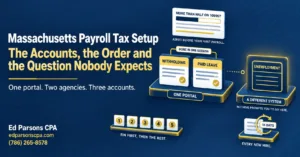
Getting that configured at the outset is far easier than retrofitting it, which is why PFML belongs in the same setup sequence as the other state accounts in the payroll tax setup checklist.
What Is Coming, and Why
The third question deserves a forward-looking answer, because a change has already been legislated.
Chapter 101 of the Acts of 2026 shifts employer contributions from the medical leave portion to the family leave portion, effective January 1, 2027. The overall funding of the programme is not the point of the change; the allocation between the two portions is.
The reason is tax treatment. Federal guidance on how state paid leave benefits are taxed turns partly on which portion was funded by whom, and reallocating the employer contribution is intended to mitigate the effect of that guidance on employees receiving benefits.
Nothing needs to change in payroll today, and something will need to change before the effective date. The practical step now is to know the change exists and to confirm with the payroll provider that the reallocation is on their roadmap rather than discovering it in a January filing.

The Cap, and the Private Plan Route
Contributions are capped at the Social Security taxable maximum, so a highly paid individual stops contributing once wages pass that figure for the year, exactly as with the federal cap it tracks.
There is also an alternative to the state programme. Employers with an approved private or self-insured plan offering benefits at least equal to the state’s are exempt from remitting contributions to the Commonwealth, provided any employee contribution to that plan stays within the published rates.
That route suits some employers and adds administration for others. The statutory framework sits in Chapter 175M, and the choice is worth modelling rather than assuming.

A Small Percentage on a Large Base
PFML is easy to under-manage because the rate looks small. It applies to wages up to the Social Security cap rather than to the $15,000 base used for unemployment contributions, so the money involved is materially larger than the other state payroll items.
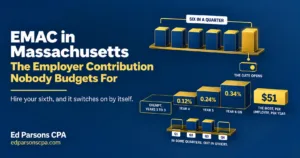
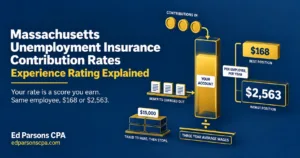
On a $100,000 salary, the total contribution is $880 a year, against roughly $141 to $2,563 of unemployment contributions and about $51 of EMAC. The base is what makes it significant, not the rate.
Ed Parsons CPA configures and reconciles the full set of Massachusetts payroll obligations, PFML included, alongside the unemployment contributions, EMAC, and the training fund, and represents employers when the quarterly filings come under review, under the firm’s Massachusetts payroll tax CPA.
Where contribution errors have already produced a balance or an assessment, a Business CPA Tax Resolution Case Analysis prices the exposure before anything is signed or paid.