Skip to content
By Ed Parsons, CPA| 17 years of tax resolution experience | Reviewed by Ed Parsons, CPA |
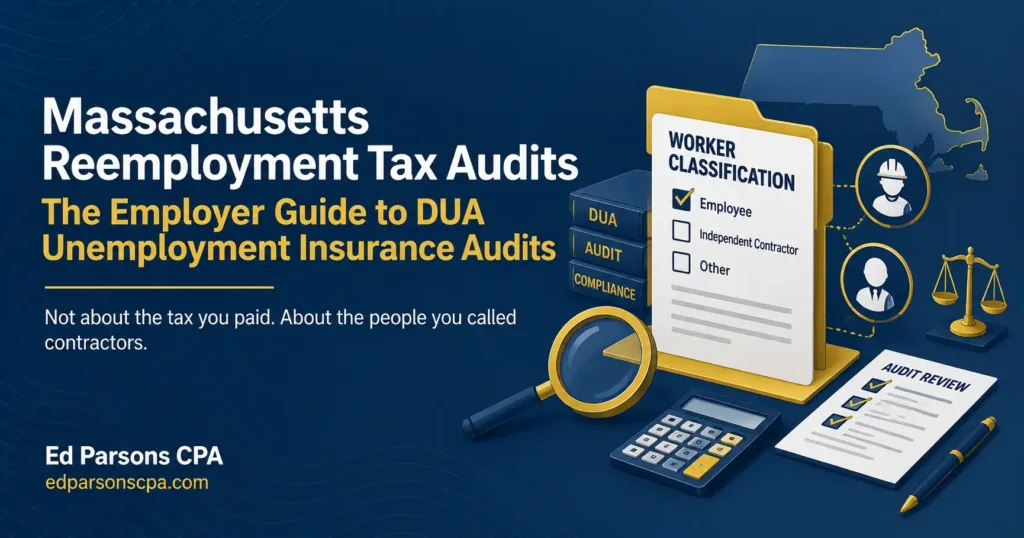
A Massachusetts reemployment tax audit is a Department of Unemployment Assistance review of whether a business has correctly reported wages and correctly classified its workers. Under Chapter 151A, services performed for an employer are presumed to be employment unless the business proves all three prongs of the ABC test. The audit usually reaches back across prior quarters, and the assessment lands on the employer.
“A contractor we let go filed for unemployment and now the state is asking about our 1099s. How did that become an audit?”
“We have used the same subcontractors for eleven years and nobody has ever questioned it. Why now?”
“If they decide we got it wrong, how far back does this go?”
Most employers meet this audit backwards. They expect a discussion about contribution rates and arithmetic, and they get a conversation about people, specifically about the people they have been paying on 1099s for years.
That is the whole subject. A reemployment tax audit is a classification audit wearing a tax audit’s clothes, and everything else in this guide follows from that.
The terminology confuses people before the substance does. Employers hear reemployment tax, unemployment tax, UI contributions, and SUTA used interchangeably, and they all describe the same obligation: the contributions a Massachusetts employer pays into the unemployment system on covered wages.
Inside This Guide
Each section links to a full article on its subject:
- Unemployment insurance contribution rates: experience rating, schedules, and reading a rate notice.
- What triggers a DUA audit: the selection flags that put an employer on the list.
- The ABC test and worker misclassification: three prongs, and the one that fails almost everyone.
- EMAC: the employer medical assistance contribution and when it switches on.
- PFML contributions: rates, the split, and employer reporting duties.
- SUTA and FUTA together: how paying the state late multiplies the federal bill.
- Responding to a DUA audit notice: the document list and the first ten days.
- How claims raise your rate: charging mechanics and when contesting is worth it.
- Penalties and personal liability: what an assessment actually costs, priced.
- Payroll tax setup: four state accounts, in the right order, before the first payslip.
What the DUA Is Actually Testing
Massachusetts starts from a presumption that works against employers. Under Chapter 151A, services performed by an individual are treated as employment unless and until the employing unit proves otherwise.
Read that word order carefully. The business does not arrive with a clean slate to be disproved; it arrives already classified as an employer and has to demonstrate its way out, prong by prong.
The instrument is the ABC test, and all three parts must hold at once. The ABC test in detail works through each prong, including the middle one, which asks whether the service sits outside the usual course of the employer’s business and which quietly disqualifies most arrangements employers assume are safe.
A signed contractor agreement does not settle it. The agreement is evidence of intent, and the test examines how the work was actually performed, which is why long-standing arrangements built on good faith still fail.
Nor does the worker’s preference. People often ask to be paid on a 1099, and agreeing is not a defense, because classification is a question of statutory status rather than a term the two parties are free to negotiate between themselves.
What Employers Expect, and What Happens
| The Question | What Employers Assume | How a DUA Audit Works |
| What is being examined | Whether the contributions were calculated correctly | Whether the people you paid were employees in the first place |
| Who carries the burden | The agency has to prove the worker was an employee | The presumption runs the other way: services count as employment unless the business proves otherwise |
| What the paperwork proves | A signed contractor agreement settles it | The agreement is one fact among many, and the test looks at how the work was actually done |
| How far it reaches | The year under review | Prior quarters, because a classification finding applies to every period the arrangement existed |
| What it costs | The unpaid contributions | Contributions, interest, and exposure that can extend beyond the unemployment system |
| Measurement | The audit is not about arithmetic; it is about status | One denied claim from a person you treated as a contractor is enough to open the whole file |
How Audits Begin
The first question at the top is the most common route in. Someone treated as a contractor files for unemployment, the agency finds no reported wages for them, and the status question opens by itself.
At that point the analysis is no longer about one person. If the arrangement fails the test, every worker engaged on the same terms is exposed, and the reporting for those quarters comes into question with them.
The trigger is often someone the business parted with on good terms, which is why employers find it disorienting. No complaint was made and no dispute existed; the person simply applied for benefits, and the system asked a question it is required to ask.
Claims are not the only route. Random selection, referrals from other agencies, industry focus, and mismatches between filings all feed the list, which the selection flags covers in full.
The second question deserves a straight answer too. Eleven quiet years is not evidence of correct classification; it is evidence that nobody has filed a claim yet. The arrangement was either compliant or not from the beginning, and a single separation can put the question in front of the agency.
The Numbers Behind a DUA Audit
- 3: the prongs of the ABC test, all of which must hold.
- 1: the denied claim that is enough to open a classification review.
- 0: the weight a contractor agreement carries on its own.
- Quarters, not months: the period an audit typically reaches across.
- 4: the state payroll accounts a Massachusetts employer generally runs.
- 10 days: the response window on a claim notice, and a preview of how the agency handles deadlines.
The Audit, End to End
A review opens with a notice naming the period and listing records: payroll registers, quarterly filings, the general ledger and cash disbursements, 1099 records, contracts, and bank records. The first ten days after that notice shape everything that follows, because scope is easier to set than to claw back.
The examination itself is largely documentary, with questions directed at how specific engagements worked in practice: who set the hours, who supplied the tools, who could turn down work, and whether the worker served other customers.
Sampling is common where the population is large. A reviewer may test a subset of engagements and extend the finding across the group, which makes the composition of that sample worth attention at the time rather than in hindsight.
A determination follows. Where workers are reclassified, contributions are assessed on the reclassified wages with interest, and the experience rating carries the effect forward into future years, which is the part employers feel long after the assessment is paid.
Determinations can be contested through the agency’s review process and the Board of Review, with firm deadlines at each stage and a record that is built, or lost, during the audit itself.
That last point deserves emphasis, because employers routinely misjudge it. Appeals are decided on the record assembled below, so the contracts, invoices, and testimony gathered during the audit are the same material an appeal will live or die on months later.
What It Costs When Classification Fails
The third question at the top has an uncomfortable answer: further back than the period that triggered it. A classification finding describes an arrangement, and the arrangement existed in every quarter it was used. The penalty arithmetic works a full example.
Unemployment contributions are rarely the end of it. The same facts that reclassify a worker for unemployment purposes are relevant to withholding, to workers’ compensation, and to wage law, where Massachusetts provides remedies that sit well outside the tax system.
That wider exposure is a question for employment counsel rather than an accountant, and the sensible engagement has both in the room. What a CPA owns is the numbers, the records, and the representation in front of the agency.
The forward-looking cost is the rate. Reclassified wages and charged claims both feed the experience rating, so a single audit can raise the contribution rate for years, a mechanism the rates article and the claims article explain together.

Getting Ahead of It
Almost everything that decides an audit is decided before it starts: how engagements are structured, what the contracts say, whether the payroll accounts were set up correctly, and whether EMAC and PFML are configured properly alongside the unemployment account. The payroll setup checklist runs the sequence.
Voluntary correction is the lever most employers do not know they have. Reviewing classifications and converting the arrangements that fail is a materially different conversation from being found in a review, and the federal side interacts with it too, as SUTA and FUTA together describes.
Documentation is the cheapest part of all of it. Written scopes of work, invoices from businesses rather than individuals, evidence that a contractor serves other customers, and clean payroll records cost nothing during a normal quarter and decide the outcome during a review.

When the Letter Arrives
The Commonwealth publishes its employer guidance through the DUA’s employer pages and the contribution rules in 430 CMR 5.00. Reading them is useful; reading them for the first time after a notice arrives is not the position anyone wants to be in.
Ed Parsons CPA represents Massachusetts employers through DUA audits and keeps the payroll tax compliance behind them clean, from ABC test classification reviews and voluntary reclassification planning through assessment and abatement work, under the firm’s DUA audit help service. If a notice has arrived, a same-week audit strategy call is the right first step.
Where an assessment has already issued, a Business CPA Tax Resolution Case Analysis prices the exposure before anything is signed or paid.