Skip to content

The federal research credit can be elected against payroll taxes by qualifying small businesses, which turns it into cash before profitability. The Massachusetts research credit works differently: it offsets corporate excise, is not refundable for most companies, and carries forward where it cannot be used. Certified life sciences companies are the main exception.
“We are pre-revenue. Can the Massachusetts credit pay part of our payroll like the federal one does?”
“Is it worth claiming a state credit we cannot use for years?”
“We are a biotech. Does anything different apply to us?”
Two Credits, One Common Misunderstanding
The first question at the top is the one most founders arrive with, and the honest answer is no, with a significant consolation.
The federal payroll election is real and valuable. A qualifying small business can elect to apply its research credit against payroll taxes rather than waiting for taxable income, which is what makes the credit useful to a company that has never made a profit. The Internal Revenue Service guidance on the payroll tax election sets out the eligibility and the limits.
The Massachusetts credit does not work that way. Under Chapter 63, Section 38M, it offsets corporate excise, and for most companies it is not refundable. There is no state equivalent of the payroll election.
The reason is structural and slightly odd. Massachusetts defines qualifying research by reference to the federal rules as they stood decades ago, so later federal additions, the payroll offset among them, simply are not part of the state credit. The two credits are close relatives that stopped speaking some time ago.
Federal and State, Side by Side
| The Question | Federal Credit | Massachusetts Credit |
| What it reduces | Income tax, or payroll taxes by election | Corporate excise only |
| Cash before profit | Yes, through the payroll tax election | No, except for certified life sciences companies |
| The rate | Its own calculation, with a simplified method | 10% of qualifying expenses over the base, 15% on basic research payments |
| The cap | An annual limit on the payroll election | All of the first $25,000 of excise, then 75% of the excise above it |
| Unused credit | Carried forward | Fifteen years, and indefinitely for the portion the 75% rule blocked |
| Measurement | The federal offset is the cash. The state credit is the asset | Massachusetts defines qualifying research by reference to the federal rules as they stood decades ago, which is why the federal payroll election does not reach the state credit |
What the Massachusetts Credit Is Worth
The rate is 10% of qualifying research expenses above a base amount, with 15% applying to basic research payments, and an alternative simplified method available. The mechanics sit in the Department’s research credit regulation.
The cap has two tiers. The credit can offset all of the first $25,000 of corporate excise, then 75% of the excise above that figure.
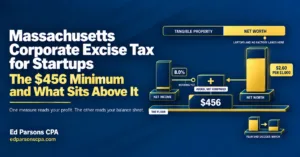
And there is a floor underneath everything. No amount of credit reduces the excise below the $456 minimum, which is the same floor that makes a pre-revenue company owe something in the first place, covered in the corporate excise article.
Qualifying costs are the familiar ones: wages for employees performing research, a portion of contractor payments, and supplies consumed in the work, provided the research was performed in Massachusetts. In-state is not a formality here; the credit reaches Massachusetts activity only.
The Numbers Behind the Credit
- 10%: the Massachusetts rate on qualifying expenses above the base.
- 15%: the rate applied to basic research payments.
- $25,000: the excise fully offsettable before the 75% limit applies.
- 75%: the share of excise above that figure the credit can reach.
- 15 years: the carryforward for credits that exceed the year’s excise.
- $456: the minimum excise no credit can take you below.
Why Claim a Credit You Cannot Use Yet
The second question is the right commercial question, and there are three answers that make the work worth doing.
The first is the carryforward itself. Unused credits carry forward for fifteen taxable years, and the portion specifically disallowed by the 75% limitation carries forward indefinitely. A credit earned in a loss year is not lost; it is banked against the years when the company is profitable, which is precisely when it is most useful.
The second is that the work is shared. The records that support a federal claim are largely the records Massachusetts relies on, so a company already preparing a federal study is doing most of the state work anyway. Claiming only the federal credit leaves the state one on the table for marginal additional effort.
The third is diligence. Documented, consistently claimed credits are an asset on a balance sheet and a sign of a well-run finance function. Unclaimed ones are a footnote about what the company did not do.
The Life Sciences Exception, and Its Newer Cousin
The third question has the best answer in this article, because refundability does exist in Massachusetts. It is just narrow.
Certified life sciences companies can, through the state’s life sciences incentive program, convert unused research credits into cash rather than carrying them forward, at up to 90% of the remaining balance. That is a genuine cash event for a pre-revenue biotech, and it turns the state credit into something closer to the federal offset in effect if not in mechanism.
There is also a separate life sciences research credit covering expenditures that fall outside the standard credit, including certain clinical trial costs, with its own rules and its own carryforward.
A comparable route has been established for certified climatetech companies, extending the same logic to another targeted sector.
The limitation is worth stating plainly rather than burying. A general software, AI or robotics startup is outside these programs. For those companies the state credit remains a carryforward asset, and the federal payroll election is where the near-term cash comes from.
What Actually Supports a Claim
Credits are won and lost on documentation, and the standard is higher than a summary of what the team was working on.
- A description of each qualifying project, the technical uncertainty it addressed, and the process used to resolve it.
- Payroll and time records tying specific people to specific research activity.
- Contractor agreements and invoices showing what was performed and where.
- Supply costs consumed in the research rather than in general operations.
- A clear connection between the activity and Massachusetts facilities.
- The claim itself on the state schedule, filed with the corporate excise return.
None of that is exotic, and all of it is far easier to assemble as the work happens than to reconstruct from commit history two years later. It is the same discipline that makes every other position in the founder playbook defensible.

Common Mistakes With Research Credits
- Expecting the federal payroll election to apply to the Massachusetts credit.
- Skipping the state claim in a loss year and forfeiting a fifteen-year asset.
- Assuming refundability is available outside the certified sectors.
- Claiming activity performed outside Massachusetts against the state credit.
- Documenting projects after the year closes rather than during it.
- Forgetting the $456 floor when modelling what the credit will actually save.
Claim It Properly, Bank It Deliberately
This is the one article in this series where the conversation is about money coming back rather than exposure being priced. The federal election produces cash now for a qualifying company, the Massachusetts credit produces an asset that matters later, and certified life sciences and climatetech companies can access both. Software companies should also check whether the manufacturing classification discussed in the software tax article applies to them, since it travels with the same corporate excise return.

Ed Parsons CPA runs research credit studies for Massachusetts companies, prepares the federal and state claims together, coordinates the payroll election where it applies, and builds the documentation that supports both, under the firm’s startup tax help service.
If prior years were never claimed, a Business CPA Tax Resolution Case Analysis is the wrong starting point; a credit study is. Reach the team through the contact page to find out what the last few years were worth.