Skip to content
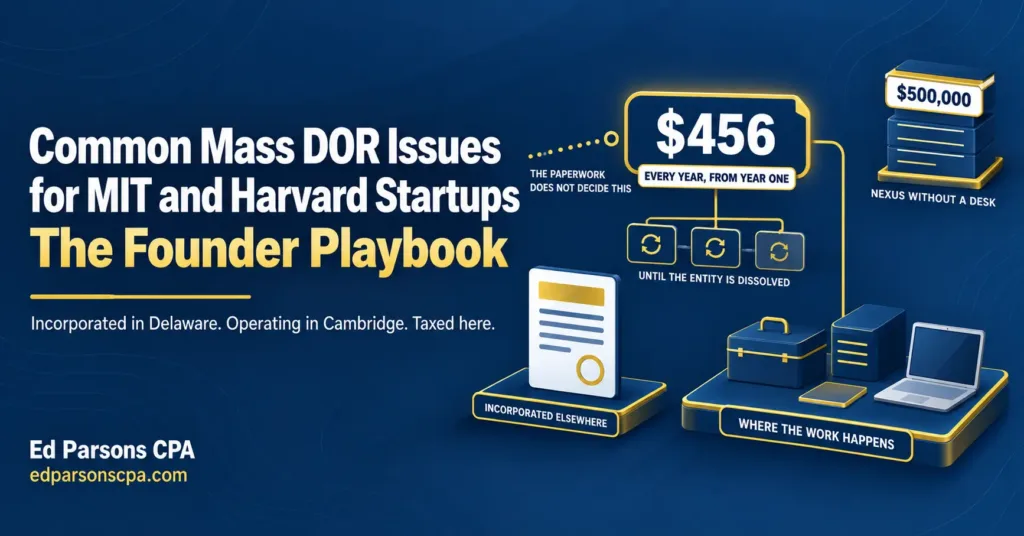
Delaware incorporation does not exempt a company from Massachusetts tax. A corporation with nexus here files the corporate excise and owes a minimum of $456 a year regardless of revenue, from the first year the charter is exercised until the entity is formally dissolved. Registration, filing and payment run through MassTaxConnect, and the obligations begin before the first customer does.
“We are a Delaware C corp. Our lawyer set it up that way. Why is Massachusetts sending us anything?”
“We have no revenue and no product yet. Surely there is nothing to file?”
“We raised, we hired two people in Cambridge, and nobody has mentioned state tax once. What have we missed?”
Nearly every spinout out of Kendall Square and Allston starts the same way. A Delaware C corp, a standard set of formation documents, a bench or a desk in Cambridge, and a founding team whose attention is entirely on the science or the product.
The tax questions arrive later and out of order, usually as a letter, a diligence request, or a discovery that something needed filing two years ago. None of them is difficult on the day it starts. All of them are awkward on the day they are found.
The gap is structural rather than careless. Formation counsel handles Delaware, the accelerator handles the pitch, the bookkeeper handles the federal side, and Massachusetts state obligations sit in the space between all three with nobody assigned to them.
This guide covers what the Massachusetts Department of Revenue actually expects from a company operating here, in the order a founder meets it.
Inside This Playbook
- The MassTaxConnect guide: account setup, login recovery, adding tax types, CPA access.
- Making a payment on MassTaxConnect: every payment type, click by click.
- Estimated tax payments for founders: safe harbors on income nobody withheld from.
- Where is my Massachusetts refund: status meanings and what unfreezes a held refund.
- DOR notices and abatement: Form ABT, and the deadlines that end the right to use it.
- The health insurance mandate: Schedule HC and the penalty your hires can still face.
- Founder equity and Massachusetts tax: 83(b), ISOs, and the surtax waiting at exit.
- Corporate excise for startups: the $456 minimum and what sits above it.
- Is SaaS taxable in Massachusetts: prewritten software, and what you should be collecting.
- Research credits and payroll offsets: money back for building here.
Delaware Is Where You Are Incorporated, Not Where You Are Taxed
The first question at the top comes up in almost every founder conversation, and the confusion is reasonable. Delaware incorporation is the default for venture-backed companies, and it does exactly what it is supposed to do, which is govern the company’s internal corporate law.
It does nothing about state tax. Per the Department’s corporate excise guide, a corporation with nexus in Massachusetts is subject to filing requirements here, and foreign corporations doing business in the state are treated the same as domestic ones for this purpose.
Nexus is created by ordinary startup behavior: an office or lab, equipment, employees working here, or a founder operating from a Cambridge address. None of that requires a Massachusetts entity to exist.
University affiliation changes none of it either. A company founded on licensed research, incubated in a campus program, or housed in accelerator space is still a taxable corporation operating in the Commonwealth, and the institution’s own exempt status does not travel to the spinout.
There is also an economic route. Under the corporate nexus regulation, corporations with Massachusetts sales above $500,000 can be subject to the excise without any physical presence at all, which matters for remote-first companies selling into the state.
The Nine Issues, Ranked by Damage
| The Issue | When It Bites | What It Costs If Missed |
| Corporate excise nexus | Year one, from the first Cambridge desk | The minimum excise for every unfiled year, plus penalties and interest, and a company that is not in good standing during diligence |
| Sales tax on software | The first paying customer | Tax that should have been collected and now comes out of margin, across every open period |
| Founder equity timing | Within 30 days of the grant | An election that cannot be made late, and a tax bill at exit rather than at pennies |
| Founder estimates | The first quarter with unwithheld income | Underpayment penalties on income nobody withheld from, compounding quarterly |
| Payroll registrations | The first hire | Unfiled periods with interest running from their original due dates |
| DOR notices ignored | The day the letter arrives | An assessment that becomes final, and an abatement right that expires on a deadline |
| Measurement | Almost all of it is year one | None of these is a large number on the day it starts. All of them are expensive on the day they are found, and diligence is usually the day they are found |
Pre-Revenue Does Not Mean Pre-Tax
The second question deserves the bluntest answer in this guide. The corporate excise is a charge for the privilege of doing business rather than a tax on profit, so it applies whether or not the company has sold anything.
The minimum is $456 for the year. It applies to a pre-revenue company with significant losses, and it continues accruing until the entity is formally dissolved, which is why abandoned entities collect liabilities quietly for years. The corporate excise article works through the structure above the minimum.
Two consequences follow that founders rarely anticipate. Credits do not rescue you, since research credits cannot reduce the excise below the minimum. And winding down is an act rather than an absence, because walking away from a company leaves the charter alive and the excise running.
That second point deserves a moment, because it catches serial founders. A previous venture that quietly stopped operating, was never dissolved, and still holds a charter has been accruing the minimum every year since, and it surfaces when the founder next needs a clean certificate of good standing.
The Numbers Behind Year One
- $456: the minimum corporate excise, owed at zero revenue.
- $500,000: the Massachusetts sales level that can create excise nexus with no physical presence.
- 30 days: the window to file an 83(b) election after a grant, and it cannot be extended.
- 4: the quarterly estimated payment dates a founder with unwithheld income meets.
- 6.25%: the sales tax rate that applies to prewritten software delivered any way.
- 2: the agencies a hiring startup registers with, before the first payroll.
The Third Question, Answered as a List
A funded company with two Cambridge hires and no state tax conversation has usually missed the same six things, and they are all recoverable if caught early.
- Corporate excise registration and the first return, covered in the excise article.
- Payroll registrations across two agencies, which is a different checklist from the federal one.
- Sales tax registration if the product is software, per the SaaS article.
- Founder estimated payments, since salary is often thin and other income is not withheld, per the estimates article.
- 83(b) elections for anyone with restricted stock, covered in founder equity.
- A MassTaxConnect account with the right tax types and CPA access, per the MassTaxConnect guide.
Why This Surfaces at the Worst Possible Time
Startup tax problems have a characteristic timing. They are created quietly in year one and discovered during diligence, when a Series A data room asks for state filings and someone realizes there are none.
At that point the cost is not the tax. It is the delay, the disclosure schedule, and the impression created at exactly the moment a company wants to look well run.
Acquirers look harder than investors do. A buyer inherits unpaid state obligations along with the company, so unfiled returns and uncollected sales tax become a matter for the purchase agreement, usually as an escrow or a price adjustment rather than a footnote.
Notices behave the same way. A Notice of Assessment is an invoice rather than a verdict, and it can be disputed, but the right to do so runs on a deadline, which the abatement article sets out in full.
The cheerful version of all this is that year one is also when everything is easiest to fix. Registrations are administrative, elections are timely, and the first return sets a pattern the company keeps.
Remote teams deserve one note of their own. A company with no Massachusetts office but a founder or engineer working from Cambridge still has people performing work in the state, and that is enough to raise the same questions as a lease would.

Where the Money Comes Back
Not all of this runs one way. Massachusetts operates a research credit that can matter considerably to a company doing genuine technical work here, and it interacts with the federal payroll offset that lets early-stage companies apply credits against payroll taxes rather than waiting for profitability, which the research credit article explains.
For a company burning capital on engineers and lab work in Cambridge, that is the one item on this list worth chasing rather than merely complying with.
Documentation decides whether it survives scrutiny. Credits rest on records of who did what technical work and why it qualified, and those records are far easier to keep as the work happens than to reconstruct from memory and commit history two years later.

Get Year One Right
Everything here is knowable and most of it is quick. Registration runs through MassTaxConnect, the rules are published, and the deadlines are fixed. What catches founders is that nobody in the formation process mentions any of it, because Delaware counsel is not a Massachusetts tax adviser and neither is the accelerator.
Ed Parsons CPA sets up Delaware C corps for Massachusetts operations, handles the excise and the annual filings, coordinates founder estimates and equity elections, runs research credit studies, and resolves DOR notices when they arrive, under the firm’s startup tax help service. A founder tax setup call before the first Massachusetts filing is the cheapest hour in the company’s first year.
Where a notice or an assessment has already issued, a Business CPA Tax Resolution Case Analysis prices the exposure before anything is signed or paid.