Skip to content

Under IRC Section 1298(b)(1), the “once a PFIC, always a PFIC” rule, if a foreign corporation is a passive foreign investment company for even one year during the time you hold it, your stock is treated as PFIC stock for the rest of your holding period, even if the company later stops being a PFIC. The punitive Section 1291 rules then apply to future gains and distributions. There are only two ways out: make a QEF election from the start, or make a purging election that recognizes gain to clear the taint.
PFIC status is decided year by year. A foreign corporation can be a passive foreign investment company in one year and not the next, depending on its income and assets. So it would be reasonable to assume that if your fund stops being a PFIC, the problem goes away. It does not. Both exits run through an election, and I compare the elections themselves in QEF vs mark-to-market vs Section 1291.
Under a rule known as “once a PFIC, always a PFIC,” the label can stick to your shares for as long as you hold them, long after the company itself has changed. This guide explains the rule in IRC Section 1298(b)(1), why it matters, and the only two ways out. For the foundation, start with our guide to what a PFIC is , or enter your company ticker or information in our PFIC Analyzer – to determine if the company you hold is a PFIC. (Calculates the Asset Test and the Income test based on public filings ).
What the “Once a PFIC, Always a PFIC” Rule Says?
Section 1298(b)(1) carries the heading “time for determination,” and its effect is simple but sweeping. If, at any time during your holding period, the corporation (or a predecessor) was a PFIC that you did not treat as a qualified electing fund, your stock is treated as PFIC stock for the rest of the time you hold it.
The key word is “any.” One PFIC year out of many is enough. Even after the company fails both the PFIC income and asset tests and becomes what the rules call a “former PFIC,” your shares stay tainted. The annual test decides whether the company is a PFIC this year; Section 1298(b)(1) decides that once it has been, your stock keeps the label. The reference to a predecessor matters too, since a reorganized or renamed fund does not shed the history of the corporation it came from.
The Rule at a Glance
- A single PFIC year during your holding period taints the stock for the rest of it.
- The taint persists even after the company stops being a PFIC (a “former PFIC”).
- While tainted, the punitive Section 1291 rules apply to gains and distributions.
- A timely QEF election prevents the taint from ever attaching.
- A purging election can clear an existing taint, at a current tax cost.
Why the Rule Matters?
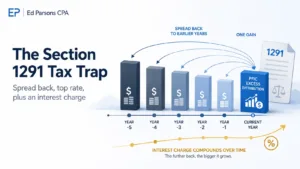
The reason the taint is worth taking seriously is what it triggers: the Section 1291 excess-distribution regime, the most punitive of the PFIC tax methods. Under it, gains and large distributions are spread back across your holding period, taxed at the highest ordinary rate for each prior year, and hit with an interest charge for the deferral. Staying tainted means living under that regime indefinitely, which is exactly what the rule is designed to discourage. It pushes investors toward making an election.
There is a quieter cost as well. Tainted PFIC shares do not receive the usual step-up in basis at death, so the built-in gain can pass to your heirs rather than being wiped clean, an outcome most investors never see coming.
The Two Ways Out
There are only two ways to keep your stock from being treated as PFIC stock under this rule, and the difference between them is timing.
The first is to make a qualified electing fund (QEF) election in the first year you own the stock. A timely QEF election means the taint never attaches, what the rules call a “pedigreed” QEF, and you are taxed under the QEF method instead of Section 1291. The second is a purging election: if the taint has already attached, you elect to recognize the built-in gain on the stock, clearing the taint going forward. Our comparison of the QEF, mark-to-market, and default elections covers the election choice in depth. In practice a timely QEF election is the exception rather than the rule, because most investors, and even many preparers, do not realize a fund is a PFIC at the moment they buy it, which is precisely how the taint attaches in the first place.
| Timely QEF election | Purging (deemed sale) election | |
| When you use it | From the first year you own the stock | After the taint has already attached |
| Measurement (how it clears the taint) | Prevents the taint from ever attaching | Recognizes gain to clear an existing taint |
| Tax cost | Annual QEF inclusions, no 1291 | Gain taxed now under 1291, with interest |
| Result | A clean, pedigreed QEF | Taint purged, a fresh start |
The Purging Election in More Detail
A purging election works by forcing a reckoning now instead of later. In the most common version, the deemed sale election, you are treated as having sold the stock at its fair market value on the last day the company was a PFIC. The resulting gain is taxed as a Section 1291 excess distribution, with the interest charge, in the year of the election.
The payoff is a clean slate. After the deemed sale, the shares are no longer treated as PFIC stock, your basis steps up by the gain you recognized, and you start a fresh holding period. A related deemed dividend election is available when the company is also a controlled foreign corporation, drawing on its accumulated earnings instead of a deemed sale. Both are made on Form 8621, or Form 8621-A for a late election, and choosing between them is a real calculation, not a default. Timing drives the math: a purge is cheapest when little gain has built up, so a recently acquired or underwater position can often be cleansed at modest cost, while a long-held, highly appreciated fund carries a heavier toll to clear.
Taints usually attach long before anyone notices them, and this one outlives the company that caused it. If you are still working out whether it attached to you, my PFIC email series goes back to the beginning. Five emails for an email address: how a foreign fund meets the passive tests, why the default Section 1291 treatment is as expensive as it looks here, how QEF and mark to market differ and why a timely election is worth so much more than a late one, and why a missing Form 8621 stops a year from ever closing. A confirmation email arrives first and gates the rest. Unsubscribe whenever you like.
Common Misunderstandings
- Believing the taint disappears the moment the company stops meeting the PFIC tests.
- Thinking a late QEF election alone fixes it; without a purge, it creates an “unpedigreed” QEF still exposed to Section 1291.
- Assuming there is nothing to do if you have not sold; the taint follows the stock, not the sale.
- Expecting to purge the taint for free; the election has a real, current tax cost.
- Treating the rule as a concern only for large positions; it applies regardless of size.

Questions Investors Ask
My fund stopped being a PFIC, am I free?
Not automatically. Under the once-a-PFIC rule, your shares stay tainted until you either had a timely QEF election in place or make a purging election.
I made a QEF election a few years late, am I clean?
Only partway. A late QEF election without a purge leaves you with an “unpedigreed” QEF that is still exposed to the Section 1291 rules for the earlier years.
Do I have to pay tax just to purge it?
Usually yes. The purge works by recognizing gain now, so there is a current cost. Whether it is worth it depends on how much gain is built in and how long you plan to hold.
How to Clear a PFIC Taint?
The hard part of this rule is not understanding it but applying it: confirming whether your shares are tainted, identifying the last PFIC year, modeling a deemed sale against a deemed dividend, and filing the right election on time. Each step turns on numbers specific to your holding.
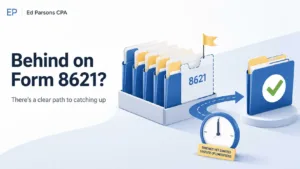
If you are not even sure whether your fund is a PFIC, our PFIC Analyzer is a quick first check. To map the cleanup itself, a consultation models the elections against your numbers, and Form 8621 PFIC Filing handles the returns and the purging election end to end. If you have left past years unfiled, our guide on catching up on unfiled Form 8621 covers that path. The rule is unforgiving, but the taint is clearable.
For the official forms, the IRS About Form 8621 page and the Instructions for Form 8621-A, the late purging-election form, set out the elections, though neither replaces advice on your own holding.

Stuck With a PFIC Taint?
Once a fund has been a PFIC, the label sticks to your shares until you clear it, and the only fix is the right election, filed correctly. Ed Parsons, CPA confirms whether your stock is tainted, models the cleanup, and files the purging election and Form 8621.
Book a Personal CPA Tax Resolution Case Analysis to map your path, or check your fund first with the PFIC Analyzer. Ready to file? Form 8621 PFIC Filing handles the elections and the return.