Skip to content
By Edward Parsons, CPA | Ed Parsons CPA, Doral, Florida | Representing taxpayers nationwide
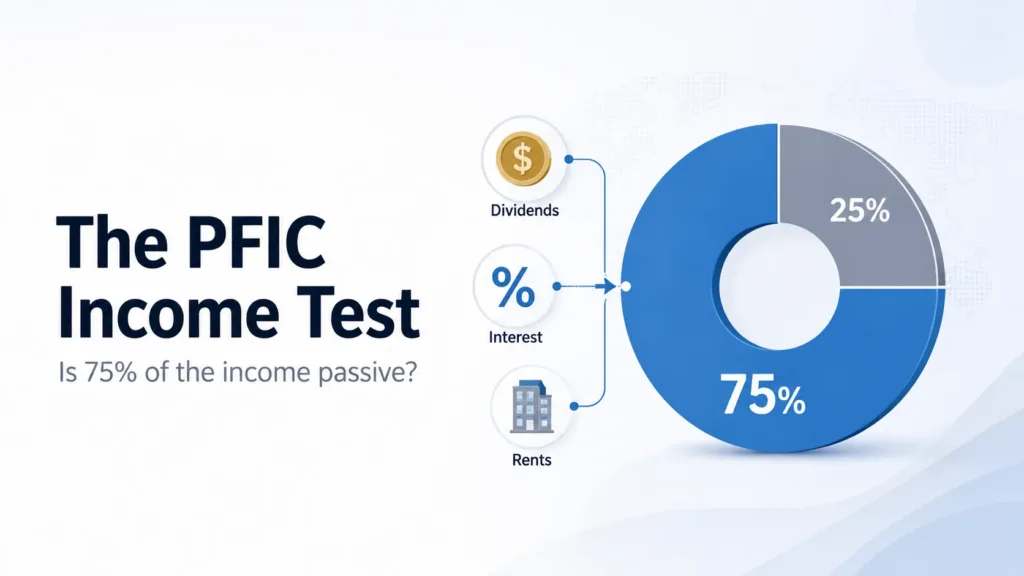
The PFIC income test asks one question: in a given tax year, is 75% or more of a foreign corporation’s gross income passive? Passive income means earnings like interest, dividends, rents, and royalties. If the answer is yes, the company meets the income test and is treated as a PFIC, even if it would pass the separate asset test.
The income test is one of two ways the IRS decides whether a foreign company is a PFIC. The other is the asset test, and meeting either one is enough.
If the term itself is new to you, start with the overview of what a PFIC is, then come back here for the income side of the math.
The calculation looks simple, just one fraction, but the inputs are where it gets complicated. This guide walks through what the test measures, how the percentage is built, and the rules that quietly change the result.
What the Income Test Measures?
The test compares one slice of income to the whole. The numerator is the company’s passive income, and the denominator is its total gross income for the year.
Two details matter from the start. It uses gross income, not profit after expenses, and the threshold is 75%, not a simple majority.
- Threshold: 75% of gross income.
- Basis: gross income, before deductions.
- Tested: each tax year on its own.
- Effect: meeting this test alone makes the company a PFIC.
The Calculation, Step by Step
- Add up the company’s total gross income for the tax year.
- Identify which of that income is passive.
- Divide the passive income by the total gross income.
- Compare the result to 75%. At or above the line, the income test is met.
On paper it is one division. The hard part is the second step, because the tax code’s definition of passive is not the everyday meaning, and a single misclassified stream can move the percentage across the 75% line.
What Counts as Passive Income
For PFIC purposes, passive income tracks the categories the IRS treats as foreign personal holding company income. The Form 8621 instructions point to this same definition.
- Dividends.
- Interest, including original issue discount.
- Rents and royalties, unless they come from an active business.
- Annuities.
- Net gains from sales of securities, commodities, and certain property.
- Net foreign currency gains.
Earnings a real operating company charges its customers are generally active, not passive. The line between an active rent or royalty and a passive one is one of the most common gray areas in the whole analysis.
The Rules That Quietly Change the Answer
Three rules can flip a company from PFIC to non-PFIC, or the reverse, and they need information most investors never see.
- The 25% look-through rule. If the company owns at least 25% by value of another corporation, it counts its share of that company’s income. A holding company that looks passive on the surface can become non-passive once you look through to an active subsidiary.
- Related-party income. Interest, dividends, rents, and royalties received from a related company can be re-characterized as non-passive in part, depending on what that related company actually does.
- Active banking and insurance. Income earned in a licensed active banking business, or by a qualifying insurance corporation, is carved out of passive income entirely.
Each of these requires a real look into a company’s books, which is exactly why the test resists a quick answer. The table below shows how the income test sits next to the asset test.
The two tests work in parallel, so a company can fail one and still be a PFIC under the other. See the companion guide on the PFIC asset test for the other half.
| Feature | Income Test | Asset Test |
| What it measures | Share of gross income that is passive | Share of assets that are passive |
| Threshold to meet | 75% of gross income | 50% of average assets |
| Measuring basis | Gross income for the year | Adjusted basis or fair market value |
| How often tested | Every tax year | Every tax year |
| Measurement: result if this test alone is met | Classified as a PFIC | Classified as a PFIC |
Because either test is enough on its own, clearing one of them does not settle the question.
Common Mistakes
- Using net income instead of gross income in the fraction.
- Labeling everyday active fees as passive, or treating real passive income as active.
- Ignoring the 25% look-through rule for subsidiaries.
- Assuming one year’s result carries over to every future year.
- Stopping at the income test and skipping the asset test, or the reverse.
- Trusting a fund’s marketing label instead of its actual income mix.
Questions People Ask
“If my fund passes the income test one year, is it a PFIC forever?”
The test is run every year, but once you are treated as owning PFIC stock, continuation rules can keep that status in place even in a later year that would otherwise come out clean.
“The company barely earned anything this year. Does a quiet year help?”
Often the opposite. When total income is low, even a small amount of passive income can tip the ratio past 75%, so a slow year can push a company into PFIC range.
“Can I just look at the dividends it pays me?”
No. The test is about the company’s own income mix, not what it distributes to you, so the dividend you receive is not the figure that matters.
Getting the Calculation Confirmed
The income test is easy to state and hard to apply, especially once look-through subsidiaries and active-business carve-outs enter the picture. A wrong classification does not just change a percentage, it can change whether years of filing were required at all.

Have your fund reviewed
A CPA tax resolution case analysis can confirm whether a holding meets the income test and whether Form 8621 filing is required for the years involved.
Want a quick first read?
Run the holding through the PFIC Analyzer to see how the income and asset tests apply before you commit to a path. For the full picture of where this fits, return to the PFIC overview.