Skip to content

A U.S. citizen with a Colombian bank account usually has two separate reporting duties. The FBAR (FinCEN Form 114) is required when your foreign accounts together top $10,000 at any point in the year, and it is filed with FinCEN, not the IRS. Form 8938 attaches to your tax return and applies at higher asset thresholds. Because Colombia is a FATCA partner, the IRS may already receive your account details from the bank, so filing correctly is what protects you.
You opened a Bancolombia or Davivienda account to get paid, pay rent, or simply live day to day. That is normal and sensible. For a U.S. citizen, though, a foreign account can create reporting duties that most people never hear about until something goes wrong.
This guide explains the two filings that apply, the thresholds that trigger each one, and why the bank reporting your account to the IRS makes compliance matter. For the wider expat picture, see our guide to U.S. taxes for digital nomads.
Quick Facts for Account Holders in Colombia
- FBAR threshold: $10,000 combined across all your foreign accounts, at any point in the year.
- Where it goes: the FBAR is filed with FinCEN electronically, not with the IRS and not with your tax return.
- Form 8938 thresholds (living abroad): $200,000 at year end, or $300,000 at any time, for single filers. Higher for joint filers.
- Where it goes: Form 8938 attaches to your Form 1040 and goes to the IRS.
- FATCA: Colombia is a FATCA partner, so Colombian banks report U.S. account holders to the IRS.
- FBAR penalty: around $10,000 per annual report for non-willful failures. Willful failures can reach half the account balance.
The $10,000 FBAR Threshold Catches Almost Everyone
The FBAR is triggered when the combined value of your foreign financial accounts tops $10,000 at any single moment during the year. It is the total that counts, not the balance of any one account, so three modest accounts can cross the line together.
It also reaches more than checking and savings. Certain investment accounts, fixed-term deposits (CDTs), and even some Colombian pension and cesantias accounts can count, along with accounts you do not own but have signature authority over. The form asks for the highest balance each account reached during the year, not the year-end figure.
Form 8938 Is a Separate Filing With Higher Thresholds
Form 8938 comes from FATCA and is a different obligation. It attaches to your tax return and applies only above higher asset thresholds, which are much higher for taxpayers living abroad. The IRS publishes a side-by-side comparison of Form 8938 and FBAR requirements that shows how the two differ.
Form 8938 also reports a broader set of items called specified foreign financial assets, which can include foreign securities and Colombian investment funds held outside a U.S. brokerage. Many people who file the FBAR still need Form 8938 as well, because the two are not interchangeable.
| FBAR (FinCEN Form 114) | Form 8938 (FATCA) | |
| Filed with | FinCEN, electronically | IRS, attached to Form 1040 |
| Measurement (filing trigger) | Over $10,000 aggregate, any time in the year | $200,000 year end living abroad ($50,000 in the U.S.), varies by status |
| What it reports | Foreign financial accounts | Specified foreign financial assets (broader) |
| Typical penalty | About $10,000 per annual report; willful up to 50% of the balance | $10,000, rising after IRS notice |
| Does filing one cover the other? | No | No |
The gold row is the trap. The FBAR threshold is low enough to catch ordinary account holders, while Form 8938 kicks in higher, so it is easy to file one and miss the other.
The Bank Already Reports to the IRS
Colombia signed a FATCA agreement with the United States, so Colombian banks identify U.S. account holders and report their account information to the IRS. Your foreign accounts are not invisible. In practice, the IRS may already hold details of the account you have not been reporting.
That visibility is the reason getting current matters. Unreported accounts are easier than ever to spot, and the gap between what the bank reports and what you filed is exactly what draws attention.
What Happens If You Do Not File
The penalties are separate for each form, and they add up. For the FBAR, a non-willful failure runs around $10,000 per annual report, and the U.S. Supreme Court has confirmed that non-willful penalties are assessed per report rather than per account. Willful failures are far worse and can reach half the account balance.
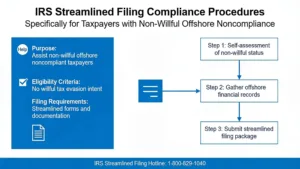
Form 8938 carries its own $10,000 penalty, which rises after the IRS sends notice, plus an added penalty on tax understatements tied to undisclosed assets. If you are already behind, the cleanest path is usually the Streamlined Filing Compliance Procedures. Our Colombia-specific catch-up walkthrough shows how that works in practice.
Common Mistakes Account Holders Make
- Treating the $10,000 as a per-account limit. It is the combined total of all foreign accounts.
- Assuming the bank reporting your account means you do not have to file. You still do.
- Filing the FBAR and thinking it also satisfies Form 8938. They are separate filings.
- Reporting the year-end balance instead of the highest balance during the year.
- Forgetting accounts you have signature authority over, or a joint account with a Colombian spouse.
- Ignoring small accounts because no single one looks big enough to matter.

File the FBAR and Form 8938 the right way
The two filings have different thresholds, deadlines, and agencies. Ed Parsons, CPA prepares them together so nothing falls through the gap between them. FBAR (Form 114) CPA Filing Form 8938 FATCA CPA Filing