Skip to content

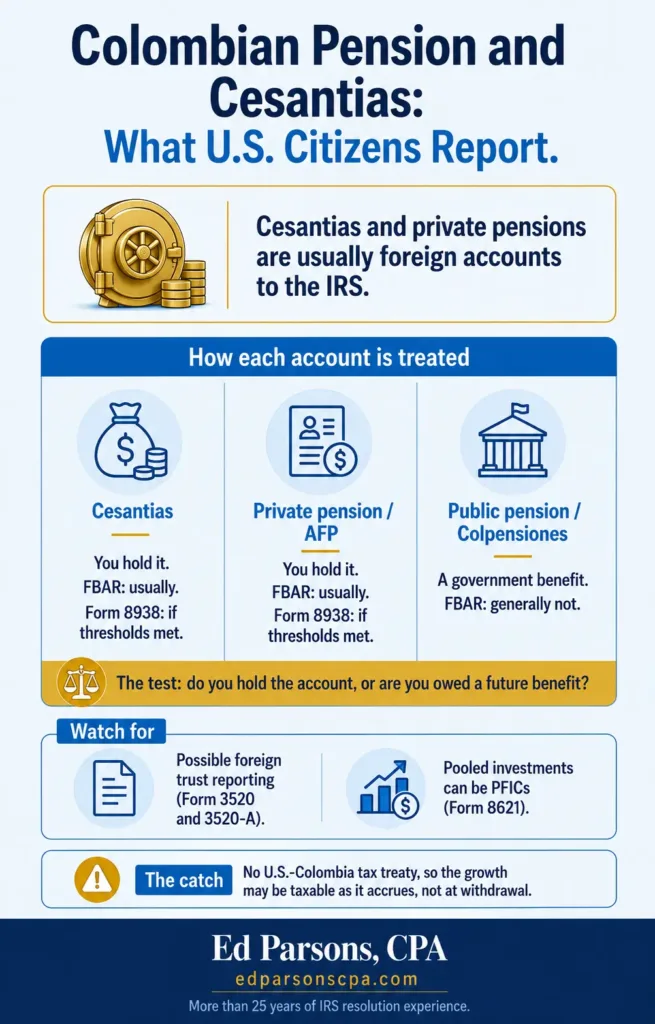
Colombian cesantias and private pension accounts are usually foreign financial accounts in the eyes of the IRS, even though they feel like ordinary employment benefits. That means they can be reportable on the FBAR and on Form 8938, and because there is no U.S.-Colombia tax treaty, the growth inside them may be taxable in the U.S. as it accrues. A few arrangements can even reach into foreign trust or PFIC territory, which is why these accounts are such a common blind spot.
Your employer in Colombia set up a cesantias fund and a pension account, and you probably never thought about them again. They run quietly in the background, managed by a fund administrator, and feel like a normal part of working in the country.
For a U.S. citizen, those accounts can carry U.S. reporting duties that most people never connect to a severance or retirement benefit. This guide walks through how the IRS sees them and what you may need to file. For the wider expat picture, see our guide to U.S. taxes for digital nomads.
Quick Facts on Colombian Pensions and Cesantias
- Cesantias and private pension accounts are usually foreign financial accounts for U.S. purposes.
- FBAR applies when your foreign accounts together top $10,000 at any point in the year.
- Form 8938 can apply on top, at higher asset thresholds that depend on your filing status.
- No U.S.-Colombia tax treaty means there is no automatic U.S. deferral on the growth, unlike a U.S. 401(k).
- Public Colpensiones pensions are a government benefit and are generally not an FBAR account.
- Pooled investments inside the funds can raise PFIC questions.
Why These Accounts Are a U.S. Tax Blind Spot
The problem is one of framing. To you, cesantias is severance and a pension is retirement, both local, both automatic. To the IRS, the relevant fact is simpler: you hold an account at a foreign financial institution, and foreign accounts carry U.S. reporting rules. The form does not care whether you think of the balance as savings, severance, or a future benefit.
Because nobody hands you a notice about it, the accounts sit unreported for years. The balances grow, the filing gaps stack up, and the first time many expats hear the word cesantias in a U.S. tax context is when something prompts a closer look at their return.
Cesantias: A Savings Fund the IRS Treats as a Foreign Account
Cesantias is a Colombian severance savings system. Each year your employer deposits roughly one month of salary into a fund held at an administrator such as Porvenir, Proteccion, Colfondos, or the public Fondo Nacional del Ahorro. You can draw on it for housing, education, or a period of unemployment.
Say you worked in Medellin for six years and dipped into the fund once to cover a deposit on an apartment. To the IRS, that fund is a foreign financial account, which means it can belong on your FBAR and Form 8938 alongside your bank accounts. The account does not stop being reportable just because you cannot freely withdraw the money. Each year the employer adds another deposit, the balance compounds, and an unreported account quietly grows into a larger filing gap.
Colombian Pensions: Private Accounts vs the Public System
Colombian pensions split into two systems, and the U.S. treatment is not the same for both. The distinction is the single most useful thing to get right here.
- Private pension (RAIS) is an individual account at a private fund administrator (an AFP). It behaves like an account you hold, so it is usually reportable like cesantias.
- Voluntary pension savings (pensiones voluntarias) are clearly your own account and are reportable as well.
- Public pension (Colpensiones, the RPM system) is a government-run defined-benefit pension. As a state social-insurance benefit rather than an account you hold, it generally falls outside FBAR reporting.
| Cesantias | Private pension (AFP) | Public pension (Colpensiones) | |
| What it is | Severance savings at a private administrator | Individual account at a private fund | Government-run defined-benefit pension |
| Measurement (what makes it reportable) | An account you hold at a foreign institution | An account you hold at a foreign institution | A government benefit, not an account you hold |
| FBAR | Usually reportable | Usually reportable | Generally not |
| Form 8938 | If thresholds are met | If thresholds are met | Generally not |
| PFIC or trust risk | Possible | Possible | Unlikely |
The gold row is the test that decides everything: do you hold the account, or are you simply owed a future government benefit.
The Part Most People Miss: Trusts and PFICs
Reporting the account is only the first layer. Depending on how an arrangement is structured, the IRS may view it as a foreign trust, which can bring Form 3520 and Form 3520-A reporting into the picture. This is an unsettled, fact-specific area, and it is exactly the kind of question that should not be guessed at. A wrong assumption in either direction, treating a reportable arrangement as exempt or over-reporting a simple account, creates its own problems.
There is also a PFIC angle. These funds invest your money in pooled vehicles, and pooled foreign investments are often passive foreign investment companies, taxed under a punishing regime. Our explainer on PFIC reporting for Colombian investment funds shows how an ordinary managed fund can trigger Form 8621.
Is the Growth Taxable in the U.S.?
This is where ignoring the accounts gets expensive. A U.S. 401(k) grows tax-deferred because the law says so. A foreign pension only gets similar treatment when a tax treaty provides it, and the United States and Colombia have no income tax treaty.
Without that treaty, there is no automatic deferral. Employer contributions and the earnings inside a cesantias or private pension account may be taxable to you in the U.S. as they accrue, rather than years later when you withdraw. Getting this right early prevents a much larger problem at retirement or distribution.
Picture a fund that quietly earned returns for a decade. If those earnings should have been reported each year, the cleanup is far harder, and the tax and interest larger, than if the account had been handled correctly from the first deposit.
Common Mistakes Expats Make
- Treating cesantias and pensions as purely local benefits with no U.S. side. They are usually foreign accounts.
- Reporting bank accounts on the FBAR but leaving off the cesantias or pension fund.
- Assuming a foreign pension defers U.S. tax the way a 401(k) does. Without a treaty, it usually does not.
- Overlooking the PFIC exposure created by the fund’s pooled investments.
- Missing the possible foreign trust reporting that some arrangements carry.
- Treating the public Colpensiones benefit and a private AFP account as the same thing for U.S. purposes.
If You Have Not Been Reporting These Accounts
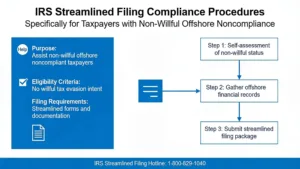
Most people in this situation were not hiding anything. They simply never knew a severance fund counted. If that is you, there is usually a clean way forward. Non-willful taxpayers can often catch up through the Streamlined Filing Compliance Procedures, which bring past years current with reduced or no penalties.
The catch-up covers the missing FBARs and, where thresholds are met, the Form 8938 reporting for these accounts, along with any trust or PFIC forms the facts require. Doing it in one coordinated submission is far safer than filing piecemeal and hoping the pieces line up.

Report your Colombian accounts the right way
Cesantias and pension accounts sit in the gap between a simple bank report and full foreign asset reporting. Ed Parsons, CPA handles them correctly, including the Form 8938 side and the trust and PFIC questions that come with them. Get help with Form 8938 FATCA CPA Filing