Skip to content
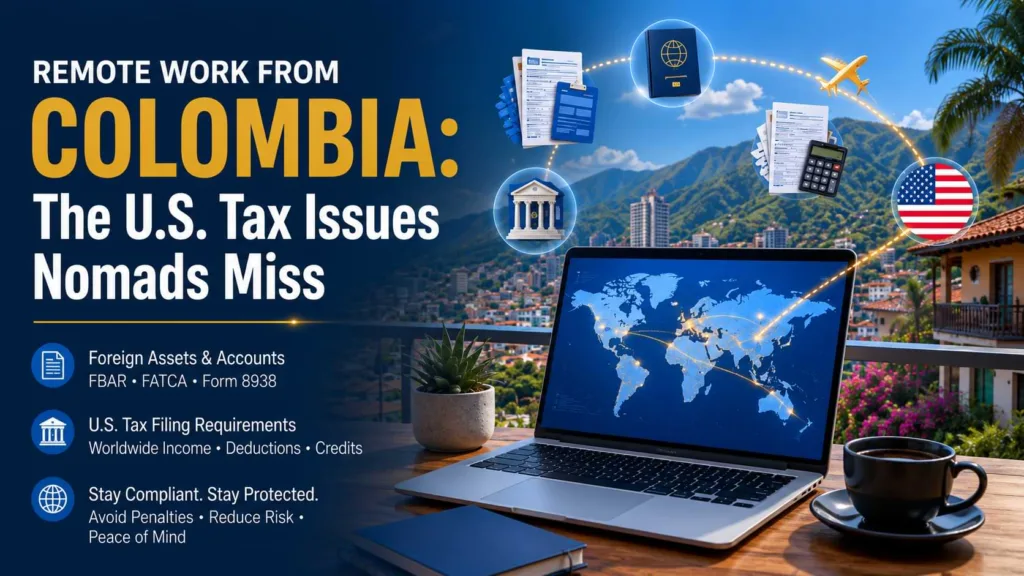
Yes, Americans working remotely from Colombia still owe U.S. taxes. U.S. citizens and green card holders are taxed on worldwide income no matter where they live, so a Form 1040 is due every year. The Foreign Earned Income Exclusion and the Foreign Tax Credit can reduce or erase the income tax bill, but they do not remove self-employment tax, foreign account reporting, or the duty to file in the first place.
Trading a cubicle for a balcony in Medellin or a co-working space in Bogota changes a lot, but it does not change your relationship with the IRS. A U.S. passport carries a U.S. filing obligation that travels with you.
That surprises many remote workers, and the details are where the real exposure hides. Below are the U.S. tax issues people working from Colombia miss most, and what to do about each one.
Quick Facts for Remote Workers in Colombia
- Worldwide income: the United States is one of only a couple of countries that taxes based on citizenship rather than residence.
- Self-employment tax: 15.3 percent on net self-employment earnings, separate from income tax.
- FBAR threshold: $10,000 in total across your foreign accounts at any point in the year.
- Colombian tax residency: generally triggered after 183 days in Colombia within a 365-day window.
- Physical-presence test: 330 full days abroad in a 12-month period to qualify for the income exclusion.
- U.S.-Colombia income tax treaty: none, which changes how you avoid double tax.
You Still File a U.S. Return, Even Living Abroad Full Time
The United States taxes its citizens and lawful permanent residents on worldwide income, regardless of where they live or earn it. A developer paid by a U.S. employer into a Colombian bank account still files a Form 1040, and so does a freelancer billing clients from a cafe in Cartagena.
Living abroad does not end the obligation. The IRS spells this out on its page for U.S. citizens and resident aliens abroad, and the rules apply whether you stay one year or ten. For the full map of expat reporting, see our guide to U.S. taxes for digital nomads.
How Remote Workers Avoid Double Tax: Two Tools
Two tools keep you from paying full tax twice. The Foreign Earned Income Exclusion (Form 2555) excludes a band of earned income up to a cap the IRS adjusts each year, if you meet a residence or presence test. The Foreign Tax Credit (Form 1116) instead credits Colombian income tax against your U.S. bill.
Choosing between them is not automatic, and the wrong pick can leave money on the table or raise scrutiny. Our walkthrough on choosing between Form 2555 and Form 1116 for Americans in Colombia goes deeper. The table below shows the trade-off at a glance.
| FEIE (Form 2555) | Foreign Tax Credit (Form 1116) | |
| What it does | Excludes foreign earned income up to an annual cap | Credits Colombian income tax against your U.S. tax |
| Best when | You owe little or no Colombian income tax | You pay meaningful Colombian income tax |
| Removes self-employment tax? | No, income tax only | No, income tax only |
| Measurement (the test) | Bona fide residence, or 330 full days abroad in 12 months | U.S. tax on that income, capped by a ratio formula |
| Filed on | Form 2555, attached to Form 1040 | Form 1116, attached to Form 1040 |
The key point in the gold row: neither tool removes self-employment tax. That is the trap most remote workers walk into.
That gold row is the part people get wrong after doing everything else right. If you would rather take the wider ground in small pieces, have the five emails sent to you. They start where this page does, with the exclusion that only exists once you file to claim it, then go on to the account reporting that FATCA makes unavoidable, the annual form that owning a Colombian company creates, and the streamlined route for years already missed. One confirmation note comes back before any of it, and nothing follows until you answer that. Unsubscribing is a single click.
The Self-Employment Tax Trap
If you freelance, contract, or run your own remote business, you owe U.S. self-employment tax of 15.3 percent on your net earnings. This is separate from income tax, and the income exclusion does nothing to reduce it.
In some countries, a Social Security totalization agreement prevents this double charge. The United States and Colombia have no such agreement, so a self-employed nomad can owe both Colombian contributions and U.S. self-employment tax on the same work.
There Is No U.S.-Colombia Tax Treaty
Many nomads assume a tax treaty smooths everything out. It does not exist here. The United States and Colombia have no bilateral income tax treaty, which means no treaty rate reductions and no tie-breaker rule to decide which country wins.
Colombia also taxes its residents on worldwide income, and you generally become a Colombian tax resident after 183 days there in a 365-day window. Without a treaty, the Foreign Tax Credit becomes your main shield against being taxed twice, which makes accurate filing on both sides matter.
Do Not Forget the Colombian Bank Account
Getting paid into a local account is normal, but it creates a reporting duty. If your foreign accounts together top $10,000 at any point in the year, you must file an FBAR with FinCEN, and a separate Form 8938 may apply. Our guide to reporting a Colombian bank account on the FBAR and Form 8938 covers the thresholds.
Common Mistakes Remote Workers Make
- Assuming life abroad ends the U.S. filing duty. It does not.
- Treating the income exclusion as a cure-all. It leaves self-employment tax and reporting in place.
- Forgetting self-employment tax on freelance and contractor income.
- Missing the FBAR on a Colombian bank account.
- Believing a U.S.-Colombia tax treaty exists. It does not.
- Ignoring state residency ties after the move, which can keep state tax alive. See U.S. state tax residency after moving to Colombia.
- Skipping quarterly estimated payments and getting hit with penalties.
- Letting years pile up unfiled. Non-willful taxpayers can often catch up through Streamlined Filing.

File it right the first time
Working remotely from Colombia adds real complexity to a U.S. return. Ed Parsons, CPA prepares accurate returns for remote workers and expats, with the exclusions, credits, and foreign reporting handled together. Get your U.S. return prepared: Form 1040 CPA Individual Tax Return Optimization