Skip to content
You may know what your tax return says. But do you know what the IRS record says?
That difference matters.
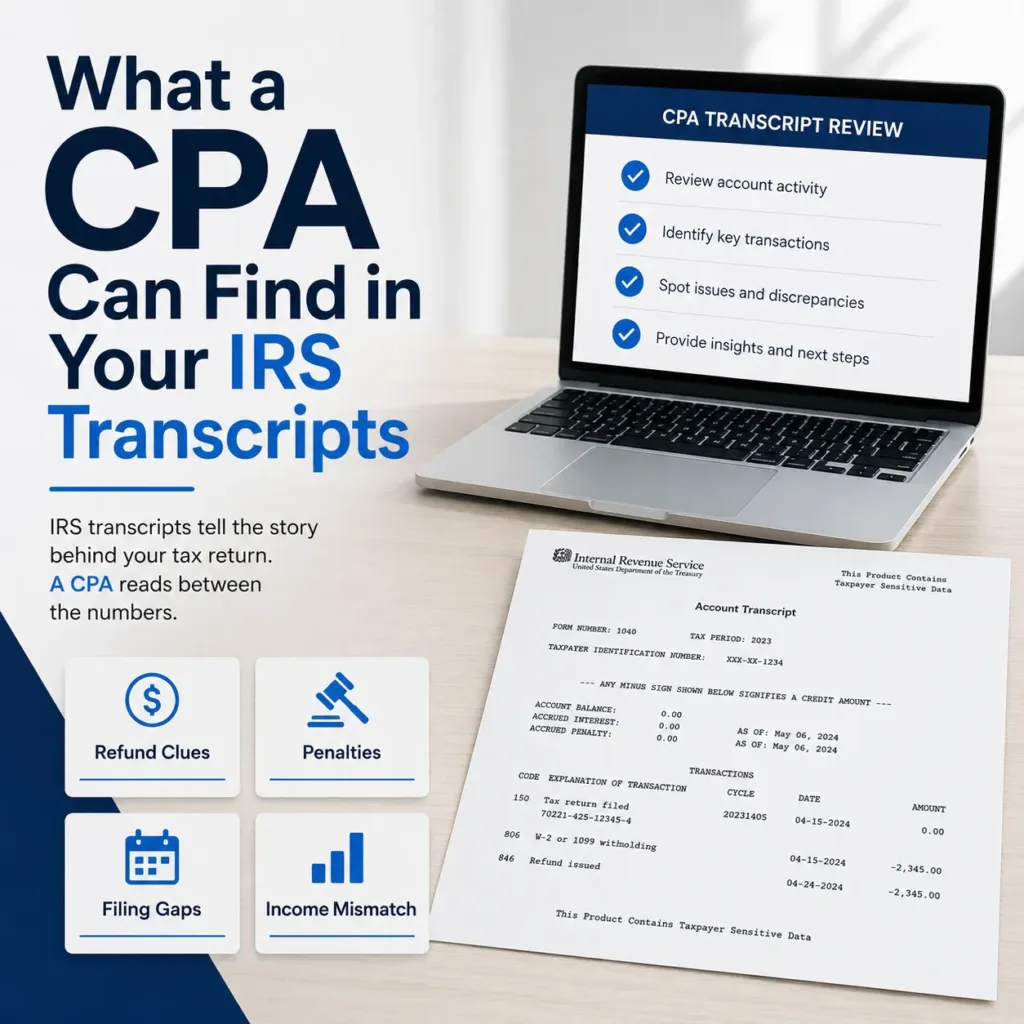
A tax return PDF shows what was filed. IRS transcripts can show what the IRS processed, what payments posted, what refund activity occurred, what penalties were assessed, what income documents were reported to the IRS, and whether prior-year filing gaps may exist.
For many taxpayers, the problem is not that they need to panic. The problem is that they do not know what the IRS is actually seeing.
That is where a CPA-led IRS transcript review can help.
If you are still learning what IRS transcripts are, start with the related education article: How IRS Transcripts Reveal Refunds, Penalties, and Filing Issues.
Quick Answer:
A CPA can review IRS transcripts to identify missed refund clues, payment issues, filing gaps, penalty activity, income mismatch indicators, balance due problems, amendment indicators, and tax resolution warning signs. IRS transcripts do not solve the problem by themselves, but they can help show whether the next step is a simple review, amended return analysis, penalty relief review, business transcript review, or tax resolution case analysis.
Why IRS Transcripts Are Worth Reviewing
IRS transcripts are useful because they show information from the IRS side of the account.
The IRS says taxpayers can access tax records online or by mail, including transcripts of past tax returns, tax account information, wage and income statements, and verification of non-filing letters. The IRS transcript types page explains that taxpayers may use Individual Online Account to view, print, or download available transcript types.
That record can help answer questions like:
- Did the IRS process the return?
- Did the IRS record the payments?
- Was the refund issued, reduced, or offset?
- Did penalties or interest post?
- Does the IRS show income documents that may not match the return?
- Is there a missing filing year?
- Is there a balance due that the taxpayer did not expect?
The transcript is not the whole case. But it often tells a CPA where to look first.
What a CPA Looks for First
A CPA transcript review is not just downloading documents.
The value is in comparing the IRS-side record against the taxpayer’s filed return, payment history, notices, income records, refund expectations, and risk profile.
A CPA may review:
- Tax account transcripts
- Wage and income transcripts
- Return transcripts
- Record of account transcripts
- Verification of non-filing information
- Payment and refund activity
- Penalty and interest activity
- Balance due indicators
- Income mismatch indicators
- Filing history across multiple years
The review is meant to classify the issue.
Is this a refund problem? A payment posting problem? A missed income problem? A penalty issue? A missing return issue? A business account issue? Or is it already a tax resolution matter?
That classification matters because the wrong next step can waste time or create new problems.
How a CPA Uncovers Missed Refunds in IRS Transcripts
One of the first things a CPA may look for is whether the IRS record suggests a missed refund opportunity or refund problem.
A transcript review may reveal:
- A refund was expected but never issued
- A refund was reduced
- A refund was offset
- A payment was posted to the wrong year
- Estimated payments do not match taxpayer records
- Withholding does not match the filed return
- An amended return may be worth reviewing
- A credit may have been missed
- A prior-year refund deadline may matter
This does not mean every transcript review produces a refund. It means the transcript can show whether refund activity deserves deeper review.
The IRS says “Where’s My Refund?” is the current refund status tool, while transcripts are better used for tax record review and account history.
For taxpayers who are unsure whether their personal IRS history may contain refund or risk indicators, the Tax Refund & Risk Assessment (Personal) is the relevant personal review route.
Penalties and Interest
IRS transcripts can also show penalty and interest activity.
A CPA may look for:
- Late filing penalties
- Late payment penalties
- Estimated tax penalties
- Underreporting-related activity
- Interest accruals
- Account adjustments
- Whether penalties appear connected to missing filings, late payments, or IRS changes
The transcript may show that a penalty exists. But the transcript alone does not decide whether the penalty can be removed.
The IRS says taxpayers may qualify for penalty relief if they tried to comply but could not due to circumstances beyond their control, and reasonable cause relief may apply when a taxpayer exercised ordinary care and prudence but still could not file or pay on time.
That is where CPA review matters. The next question is not just “Is there a penalty?” The next question is “Why is it there, and does the taxpayer have a supportable relief path?”
Filing Gaps and Missing Returns
A CPA may also use transcripts to identify possible filing gaps.
This can matter when:
- You are unsure whether an old return was filed
- A prior preparer may not have filed a return
- A paper return may not have processed
- The IRS shows no return on record
- A missing year is blocking a payment plan or refund claim
- You want to become compliant before resolving a balance
A verification of non-filing letter may show that the IRS has no record of a processed return for a tax year. That does not always prove that the taxpayer intentionally failed to file. It may mean the return was rejected, never submitted, mailed but not processed, or filed under circumstances that require more review.
A CPA can help separate “missing IRS record” from “confirmed unfiled return.”
That distinction matters before you file, amend, respond to a notice, or enter a tax resolution process.
Income Mismatch Clues
A wage and income transcript can help a CPA compare third-party income reports against the filed return.
The IRS says wage and income transcripts show data reported on information returns such as Forms W-2, 1099, 1098, and 5498.
That can help identify:
- Missing W-2 income
- Missing 1099-NEC or 1099-MISC income
- Interest or dividend income
- Brokerage activity
- Retirement distributions
- Mortgage interest reports
- Payer-reported items the taxpayer may not recognize
This is important because the IRS may issue a CP2000 notice when income or payment information received from third parties does not match what was reported on the tax return. The IRS explains that CP2000 proposes changes and is not automatically a bill, but a response may be required.
A CPA transcript review can help spot income mismatch clues before they become a bigger problem, or help explain why a notice may have arrived.
Payment Posting Problems
Sometimes the taxpayer paid, but the IRS record does not look right.
A CPA may review transcripts to identify:
- Payments posted to the wrong year
- Missing estimated payments
- Payments applied differently than expected
- Refunds applied to another balance
- Balance due activity after payment
- Payroll or business tax payment issues
- Multiple-year payment confusion
This can be especially important when the taxpayer has made several payments, filed amended returns, changed preparers, or received IRS notices that do not match their records.
A transcript review does not replace bank records, payment confirmations, or IRS notices. But it can show how the IRS account currently reflects the activity.
Amendment Indicators
A CPA may identify signs that an amended return should be considered.
That does not mean amending should be automatic.
The IRS says taxpayers generally use an amended return to correct items such as filing status, income, deductions, credits, or tax liability. The IRS also states that to claim a refund, an amended return generally must be filed within 3 years after the original return was filed or 2 years after the tax was paid, whichever is later.
Before amending, a CPA may review:
- The original return
- Account transcripts
- Wage and income transcripts
- Notices
- Payment history
- Refund history
- Source documents
- Prior-year patterns
- Whether amending may create a new balance, refund, or mismatch
This is one of the biggest benefits of a CPA-led review. It helps avoid filing an amended return before the real issue is understood.
Personal Review vs. Business Review
Not all IRS transcript issues belong on the personal side.
A personal Form 1040 issue may involve wages, withholding, credits, refunds, dependents, personal estimated payments, retirement income, or personal penalties.
A business issue may involve:
- Payroll tax deposits
- Form 941 account activity
- Business penalties
- Entity-level filing gaps
- Business refunds or credits
- Owner and business account interactions
- Business IRS notices
- Revenue officer or collection concerns
If the issue is personal, the Tax Refund & Risk Assessment (Personal) may fit.
If the issue involves business IRS transcript history, payroll indicators, filing gaps, business penalties, or entity-level tax risk, the better route may be the Tax Refund & Risk Assessment (Business). The catalog describes the business version as a CPA review of business IRS records for refund opportunities, penalties, filing gaps, payroll issues, and tax risks.
Review Issue vs. Tax Resolution Issue
A transcript review is not the same as tax resolution representation.
This distinction matters.
| This may be a review issue if: | This may be a tax resolution issue if: |
|---|---|
| You are unsure whether anything is wrong | You received an IRS notice |
| You want to check refund activity | You owe a balance |
| You want to identify penalties or filing gaps | You have penalties that need relief analysis |
| You want to compare IRS records to your return | You have unfiled returns |
| You suspect income mismatch risk | You have a lien, levy, audit, or collection issue |
| You do not have active IRS collection activity | You need representation or negotiation |
If the issue is still unclear, review first.
If you already know there is an IRS notice, balance, penalty, unfiled return, lien, levy, audit, or collection problem, the Personal CPA Tax Resolution Case Analysis may be the better fit. The catalog describes it as a structured CPA review of tax account history, notices, transcripts, compliance status, balances, penalties, interest, filing history, and available resolution paths.
What the Tax Refund & Risk Assessment Reviews
The CPA-led Tax Refund & Risk Assessment is designed to help taxpayers understand what their IRS transcript history may be hiding.
For personal taxpayers, the review may include:
- Filing history review
- IRS account transcript review
- Wage and income transcript review
- Balance due and payment activity
- Penalty and interest review
- Potential abatable penalty indicators
- Missed refund or amendment indicators
- Income mismatch and underreporting risk indicators
- Compliance issue identification
- Written findings and recommended next steps
The product catalog describes the Personal Tax Refund & Risk Assessment as a one-time CPA-led review to identify potential missed refunds, penalty relief opportunities, IRS account issues, filing gaps, and personal tax risks based on IRS transcript history. It also states that the assessment does not guarantee a refund, penalty removal, or IRS outcome.
That positioning is important.
The assessment is not a guarantee. It is not a full tax resolution case. It is not a promise that money is owed to you. It is a structured way to find out what the IRS record shows and what the next step may be.
What Happens After the Review?
After a CPA transcript review, the next step depends on what the record shows.
Possible outcomes may include:
- No major issue found
- Explanation of refund or payment activity
- Missed refund indicator
- Amendment review indicator
- Penalty relief indicator
- Filing gap indicator
- Income mismatch risk indicator
- Business account review recommendation
- Tax resolution case analysis recommendation
- Need for additional documents before deciding
The value is clarity.
Instead of guessing, the taxpayer can understand whether the issue is minor, worth reviewing further, business-related, or already a tax resolution matter.
When This Review May Not Be Enough
A refund and risk assessment is not the right fit for every situation.
It may not be enough if:
- You already have active IRS collection activity
- You received a serious notice
- You have an IRS levy or lien
- You are under audit
- You have multiple unfiled years
- You need representation before the IRS
- You have a complex business tax problem
- You need a full tax resolution strategy
That does not mean the transcript review is useless. It means the issue may need to be routed to a deeper service.
For known personal IRS problems, use Personal CPA Tax Resolution Case Analysis. For serious business tax problems, the catalog also includes a Business CPA Tax Resolution Analysis for unpaid payroll taxes, business notices, revenue officer contact, business liens or levies, unfiled business returns, and owner exposure issues.
Why Work With a CPA Instead of Reading Transcripts Alone?
IRS transcripts are not written for normal taxpayers.
They can contain codes, dates, account activity, adjustments, penalties, and transcript sections that are easy to misunderstand.
A CPA can help connect the record to the practical question:
“What should I do next?”
That may mean:
- Wait
- Gather more documents
- Review an amended return possibility
- Request penalty relief
- Fix a filing gap
- Review business records
- Respond to a notice
- Move into tax resolution analysis
The point is not to make the transcript more complicated. The point is to avoid acting on the wrong interpretation.
The Safer Next Step
If your IRS record does not make sense, do not guess.
Start by understanding what the IRS transcripts show.
A CPA can review the IRS-side record for refund activity, filing gaps, payments, penalties, income mismatch clues, account balances, and amendment indicators. From there, you can decide whether the issue is a basic review, a missed refund opportunity, a penalty relief issue, a business account concern, or a tax resolution matter.
For the background education piece, read How IRS Transcripts Reveal Refunds, Penalties, and Filing Issues.
If you are ready for a CPA-led personal review, the next step is the Tax Refund & Risk Assessment (Personal).
This article is general educational information. IRS outcomes depend on the facts, account history, filing compliance, deadlines, and documentation in each case.
CPA IRS Transcript Review: Common Questions
These FAQs explain what a CPA may find in IRS transcripts and when a transcript review should turn into amended return review, penalty relief review, business review, or tax resolution analysis.
What can a CPA find in IRS transcripts?
A CPA can review IRS transcripts for refund activity, payments, penalties, interest, filing gaps, income mismatch clues, account balances, and amendment indicators. The transcript does not solve the issue by itself, but it can show where the review should focus.
For background, read How IRS Transcripts Reveal Refunds, Penalties, and Filing Issues .
Official source: IRS Get Transcript
Can a CPA find a missed refund in my IRS transcripts?
A CPA may find refund indicators, missed payment clues, withholding issues, credit issues, or amendment indicators. A transcript review does not guarantee a refund, but it can help identify whether a missed refund or refund correction deserves deeper review.
Personal review: Tax Refund & Risk Assessment (Personal) .
Official source: IRS refund guidance
Can IRS transcripts show penalties?
Yes. A tax account transcript may show penalty and interest activity. A CPA can review the transcript to help identify the year, account activity, and whether penalty relief review may be appropriate.
Official source: IRS reasonable cause penalty relief
Can a CPA use transcripts to find income mismatch problems?
Yes. Wage and income transcripts can show information reported to the IRS on forms such as W-2s, 1099s, 1098s, and 5498s. A CPA can compare those records to the filed return to identify possible mismatch issues.
Official source: IRS wage and income transcript guidance
Does an IRS transcript review mean I need to amend my return?
Not automatically. A transcript review may suggest that an amended return should be considered, but amending should usually happen only after reviewing the filed return, IRS records, source documents, payment history, notices, and the reason for the issue.
Official source: IRS amended return guidance
Is this the same as tax resolution?
No. A transcript review is often a diagnostic review. Tax resolution is usually needed when there is already an IRS notice, balance, penalty, levy, lien, audit, unfiled return, or collection issue that requires deeper analysis or representation.
Known IRS problem: Personal CPA Tax Resolution Case Analysis .
Official source: IRS choosing a tax professional
What if my issue involves a business?
Business IRS transcript issues should be reviewed separately from personal Form 1040 issues. Business review may involve payroll tax indicators, entity-level filing gaps, business penalties, business credits, and business IRS account activity.
Business review: Tax Refund & Risk Assessment (Business) .
Official source: IRS business tax transcript guidance
What happens after a CPA IRS transcript review?
The next step depends on the findings. The result may be an explanation of account activity, a missed refund indicator, an amendment review recommendation, a penalty relief review, a business review recommendation, or a tax resolution case analysis recommendation.
Start here: Tax Refund & Risk Assessment (Personal) .
Official source: IRS transcript types and ordering