Skip to content

If the IRS reclassifies your foreign company as a Controlled Foreign Corporation (CFC) under the constructive ownership rules of IRC Section 958, you owe Form 5471 for every year you were a U.S. shareholder. The penalty is $10,000 per form, per year, plus tax on undistributed GILTI and Subpart F income. The Streamlined Filing Compliance Procedures can resolve the back-year exposure without the automatic penalty stack, but only if eligibility holds and the filing is built correctly.
What CFC Reclassification Actually Means?
A Controlled Foreign Corporation is a foreign company where U.S. shareholders own more than 50% of the stock (by vote or value). Each U.S. shareholder must own at least 10%.
You may have looked at the cap table and concluded the foreign company was not a CFC. The IRS uses a different test. Constructive ownership rules under IRC Section 958 attribute stock held by family members, partnerships, trusts, and certain related entities back to you for the CFC determination.
That attribution can flip a foreign company from “not a CFC” to “CFC” retroactively, for every year the underlying ownership existed.
How the Constructive Ownership Rules Work?
IRC Section 958(b) imports the attribution rules of Section 318 with modifications. The result is a broad net:
- Stock held by your spouse, children, grandchildren, and parents is treated as yours
- Stock held by a partnership or estate is attributed proportionally to partners or beneficiaries
- Stock held by a trust is attributed to beneficiaries based on actuarial interest
- Stock held by a corporation is attributed to 10%+ shareholders proportionally
- Option holders are treated as owning the underlying stock
The 2017 Tax Cuts and Jobs Act repealed Section 958(b)(4), which had blocked “downward attribution” from foreign persons to U.S. persons. After repeal, U.S. persons can be deemed to own stock held by foreign relatives, foreign partnerships, and foreign parent companies. That single change pulled thousands of foreign companies into CFC status.
A Family Scenario That Triggers CFC Status
A common pattern: a U.S. citizen owns 40% of a foreign operating company. The remaining 60% is held by their non-U.S. parent and sibling abroad.
On paper, 40% is below the 50% threshold. No CFC, no Form 5471. That is the conclusion most people reach.
The IRS reads it differently. Family attribution under Section 958(b) and Section 318 deems the U.S. person to constructively own the parent’s and sibling’s stock. Total constructive ownership: 100%. The foreign company is a CFC. Form 5471 was due for every year the structure existed.
The Damage at a Glance
| Item | Before Reclassification | After Reclassification | Measurement |
| Form 5471 filing obligation | None | Every year you were a U.S. shareholder | Annual filings |
| Per-form penalty | $0 | $10,000 per form, per year | IRC Section 6038 |
| Continuing penalty after IRS notice | $0 | Additional $10,000 per 30 days, up to $50,000 | Cap |
| Statute of limitations on 1040 | 3 years | Never started running | Open years |
| GILTI / Subpart F tax | $0 | Phantom income, taxed currently | Federal tax |
| Foreign tax credit | N/A | Limited without 962 election | Credit availability |
The damage compounds across every open year. A five-year exposure can stack $50,000 in 5471 penalties before tax is even computed.
What Happens Across Open Years?
When the IRS reclassifies a company as a CFC, the assessment is not a single year. The exposure is layered.
For each year the structure existed, you face a missing Form 5471, a missing GILTI computation (post-2017), missing Subpart F inclusions, missing E&P tracking, and a 1040 with understated income. If the CFC has foreign bank accounts, FBAR exposure is layered on top. If it owns foreign financial assets, Form 8938 exposure follows.
Where prior CFC compliance gaps existed alongside other foreign reporting, the analysis pulls in FBAR penalty exposure under streamlined filing, Form 8938 streamlined treatment, and Form 3520-A penalty exposure on the same engagement.

Common Mistakes After a Reclassification Notice
- Filing only the current-year Form 5471 and ignoring prior years
- Attempting to claim a Section 962 election retroactively (it must be made on a timely-filed return)
- Filing under streamlined without verifying non-willful certification can be supported
- Submitting a quiet disclosure (filing late forms outside any program) and exposing yourself to willfulness arguments
- Treating the IRS reclassification letter as the end of the analysis instead of the start
- Skipping the E&P reconstruction needed to compute GILTI and Subpart F correctly
Each of those turns a manageable cleanup into a worse problem.
How Streamlined Filing Reduces the Damage?
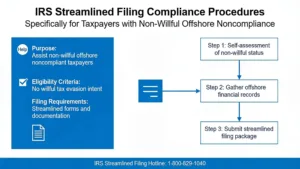
The Streamlined Filing Compliance Procedures provide a structured path for taxpayers whose noncompliance was non-willful. For CFC reclassification cases, the program does three things:
- Files the missing Form 5471s for the prior three years under reduced penalty exposure
- Amends or files the corresponding 1040s with GILTI and Subpart F included
- Caps the streamlined miscellaneous offshore penalty at 5% of qualifying foreign assets (domestic track) or 0% (foreign track)
The key word is “may.” Streamlined eligibility requires non-willful conduct, no current IRS exam, and full disclosure across all years. If the IRS already opened an audit on the foreign company, streamlined is closed and the analysis shifts to other resolution tracks.
Sequencing matters. Before any election (including the Section 962 election that drops GILTI from 37% to 21%) is on the table, the back-year filings have to be accepted. Only then can current-year planning be evaluated against the corrected baseline.

Conversational Queries This Article Answers
- “The IRS sent a letter saying my foreign company is a CFC. What do I do?”
- “I own 40% of a foreign company with my family. Am I really a CFC shareholder?”
- “Can I still use streamlined filing after the IRS reclassifies the company?”
- “Does the IRS go back forever on unfiled 5471s?”
- “What is the difference between an IRS audit of my CFC and a reclassification?”
If you received a notice, the answer almost always involves engaging a CPA before you respond.
What to Do Next?
A CFC reclassification notice is time-sensitive. Once the IRS issues a deficiency or opens an exam, streamlined eligibility may close. Penalties grow by another $10,000 every 30 days after IRS notification, up to $50,000 per form.
If you have received a reclassification letter, or your structure includes family attribution patterns and 5471s were never filed, the Form 5471 CPA filing engagement is the right starting point. The engagement covers eligibility analysis, prior-year preparation, E&P reconstruction, and the streamlined narrative submission.
Speak with a CPA who handles CFC reclassification cases.
Visit the contact page to start the analysis. Ed Parsons CPA has 25+ years of IRS tax resolution experience handling international compliance and back-year cleanup.